Doubling down hunh!!??
They didn’t bother darkening the Klingon’s skin like in other episodes, they just had the Fu-Manchu facial hair. But this was probably simply to make it more believable that Darvin could impersonate a human. And body temp was just one thing McCoy started to say was wrong. And since right from the start there were Klingons on board the station, nobody would have bothered scanning for them. As for beaming the Tribbles all off: there were initially thousands of them, they were multiplying rapidly, they were all over the place, and they were small. Beaming them en masse wasn’t really an option until they stopped them from breeding and gathered them together. Bigger thing that bothered me was how even though it was initially a great joke (beaming them onto the Klingon ship), how obvious it was that upon discovery the Klingons would have merely slaughtered them all*!*
The original series didn’t know it was going to be a cultural icon so they sometimes fudged things (i.e. ‘plot drive’), but the show was still much more consistent than any other show of the 1960s (particularly for a sci-fi show). As a kid watching it what bothered me more about that episode was why Gen.Trelane (ret.) was now playing a Klingon?!
As for it being a comedy episode it still more than held up in quality, even today. I, Mudd also holds up pretty well although it does get silly at the end. A Piece of the Action is a much better example of a comedy episode that is pretty cringe-worthy throughout (Fizzbin? “Only on Tuesdays”?! Kirk & especially Spock doing Edward G. Robinson accents?!?)
I don’t remember ever seeing that episode, all I remember from Galactica 1980 were flying motorbikes and raptors that were invisible (presumably to save on a special effects budget as well as act as a plot device).
A also didn’t realise I was as far out of step with Whovian fandom as I thought.
Yeah Galactica 1980 was pretty bad but the last ep was pretty decent. I heard that the opening two parter where the heroes stop someone who went into the past to change WWII was pretty good as well but I haven’t seen that one.
I just saw this series on Netflix a while ago and that show was not good at all. Everything with the kids was awful. Reading up on it, the show was in the early slot on Sunday nights (7:00, 6:00 Central) so they were getting a lot of pressure to make it kid friendly and educational, so they had to cut out the laser gun action and up the cute moppets playing baseball stuff. Apparently nobody involved in the show’s production was happy with the mandates and I can see why.
Laddie… don’t ya think you should… rephrase that?
I didn’t mean to say that “The Trouble With Tribbles” should be hauling garbage. I meant to say that it should be hauled away AS garbage!

Castle…in the last three minutes of the last episode. it went totally off the rails, giving fans the biggest FU I’ve seen in years.
edited to add: This review has spoilers galore concerning that fiasco.
In the animated episode “More Tribbles, More Troubles,” the Klingons even created a tribble predator called a “glommer,” which Cyrano Jones promptly stole for himself in order to shorten his sentence of removing all of the tribbles from the space station. In the meantime, Jones had the tribbles genetically engineered so they didn’t reproduce. Unfortunately, they grew to a gigantic size instead, becoming a colony organism consisting of hundreds of normal sized tribbles.
The tribbles were pink in that episode, supposedly because executive producer Hal Sutherland was color-blind. I like to explain the color change as being a side effect of the genetic mutation.
Every episode of that show was a fantasy episode. If you tried to view it as science fiction, and know even the bare minimum of science, you’d go insane.
The problem with the later portion of the show wasn’t that it was fantasy. It was that it completely lost its direction. When your show is driven by the main character trying to get something, and he then gets the power to gain it, and doesn’t do so for completely unexplained reasons, what is there left for the show?
At the end of that episode, didn’t McCoy announce he had produced genetically-modified tribbles that would finally be safe to keep (i.e, whose multiplicative proclivities were now limited)?
Yes, he did - probably 10 years ago. He made guest appearances for a while.
My local PBS station airs it in the mid-afternoon.
Thing about Trouble With Tribbles was, it had a serious underlying story, which was also part of an on-going continuity in the series; and yet it simultaneously did a good, somewhat-silly comic relief that played well with the serious underlying story instead of ruining it. This episode and City on the Edge of Forever were widely judged to be among the best episodes – perhaps the best two.
For a comic-relief episode that was So Bad It Wasn’t Even Good, we have I, Mudd. Okay, there were a small handful of memorable quotes. (“Logic is a little tweeting bird chirping in a meadow. Logic is a wreath of pretty flowers which smell BAD.”) But mostly it was just a dumb slapstick clown show. The actors must have been terribly embarrassed to play that episode. (The episode Plato’s Stepchildren must have been embarrassing too.)
Years ago I read David Gerrold’s book about his writing of “The Trouble With Tribbles”. I believe it was his first script. His inspiration was some ball of fluff on a keychain his girlfriend had. And his goal was to write an episode where Kirk ended up buried in an avalanche of these fluff balls.
A little known factoid: there was talk about casting Boris Karloff as Cyrano Jones, which would have meant a completely different character.
No, his inspiration was Robert Heinlein’s “The Rolling Stones”, in which a family in a spaceship gets into trouble when the twin brothers decide to transport and sell ‘flat cats’ to miners in the asteroid belt to serve as pets. The flat cats are described as little nondescript lumps of fur that serve no purpose other than to purr and make you feel good. Unfortunately, the brothers don’t realize that if you keep feeding them, they reproduce uncontrollably. Eventually they get into the ventilation ducts and wind up all over the ship, and the boys have to solve the problem.
Sound familiar?
David Gerrold actually wrote to Robert Heinlein to apologize for using his idea, claiming that he forgot that he had read Heinlein’s book and must have subconsciously stolen the idea. Heinlein graciously wrote back and said it was not a problem, and he was sure he must have gotten the idea from someone else anyway.
Saw that when it originally aired. I was like 15 in 1980 and had loved the original BG so I was excited that it was brought back. My excitement quickly turned to embarrassment after the first few episodes. But when I saw the promos for The Return of Starbuck I figured it was worth a look. It was without a doubt the best episode of the series (which isn’t exactly saying a whole lot, but…) It was essentially done like a play, with only three characters stuck on a deserted planet (Dirk Benedict’s Starbuck from the original, a re-programed Cylon, and some chick they find). This, and the fact that it was all a flashback and therefore took place during the time of the original show, is what made it work (they even recast the godawful Robbie ‘cousin-Oliver’ Rist as Dr. Z for it). Seeing it again a couple years ago (for the first time in over 25 years) I was struck by two big distractions:
[ul]
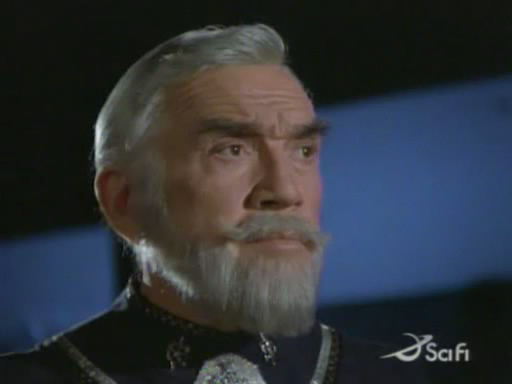
[li]Lorne Greene’s beard was unbelievably fake looking*!*[/li][li]The ‘friendly’ Cylon was voiced by radio legend Gary Owens (I kept thinking it was a Laugh-In sketch*!*)[/li][/ul]
Here’s the whole episode btw…
Good thing it wasn’t Harlan Ellison otherwise they’d still be in litigation to this day!!
Heinlein cited “Pigs is Pigs” Pigs Is Pigs - Wikipedia
Bobby Ewing in the shower
I totally agree, and I suspect there is something systematic going on here that is specific to the structure of police procedurals.
General ensemble shows have a cast thrown together on flimsy or trivial premises. Characters in Seinfeld and Friends are just people who fell into each other’s life arcs. The point of the shows is about the character interactions in various whimsical set-ups, where the characters are drawn broadly from “types” like Ross’s nerdy scientist, or George’s selfish and grubby main-chancer.
But law enforcement ensemble shows have an external, and very serious, reason to be together, which can conflict with the above premise that drives the typical ensemble show.
In the beginning of their run, these law enforcement shows are all about a different crime each week, and that is what attracts the audience. The pretty characters often generate unresolved sexual tension pretty early. That, too, is forgivable if it is a B or C story line.
But where they jump the shark is when the driver of the ensemble aspect of the show, character interaction, starts to overtake the premise that the cast is there to do an independently important job, and the writers run out of ideas for the primary job the characters are supposed to be doing.
Oddly,there seem to be two, quite specific, manifestations of this.
The first is the story arc that generates the prospect of disloyalty or betrayal or corruption among the group, with everyone wondering who the Spy is. It is often resolved with the simple device of there being no spy at all, only paranoia about it, but often the doubt lingers, as with Ziva in NCIS.
The problem is that allowing of the possibility of disloyalty breaks the innocence of the collective group, and the show’s pact with the audience now includes the unpleasant prospect of more face-heel turns, instead of the cast being resolutely outward looking. This is dull because it is a game without rules. We can’t tell who has done the face-heel turn generally, and the set-up is that it could be anyone (to maximise suspense). Watching along becomes a little like playing Where’s Waldo where everyone, including Waldo, is dressed in white. The suspense is so artificial it is actively boring.
The second manifestation is where a master criminal starts targeting the heroes themselves, either with direct violence or with improbably elaborate set-ups that test group cohesion. We are supposed to be engaged by the idea of the tables being turned, and the hunters becoming the hunted. In these arcs, the entire resources of the group are spent protecting their own. Instead of merely taking one of the group’s characters out of play, with the rest being allowed to get on with the regular job, the entire group lets its primary mission be derailed by an attack on any one of them. This baffling approach actually maximises the impact of the master villain.
In real life, of course, specialist protection units would be engaged, and investigators from outside the group would be used. Imagine if an investigation of a real-life homicide could be derailed by a threat to one of the officers in the Homicide Squad, with everyone in the squad dropping what they are doing to support the threatened officer for protracted periods? In fairness, TV sometimes represents that the person threatening the officer is the same as the target of the primary investigation, so solving the threat problem also helps solve the primary investigation, but that’s a figleaf. The risk of misprioritisation by the group and the risk of conflicts of interest mean inevitably IRL that the secondary threats will be investigated and managed by a different group.
Both these manifestations are, for mine, the hallmarks of sharkjumping.
The reason they fail is that they highlight the structural contradictions in treating the cast as a traditional ensemble, where the personal relationships are the raison d’etre of the show, and at the same time pretending that they have a serious job to do. It rapidly deteriorates to the point where the tasks undertaken by the group become solely directed to justifying the group’s continued existence. This conflicts with the idea that their group cohesion only exists to serve the greater purpose for which they came together in the first place.
Common tropes of this involve resolving who “believes in” the embattled hero sinking under superficially compelling but false allegations, as though “believing in” someone at an intuitive level has anything to do with their guilt or innocence or the strength of evidence against them. In other words, the resolution of the dilemma is achieved by irrelevant emotional considerations that contradict the values and principles of their primary job. The same issue occurs in the external existential threat scenario, where irrelevant emotional loyalty to the group is allowed to trump the same values and principles.
So the instant I see the ads that go (cue melodramatic music and voiceover) “Will one of their own be the next victim?” or “Who has betrayed them all?”, my sharkometer explodes, and I stop watching.
And eventually, they all seem to do it. It seems almost to be a law of the universe that police procedurals fail in these quite specific ways.
Noel (above), bravo/a . . . a most excellent exegesis of the genre! I’ve downloaded your post to my “Coolest Dope Answers Evah” folder.
The Trouble With Tribbles is one of the most beloved episodes of the series. There’s a reason the DS9 team used that episode for their time travel homage to TOS.
Spock’s Brain is underrated as fuck. It’s silly, but watchable, unlike that episode with the space hippies or Turnabout Intruder (no wonder the series got canned after that fucking shit).