This looks interesting:
First of all, I have to admit that I don’t know. But if I had to guess, I’d guess that the five-letter code identifies a race. Let’s look at one of the examples that you linked to:
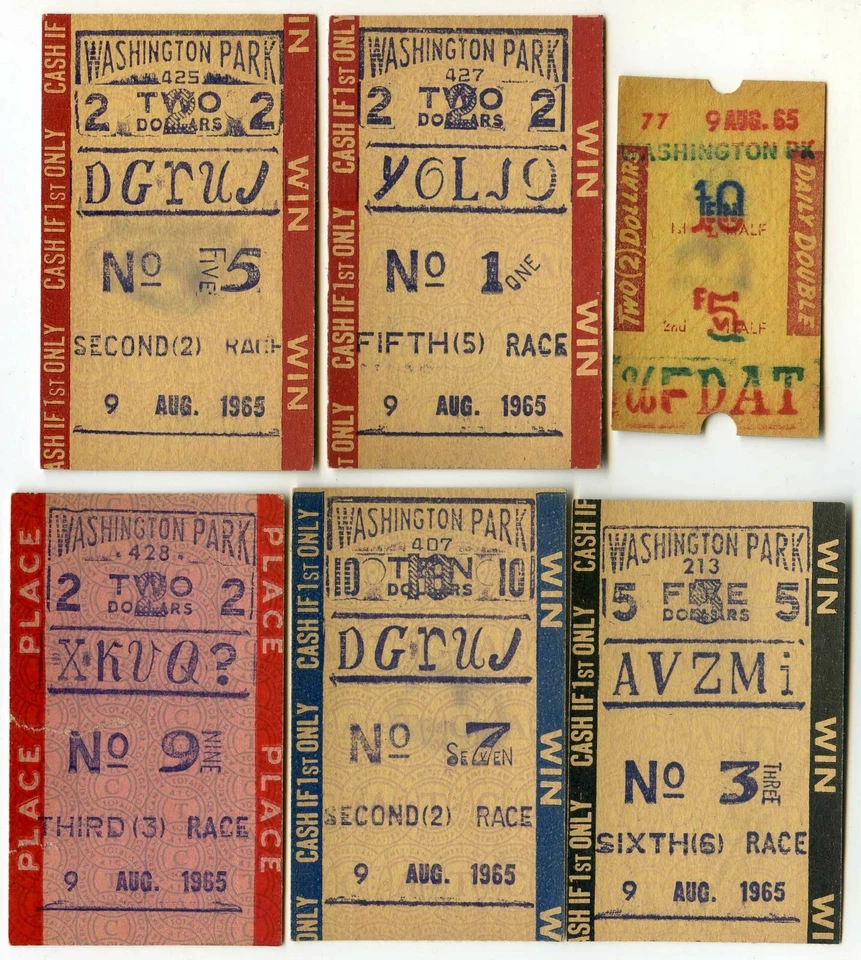
Notice how the five-letter code on the top left is identical to the five-letter code on the bottom middle: DGrUJ. Both tickets were on the second race at Washington Park on August 9, 1965, but both were for different horses, and different wagering amounts, which leads me to believe that the code identifies a race. The other tickets for other races on the same day at Washington bear different letter codes.
Generally, there are a lot more ways than 65,780 to mix up the letters. Notice that different fonts are used; that many letters are uppercase, while some are lowercase; and that some are italicized.
I’ve seen similar in a few of my references on racing history, but nothing to explain the five-letter code. Mind, right now, I’m looking at a reference published in 1961, when it was just accepted as the way things were, so probably didn’t need explaining. Still, based on the above example, I’d guess that the code identifies a race.
Thanks!
It’s more than interesting, it’s fascinating. To me anyway. Thanks for that!
For those who are curious, it’s a link to a two-minute British newsreel about a parimutuel tote behind the scenes. It looks to be from the 1950s.
But the equipment! It looks so primitive, and it is—like I said earlier, technology developed further, and became more sophisticated, until it got to where we are today. And also like I said, I can now place my own wagers using a machine that is the same as a mutuel teller (bet seller) would use, but there is no way I’d have any idea of how to place a wager using the machines shown in that newsreel.
Just to fill in some info, and for the sake of comparison, here’s a tote ticket from 1989:

It’s obviously issued by an Amtote machine, but it identifies the track (Santa Anita), the date, the race number, the horse, and the wager. In this case, the bettor has bet $10 WPS (“Win, Place, Show”) on horse number 4. That’s actually three wagers, so the total cost of the ticket is $30, which is indicated also.
Note also the rudimentary bar codes on the top and bottom. They don’t look it, but they contain all the information you can read on the ticket. They can be read by an Amtote machine. Back when I started going to the track (early 1980s), these were the tickets issued. I remember the teller manually feeding my winning tickets through the machine (yes, that’s actually how it was done), then cancelling them and paying me off.
Nice ! Thanks.
Reading up on the history of totalisator machines, they started in the late 19th C in France and were completely mechanical with the power coming from clockwork weights. The French authorities didn’t approve so the market moved to New Zealand and then Australia.
Clockwork was replaced by electric motors, but it wasn’t until Strowger (the inventor of the telephone relay) that the hugely complicates chains and pulleys could be replaced by a proper electro-mechanical system.