[QUOTE=yabob]
The amount in CA is $750 in damages (used to be $500). Given what body shops charge, that isn’t a lot of damages, and an awful lot of fender-benders which should be reported according to the letter of the law aren’t. Nobody seems to mind. I got rear ended a couple years ago, and there were three cars involved (somebody actually rear ended the guy stopped behind me, and turned him into a “sandwich”). No report, we just exchanged insurers. My car was still new, and I wasn’t inclined to not fix a rear end ding. The body shopped charged the insurer well over that amount for my car alone, let alone the damages to the poor sod who was in the middle.
[/QUOTE]
This reporting is not calling the police. It is filling out a form and mailing it to the department of motor vehicles.
[QUOTE=Triskadecamus]
In Virginia, you can pay an “uninsured motorist fee” and register your car, without insurance. Wonderful idea, since the fee is less than really bad drivers pay for insurance, thus encouraging the most dangerous drivers to remain uninsured.
Tris
[/QUOTE]
http://www.dmv.state.va.us/webdoc/commercial/insurance/umvfee.asp
That’s nuts. And it doesn’t look like they pay much attention to whether the fund actually does reduce the cost of premiums for uninsured motorist coverage.
[QUOTE=chowder]
Even if there is some massive damage we don’t have to contact police.
It’s thrashed out between insurance companies and can take bloody ages.
[/QUOTE]
I would presume we are expected (required?) to call the police if a third party can’t be identified or contacted at the scene. (Not necessarily the owner of one of the cars, but of other property beside the road.)
[QUOTE=chowder]
Oppressive? Limey?
You wouldn’t like us to burn that White House of yours again would you?
[/QUOTE]
Yes, we rather would.
Depending on the state, the tags expire after one year and need renewing while the plate only needs renewing every 2 years. That’s how it is in South Carolina, where my car’s registered. (Though I live in Georgia, but my hubby’s in the military so neeener neener I don’t have to re-register in GA.)
Here in Indiana registration renewal (getting that current year’s little sticker for your license plate, which you have to do annually) is based on a sliding scale of how much your car is worth, in other words, it’s a property tax. Insurance proof is required for initial registration, but not subsequently.
We also drive on the “correct” side of the road… 
[QUOTE=GorillaMan]
In that case, the tags are more analagous to our tax disc (renewed once a year, requiring proof of insurance) than our number plates (assigned to the car when it is first registered with the DVLA, and stay with the vehicle throughout its life even if it is declared off the road).
[/QUOTE]
I seem to recall we had this discussion recently …
License plates or tags = number plates. You pay a yearly registration fee for them. When you first register, you are given the plates. In subsequent years, you are given a little sticker to stick on the corner to show that your registration is current. This is considered a registration fee, not a tax. The main difference seems to be that here in the United States, if you sell the car, you keep the license plates. The new owner has to get his own registration/plates. In order to uniquely identify a particular car, each car bears a vehicle identification number (VIN), which does not change from owner to owner, but the VIN is not displayed prominently on the car.
Some states charge an annual property tax on cars. This is separate from the registration/plates/tags.
[QUOTE=acsenray]
I seem to recall we had this discussion recently …
License plates or tags = number plates. You pay a yearly registration fee for them. When you first register, you are given the plates. In subsequent years, you are given a little sticker to stick on the corner to show that your registration is current. This is considered a registration fee, not a tax. The main difference seems to be that here in the United States, if you sell the car, you keep the license plates. The new owner has to get his own registration/plates. In order to uniquely identify a particular car, each car bears a vehicle identification number (VIN), which does not change from owner to owner, but the VIN is not displayed prominently on the car.
Some states charge an annual property tax on cars. This is separate from the registration/plates/tags.
[/QUOTE]
It’s paid at the same time and is part of the renewal process, though. I know VA does it, KY does it (in fact I think all Commonwealth states do) and IN does it…but OH does not, from what I am told.
[QUOTE=chowder]
Well you may be the USA but it seems to me that each state is semi-autonomous.
What a strange state of affairs 
[/QUOTE]
That was the whole point when the Constitution was framed. Many of the states wanted to be completely independent, charge each other import taxes, mint their own coins, etc. The compromise was that for things that involve interstate or multi-state concerns (banking, military service, basic human rights, etc.) federal law is invoked. For intrastate issues like driving, traffic laws, state taxes, land zoning, and so on, each state can have its own laws as long as they don’t violate a federal law.
At one time the federal government had a 55 MPH speed requirement as a fuel conservation effort. An individual state could set a lower speed limit where appropriate, but not a higher one. Interestingly, the states also got to set the local consequences for going over 55 mph. Most states did the same traffic fines, as for other speed limits. One state, I think it was Montana, didn’t like to be told what to do, but didn’t want to give up the federal highway money, either. So they made the “over 55” violation a non-moving violation “failure to conserve fuel” with a minimal penalty, payable on the spot, no points on the driver’s license.
I bet back in jolly old England you still have different laws from one town to the next, right?
[QUOTE=acsenray]
I seem to recall we had this discussion recently …
License plates or tags = number plates. You pay a yearly registration fee for them. When you first register, you are given the plates. In subsequent years, you are given a little sticker to stick on the corner to show that your registration is current. This is considered a registration fee, not a tax.
[/QUOTE]
We did do this recently, and I think a lot of the confusion stemmed/stems from saying that tags=number plates. They might be the same physical item, but their function and purpose is really quite different. (It’s worth pointing out that our cars have VINs, too, and this is included in the information on our registration certificate.)
I think this is the thread where we talked about plates vs. tags: Can a cop just run your tags while being behind you? - Factual Questions - Straight Dope Message Board
For ease of reference, here is a picture of some license plates (tags) with renewal sticker (tags): A Comprehensive Guide to Car Insurance for Students 🤓| Studyfy
[QUOTE=FoieGrasIsEvil]
It’s paid at the same time and is part of the renewal process, though. I know VA does it, KY does it (in fact I think all Commonwealth states do) and IN does it…but OH does not, from what I am told.
[/QUOTE]
In West Virginia, the annual property tax on vehicles is paid separately from the registration fee. The tax money is paid to the county sheriff’s tax office, the registration fees to the DMV. You do, however, have to provide evidence that your taxes are up to date to renew your registration.
And you are correct about Ohio, there is no such tax.
Here’s the thread I was thinking about, Gfactor: Why do Americans have to keep their car documents with them? - Factual Questions - Straight Dope Message Board
And the conclusion I came to there of the equivalence of function rather than appearance: US title = UK registration, US registration = UK tax disc
[QUOTE=FoieGrasIsEvil]
It’s paid at the same time and is part of the renewal process, though. I know VA does it, KY does it (in fact I think all Commonwealth states do) and IN does it…but OH does not, from what I am told.
[/QUOTE]
In Virginia, the personal property tax is paid to the county government. The registration fee is paid to the Department of Motor Vehicles. Completely separate. You can renew your plates without proof that you have paid your property tax.
[QUOTE=FatBaldGuy]
Some states require the insurance company to notify the state when a policy is lapsed or canceled, and the state will then demand proof of new insurance or revoke the tags.
[/QUOTE]
North Carolina is (or was) like that - when we registered our car in Virginia (after moving here from NC) we naturally cancelled the NC insurance policy. We got a letter from the NC Department of Motor Vehicles saying they’d been told we had cancelled our insurance and if we didn’t provide proof we’d re-insured it, they were going to take our plates. IIRC we simply notified them that the car had been re-registered in Virginia. Not sure how, logistically, they’d have taken the places; perhaps we’d have been required to return them on penalty of being fined.
Virginia simply has us write down our insurance company’s name when we renew the tags.
[QUOTE=GorillaMan]
Here’s the thread I was thinking about, Gfactor: Why do Americans have to keep their car documents with them? - Factual Questions - Straight Dope Message Board
And the conclusion I came to there of the equivalence of function rather than appearance: US title = UK registration, US registration = UK tax disc
[/QUOTE]
Hadn’t seen that thread. Thanks.
For the sake of completeness,
Title is a piece of paper issued by the state that shows who owns the vehicle. Here is an example: http://www.cardonationstocharity.org/images/uploads/title_alabama.jpg

This usually only comes into play if the vehicle is transferred.
Registration is a piece of paper that shows that you’ve paid the annual fee. This example includes the renewal sticker: http://www.dmv.ca.gov/images/vr/regcard_w_arrow2.jpg

When we first register a vehicle, the state issues us (a) license plate(s) and a registration document. When we renew, we usually get a new registration and new stickers to put on our plates.
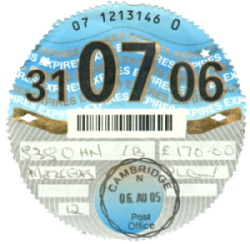
The tax disc itself seems similar to the renewal stickers we get here, as others have said. Here is a photo of one (I’m quite sure **GorillaMan ** knows what they look like, but I didn’t until just now): http://www.statusq.org/wp-content/uploads/2006/09/roadtax.png
So in the U.S. we get two documents and a plate (or two) and a sticker (or two)!
[QUOTE=Gfactor]
For the sake of completeness,
Title is a piece of paper issued by the state that shows who owns the vehicle. Here is an example: http://www.cardonationstocharity.org/images/uploads/title_alabama.jpg
This usually only comes into play if the vehicle is transferred.
[/QUOTE]
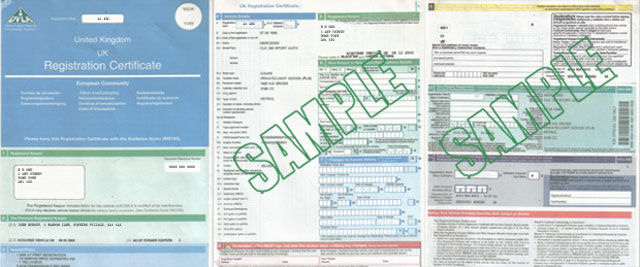
And for absolute completeness  a UK registration certificate: http://www.plates4less.co.uk/images/public/forms/large/v5c/v5c.jpg
[QUOTE=FoieGrasIsEvil]
It’s paid at the same time and is part of the renewal process, though. I know VA does it, KY does it (in fact I think all Commonwealth states do) and IN does it…but OH does not, from what I am told.
[/QUOTE]
Not exactly correct for Virginia.
In Virginia, property tax on vehicles is a local (generally county) tax, and is paid separately to a different government. The local government does not enforce the insurance requirements, nor does it provide the actual number tag. (Some provide a windshield sticker, some don’t) The State Dept of Motor Vehicles charges a license Fee, and you have to sign a sworn statement that the car is insured, but the only tax paid is when the car is originally purchased. Generally, the process for reregistration of a vehicle already licensed is accomplished every two years, by mail. (It also requires an emission inspection, and a mechanical safety inspection, but those verifications are done in computer databases.)
Tris
[QUOTE=MLS]
At one time the federal government had a 55 MPH speed requirement as a fuel conservation effort. An individual state could set a lower speed limit where appropriate, but not a higher one.
[/QUOTE]
Not strictly true. The states can set speed limits to whatever they want. If they set limits above 55MPH they would lose federal highway money and no state was willing to do that, but there was never a federal law restricting speed limits.
[QUOTE=Telemark]
Not strictly true. The states can set speed limits to whatever they want. If they set limits above 55MPH they would lose federal highway money and no state was willing to do that, but there was never a federal law restricting speed limits.
[/QUOTE]
Yes, you are correct.
[QUOTE=Telemark]
Not strictly true. The states can set speed limits to whatever they want. If they set limits above 55MPH they would lose federal highway money and no state was willing to do that, but there was never a federal law restricting speed limits.
[/QUOTE]
The feds like to use that back-handed tactic to overstep their general authority over the states. Speed limits and drinking ages are but two examples. It just isn’t right. If New Orleans wants to have an 18 year old drinking age and West Texas with miles upon miles of straight, desolate roads wants to have an 80 mph speed limit, that is their right and also practical. Consistency for its own sake is not a virtue in a country as diverse in all ways as ours.