The original constitution neither precludes discrimination based on race or explicitly endorses it. It is again, left up to the States. That means that the 1788 Constitution took no position on a State disenfranchising people based on their ethnic ancestry, that was considered a matter of State law.
But it protected slavery. The fugitive slave clause in Article IV meant that the federal Constitution protected the right of slaveowners to reclaim their escaped “property” in another state. That in turn was the basis for federal laws, starting from 1793 onwards, giving jurisdiction to the federal courts to enforce this clause of the Constitution.
That is more than just allowing slavery; the federal Constitution protected slavery, in its inter-state aspects, just like interstate commerce.
Common law can always be changed by statute. Even if the common law forbade all types of slavery (which is a very broad reading of Somersett), then state legislatures could change that. Somersett itself proceeds on the basis that there was no positive statutory authority for slavery in England. Would have been decided differently if the British Parliament had enacted legislation authorising the recovery of a slave.
Sorta: No Person held to Service or Labour in one State, under the Laws thereof, escaping into another, shall, in Consequence of any Law or Regulation therein, be discharged from such Service or Labour, but shall be delivered up on Claim of the Party to whom such Service or Labour may be due.
That included indentured servants, and likely bound apprentices, and even perhaps a contractor, depending on the contract (some dude paid in advance for e years work, and running off would be included). The clause did not mention slaves or even “property”.
This sounds good at first glance but is it really dispositive on the constitutionality of the Emancipation Proclamation? How would you define “rebel”? Does it include any resident of a geographic area regardless of their participation or non-participation in a rebellion? What about slave-owning, pro-Union residents of the geographic areas listed in the Emancipation Proclamation? There really were such residents.
At least one part of the Constitution that the Emancipation Proclamation might have violated is the Fifth Amendment: “No person shall be … deprived of life, liberty, or property, without due process of law; nor shall private property be taken for public use, without just compensation [emphasis added].”
And yes, it is absolutely reprehensible to refer to human beings as property. But this was not uncommon prior to the Civil War.
The Fifth Amendment also seems to support ASL_v2.0’s position when it states: “No person shall be … deprived of … liberty … without due process of law … [emphasis added].”
I just realized that the Emancipation Proclamation does not mention the slave-owning factions of the Indian Nations in what is now Oklahoma that were allied with the C.S.A. Do you think this was just an oversight or was it policy-driven?
That is a Federal statute protecting slavery, that is not the same as the constitution protecting it.
The fact that it applied to others didn’t exclude slaves. And the fact that the Congress legislated to provide for the use of federal courts to allow slaveholders to reclaim their “property” indicates that was how it was seen at the time.
Lincoln crafted the Proclamation to refer to “States or parts of States” that were in rebellion, suggesting that there could be “parts of States” that weren’t rebelling (parts of Kentucky perhaps). Loyal Union slave-owners could flee to non-rebellious territories (which is probably wise anyway).
The Proclamation, by talking about areas “in rebellion” might be construed as implying that due process would be involved in determination of which areas the Proclamation would apply, so you might be able to finesse that issue. After all, a law saying that the punishment for crime X is death doesn’t violate the 5th amendment unless someone is punished under that law without due process. So someone could claim that the Proclamation didn’t apply to him and his slaves - and a court would look at the evidence (dead Union soldiers shot by this supposed non-rebel) and decide accordingly.
And that’s why I think, if we were to grant that people really can be property, there is an argument to be made that the Emancipation Proclamation was unconstitutional, and I think you are exactly right in identifying the pro-Union slaver in the south (in a state still in a state of rebellion) as the most likely test case (that is, if it hadn’t been for the later 13th amendment rendering it moot). They’d have found one guy who owned slaves, was vehemently pro-union, and somehow managed to not get lynched by his rebel neighbors, and they’d have put him forward as the exemplar for just how awful the big bad Mister Lincoln was with his government overreach, and more or less the same Supreme Court that said Dred Scott wasn’t a person under the law, and never could be, would have said “Yep, you’re right, this poor, honest, decent, salve-owning American lost his ‘property’ due to arbitrary and capricious government action, and he deserves to be compensated or to have his property returned to him, along with every other citizen now that the war is over and we’re ready to just let bygones be bygones.”
So I simply do not grant that slaves were truly property. They were called property by ignorant racists, but they were not property.
Setting aside the 8th amendment (the whole cruel and unusual thing), even the 5th amendment might be read as placing a limit on what crimes could be punished with death. It comes down to the difference between procedural due process (is there a law that says the government can deprive you of Y according to procedure X? And did the government follow it?) and substantive due process (weighing the importance of Y and the right to have Y, versus the government’s interest Z: the more significant the Y, the more significant the Z and the more rigorous the procedure X must be before you can be deprived of Y).
Slavery was entirely within the due process of the laws of the various States.
It only implies that on matters pertaining to property the Federal courts deferred to the laws of the States in which the property owner was resident, as instructed by a Federal statute.
“Hi there, I’m ASL_v2.0 from the 21st century. I know you’re being sold to work on a Louisiana cotton plantation and probably will die there without ever seeing your family again. But I want you to know that despite the fact that you can be bought and sold at whim by anyone, including free blacks, you’re not property and that only ignorant racists think so, even though they have the Constitution, federal legislation, state legislation, the court system, public opinion, and the everyday reality of your existence on their side.”
You think showing up to say “I see nothing but property here, because that’s what a bunch of ignorant racists see, and I am bound to see whatever property may be here in my presence as they, the ignorant racists of this time, would see it” would be better?
In the real world real people have to live with the reality of the actual laws, not the laws you would prefer. It isn’t helpful either in a silly time traveling scenario, or in actually understanding and recognizing history, to create a fiction that the law was different than it was. Frankly, it harms proper understanding of why and how slavery operated for as long as it did in the United States to create legal fictions about it–it is important to understand that it was legal.
This is the weirdest piece of American history apology I have ever seen. Just wow!
It’s not an apology, it’s a reclamation. I am not obliged to see historical people as property just because the racists of their time saw them as property.
In many states. In others, it was illegal.
You’re not obliged to see the earth as round just because it is. But other people will judge you if you don’t.
You are rewriting history to make the gods of American history look less despicable. No one is fooled.
On that note, here is a picture of Dred Scott:
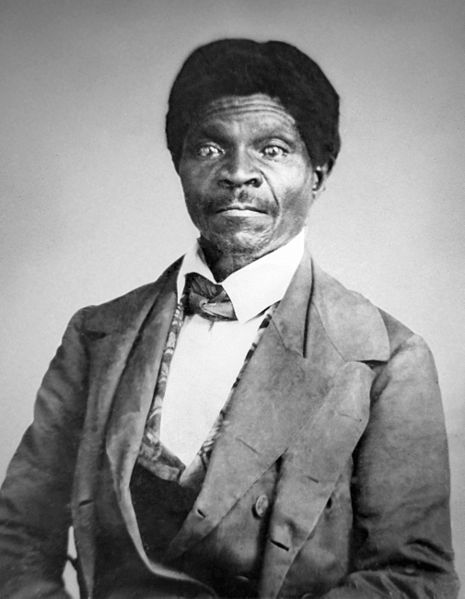
Is that a picture of a human man who has suffered oppression and seen the fruits of his labor usurped by racists, or is that a picture of property? Or would you say both?
Just because people called the world flat ten thousand years ago doesn’t mean we have to talk about the world of ten thousand years ago as if it truly was flat.
Examine your prejudices.
You would apparently prefer I view history through the lens of the oppressor, as if enslaved African Americans truly were property just because ignorant racists of their age said they were.
Is that really the position you want to take? That it’s a positive to adopt the language and the interpretation of the oppressors in describing the experiences of the oppressed?
They were treated as property, but they were not property.