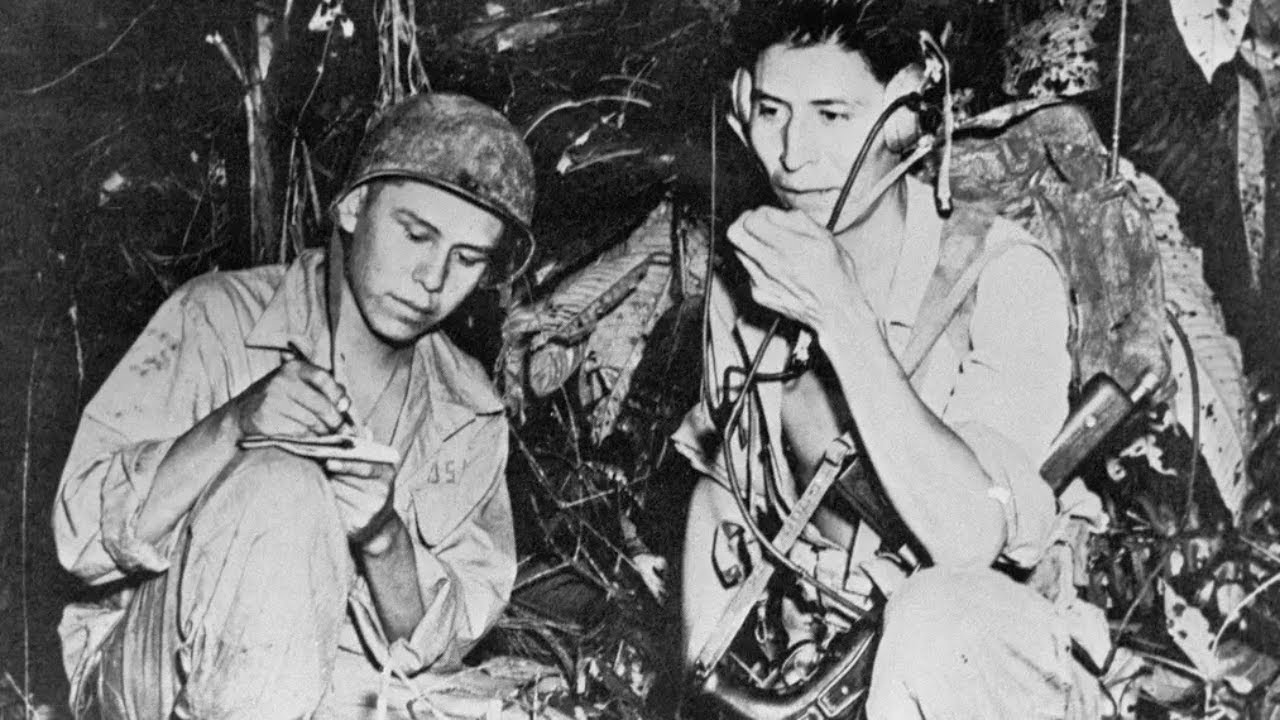
In a big enough war almost every stupid thing we can imagine happened at least once.
Now whether it got documented, and whether the whole string of stupid things needed to make a good “just so” story really happened? That’s a much heavier lift.
I put no credence in this particular “Get off the radio!” story. But have radio operators from opposing sides gotten into verbal abuse on each other’s radio nets? Of course they have. Heck, just keying the mike or babbling on the other side’s frequency is a primitive form of EW jamming. That works plenty well enough in a local area where everybody’s radios are of comparable power and (low) tech.
That story is based on how inconceivable the teller thinks it is that there were actual linguists or even just visitors to the US Southwest living in Japan during the war.
Another way that the existence of the Navajo codetalkers could have leaked to the Japanese is that the June 1943 issue of Arizona Highways magazine contained an article, titled "The Navajo Indian at War” by James M. Stewart that mentioned Navajo Code Talkers during World War II. Although this fact was classified, the author and editors didn’t realized that it was. It’s possible that this fact got to the Japanese somehow.
To the original question, I can contribute one sample decoded only in 2013, and verified by the same radio message also being logged in the boat’s surviving log:
BOOT KLAR BEI SCHNOOR ETWA ZWO SIBEN NOV SECHS NUL CBM PROVIANT BIS ZWO NUL DEZ BENOETIGE GLMESER NOCH VIEF KLHR STEHE MARQU BRUNO BRUNF ZWO FUHF LAG WIE KCHAEFER NW FUNF EINS FUNF STEIGEND GUTE SI RASCH
Written as normal German text
Boot klar. Bei „Schnoor“ etwa 27. Nov. 60 cbm. Proviant bis 20 Dez. Benötige Gläser, noch 4 klar. Stehe Marqu. BB 25. Lage wie „Schaefer“. NW 5, 15 mb steigend, gute Sicht. Von „Rasch“.
Translated into English
Boat ready*. At “Schnoor” circa 27 Nov 60 cubic meters. Provisions until 20 Dec. Need glasses, 4 still ready. Are ad grid reference BB 25, as is “Schaefer”. Wind NW, pressure 15 mbars [note: would mean 1015 mbars] rising, visibility good. From “Rasch”.
Some takeaways:
digits are spelled out, some in nonstandard manner (SIBEN instead of SIEBEN, FUNF instead of FUENF)
u-boats are referenced by the name of their commander, rather than by their hull number
The reference to “glasses” (4 ready; need more) looks like obfuscation (code for “torpedoes”?)
*) in nautical context the German word klar can mean: clear (from entanglements), ready (to use), not defective, secured, prepared, standing by for (as persons, awaiting a stated command). I have read of the Titanic having become unklar with an iceberg.
It was at the Monument Valley Tribal Park Visitor Center. If you’re visiting the park, it’s worth a visit but it’s mostly just old photos and training manuals. I’m not sure they even had a radio set. It killed a half hour.
I want to highly recommend the podcast “en clair” to anyone interested in this subject (and other fascinating stories about forensic linguistics). There is a 3-part mini-series on the Enigma cryptoanalysis, as well as an episode on the code talkers. Both in-depth and carefully researched. The role of the Polish cipher bureau in being the first to crack Enigma and building the first bombes is an exciting story and could do with being more widely known.
One important point not mentioned in this thread is that the success of the Choctaw codetalkers in WW1 led the Germans and Japanese to study Native American languages, but they found Navajo difficult to learn for various reasons. The citation for this claim is Santella, A. (2004). Navajo Code Talkers (pp. 11-13). MN: Compass Point Books.
So by the time of WWII, they were aware of the concept of using Native American languages as a code and Japanese linguists would likely have been able to identify the language, but not to understand it.
No, you don’t, what sense would a nonsense letter make? And I don’t know what the method was to insert the Xs, Js, Bs, Ys and so on if there was one at all.
Cases where German compounds are ambiguous are reasonably rare (Kindergarten|leiter = manager of a daycare; Kinder|gartenleiter = garden ladder for the use of children); in the terse prose and limited vocabulary of naval signals they would not be a problem.
English sometimes has ambiguities from breaking a compound at places other than the actual root joins, like “mans laughter” or “the penis mightier”. But those are also rare enough to be unlikely to cause confusion, especially since the context will usually make it clear.
I do find it interesting, though, that “ladder” and “leader” are apparently homonyms in German. Do they come from the same root?
I like Urin Sekten (looks like urine sects, but those are primordial insects when written together and pronounced correctly) and Blumento Pferde (horses from or belonging to Blumento, or rather soil for potting plants). Those examples are so rare that the second one is completely artificial. The first one is just barely possible IRL.
They seem to have a distant common derivation from the verb for ‘to lead’, but they are easily distinguished by grammatical gender.
Bitte stellen Sie die Leiter an die Wand = Please lean the ladder against the wall. Bitte stellen Sie den Leiter an die Wand = Please have the boss executed by firing squad.
I have found a YouTube video which also discussed this, but it doesn’t have references so I’ve been trying to dig deeper.
The gist is that they had figured that it was a Native American language but had not definitively decided that it was Navajo.
They had reached out to Germany for help but that didn’t work.
The Imperial Navy’s fourth section assigned 30 cryptoanalysts exclusively to these transmissions. Captain Yoshiro Tanaka tried innovative approaches, musical analysis for tonal patterns, comparison to Native American recordings, consultation with scholars who studied in America. They developed special recording equipment to slow transmissions without distorting pitch.
Captain Yasuji Kawamoto was specific, “We recorded thousands of transmissions. Our best linguists studied them for three years. Nothing worked. It was a greatest cryptanalytic failure. In 1944, analysts had noted tonal patterns suggesting indigenous American languages. They requested German assistance, but wartime difficulties and German ignorance prevented breakthrough.
Captain Minoru Yamada revealed, “We knew it was Native American by late 1943, but couldn’t identify which language.”
I don’t wish to leave this without comment, because true statements like that are often taken out of context.
The Enigma algorithm was never “cracked”. What the Polish, and later the Allies, did was just try every possible decoding key, until they found one that fit. The Poles realized that German practice reduced the complexity by an order of magnitude, optimized the practice further by recognizing the limitations of the coding system, and built a manual / mechanical system to try more valid keys faster.
The Allied code-breaking effort was a massive technological achievement, to handle the exponentially larger number of keys that needed to be tried in the more secure versions used by the Germans, but it wasn’t just that: they didn’t just copy the Polish idea and stop there.