Exactly. Just as it would take infinite amounts of energy to accelerate regular particles to the speed of light, it would take infinite amounts of energy to decelearate tachyons (theoretical particles that travel faster than light) to the speed of light.
The idea that we are at the end (or past the end) of an ice age comes from when there was one known cold period. We now know that there an be cold periods (glacials) and warm periodws (interglacials) within an ice age.
Actual ice ages tend to be millions of years in length. we’ve been in our current ice age for a bit more than two and a half million years.
What drives an ice age is not determined for sure, but it seems to be largely based on continental drift. It is quite possible that this ice age will last until such time as Antarctica moves enough to no longer interfere with the currents in the Atlantic.
I am not sure that those are even hypothetically hypothetical particles like, e.g., magnetic monopoles or axions.
That and the Arctic Ocean becoming less landlocked, too. Basically warm equatorial waters being able to reach both poles.
Depends what you mean. (Definitions!) The age of our current series of cycles may be 2M+ years, but each ice episode occurs roughly 100,000 years.
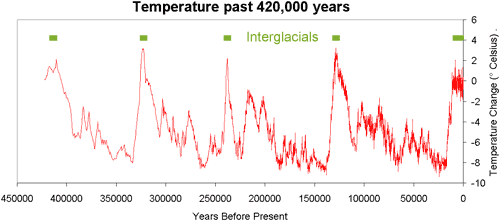
The point is, earth seems to dwell in the cold period far longer than the long period, and we’ve been in the current interglacial warm period for a while. However, it’s unpredictable in that the pattern - declining global temperature - may repeat tomorrow or in 10,000 years and the decline itself takes thousands of years. Glaciers will not reach Wisconsin next year. Meanwhile, who knows what the current overload of CO2 and resultant global warming will do to that cycle?
I once saw an estimate that 50% of all published mathematical papers contain a significant error. I don’t know if that is true, but it seems high to me. I have had to modify some things once or twice, but somehow it never made a serious difference. But you are right that people can err, error checkers can be wrong (leaving aside the difficulty in translating your proofs into the format required by the checker. Yet never has a genuine contradiction arisen.
As far as the probable prime tests, numbers that are Carmichael even to 2 alone (that is for which 2^{n-1} = 1 (mod n)) are astonishingly rare and I am content that if there is one chance in 2^100 that one of factors of an RSA code is not prime, well no one is going to look for it anyway. Much more serious is that quantum computers can crack the RSA once they get enough cubits together. That means that anything coded now or in the past will likely be crackable at some time in the future.
Apparently a 300-cubit ark is enough to decrypt a pair of every kind.
It is one thing to have a minor error in a proof. Even in the statement of a theorem (perhaps some assumptions need to be stated). However— and wherever you want to draw the line— people can and have published “proofs” of statements that are false. Wang–Grunwald theorem for instance: here you have a theorem which has multiple published proofs, and a counterexample to that theorem. If that is not a contradiction, I do not know what is. [Of course, it was not a “genuine” contradiction, just due to human error. But is that not exactly what we are talking about when we mention error checkers?]
P.S. to emphasize that it is not a self-containing problem, sometimes people cite and use the false theorem, or, what is even worse, the argument or technique. I checked that, e.g., I. N. Baker’s “theorem” in complex analysis was published in 1970, but a counterexample was not published until 2018(!!!)
Some “theorems” (false, whether due to honest mistakes or deliberate fraud) end up published in prestigious journals (which nevertheless screwed the pooch on basic peer review). Consider the works of Daniel Biss, for instance. Bet on the computer every single time.
I’m pretty sure Milankovitch cycles – the combination of three regular, predictable components of Earth’s orbit – are the primary cause of ice ages. Yes, this is complicated by atmospheric feedback loops, and by changing arrangement of continents (e.g., more polar landmasses in some eras, and changes to ocean currents), but the orbital cycles are the main thing, no? (Obviously, I’m talking about before the current mess of anthropogenic warming – but even that will interact with Milankovich cycles).
Hence the (imperfect but clearly present) regularity in the timeline graphic md-2000 posted.
The Milankovitch cycles are short term cycles. They do affect the climate, but they do not create ice ages. If they did, we would see there being ice ages every hundred thousand years or so going back millions of years.
It does seem clear that they affect the cycles of glaciations and interglacial periods within our ice age, though.
This ice age, the quaternary glaciation, has been going on for about 2.6 million years or so. During this ice age, we have had several periods of glaciation and interglacial periods within the ice age.
Referring to the last glacial period as an ice age dates back to when we only knew of one such period. It doesn’t make sense to refer to periods of glaciations within an ice age as ice ages, but people still do it.
Ah, yes - back to definitions.  For the longer-timespan definition of “ice age” (I agree it’s a better one in most contexts), the arrangement of the continents (and therefore the oceans) is the dominant factor, indeed.
No. They’re the primary driverof the glacial/interglacial cycle, but not of ice ages themselves.
For many years, Euclidean geometry was accepted as the “final word”. Serious challenges didn’t make an impact until the late 1800’s.
It may have been accepted, but not in the sense people did not spend thousands of years probing Euclid’s Fifth Postulate. Euclid did not fuck up by publishing anything wrong.
ISTM that most of the wrong but widely accepted consensuses dated from the early scientific era. IOW stuff believed in the 1700s on what we now know to be very thin very circumstantial evidence that was later overturned by the far better and more voluminous data which led to the different or refined theories of later centuries. That doesn’t happen as much any more.
As a separate but related matter, I think Science itself, not science in the popular conception, has gotten better internally about giving voice to what they don’t know, not merely what they do.
The Great Scientist of e.g. 1850 making a grand pronouncement that there’s nothing more to be learned about X is a cliché for a reason. That happened often; the zeitgeist demanded certainty.
IMO there’s not the degree of public certainty today. Witness the Hubble constant / dark matter / dark energy stuff. They always knew something was weird, or not quite fitting together. But what? “We don’t know yet” was, and still is the stock answer. And is accepted as such. Which would have been largely anathema in e.g. 1850.
Same for quantum mechanics vs relativity. They don’t fit together, we all know they don’t fit together, but nobody is loudly announcing that either we know the answer or that we’ll never know the answer.
As such I’ll argue the OP is asking a question mostly about century old history, not current events. There are some exceptions: plate tectonics mentioned by many above is one prominent sorta-recent example. But IMO that’s more the exception that proves the rule.
It was the difficulty of gathering data to prove the different ancient arrangements of continents that led to the untested “commonsense” assumption that the land doesn’t move being mistakenly elevated to the level of proven fact. Which assumption had very deep historical roots. And as such was hard to recognize as an assumption.
As discussed above, the “glacial” part of that cycle is colloquially called an “ice age.”
I concur that it’s better to use the proper scientific terms in this forum, so I appreciate the suggestion.
I never said he did, but the consensus that it was complete proved to be wrong.
Except there was no such consensus.
That’s how non-Euclidean geometries came about - people spent centuries trying to prove the parallel postulate without success until somebody (actually, more than one independently) tried going about with a different 5th postulate in an attempt to show it led to nonsensical results but ended up showing it did not.
Many strongly suspected the parallel postulate was true but could never prove it and it was never, never, never accepted as a proven statement, mainly because mathematicians are particular like that, even about things they think are probably true. Though there have been some false proofs that were fashionable for short periods.
Right.
And I get frustrated because it’s a popular meme that science is “always changing”, and even many science communicators agree with that statement, when it’s very misleading.
Because often the man on the street sees it as “we think life on earth evolved now, but science is always changing”.
Theories like ToE would have had to make millions of lucky guesses at this point. Nothing like that is ever likely to be overturned, though of course it gets more refined and complete over time.
I think that’s right, however often tentative theories get relayed with too much certainty in articles aimed at the layman. Plus obviously there’s an incentive to report anything that overturns fundamental knowledge, even if it’s just an out-there theory among hundreds published every day.
So I do understand why many people have this view of science both constantly changing and being largely guesswork and groupthink. Before we even get to the actors deliberately trying to seed that idea.