# What can be done about wage stagnation in the U.S.?
**URL:** https://boards.straightdope.com/t/what-can-be-done-about-wage-stagnation-in-the-u-s/667222
**Category:** Great Debates
**Created:** [August 26, 2013, 6:06pm UTC](https://boards.straightdope.com/t/what-can-be-done-about-wage-stagnation-in-the-u-s/667222 "2013-08-26T18:06:03Z")
**Posts on this page:** 14
**Page:** 2
### Author:  [@msmith537](https://boards.straightdope.com/u/msmith537)
#### Post date: [August 26, 2013, 8:41pm UTC](https://boards.straightdope.com/t/what-can-be-done-about-wage-stagnation-in-the-u-s/667222/21 "2013-08-26T20:41:45Z")
> [@XT](#):
>
> Just a drive by, but why SHOULD wages continue to go up and up in the US? What about the US and US citizens/workers enables a perpetual wage upgrade machine for us? Why do US workers deserve continual increases? What about us is special that this should be expected ad infinitum?
> .
As a general rule, there should be an increased value for your labor as you gain knowledge and experience and demonstrate loyalty and reliability to your employer. You should also get wage increases as you get promotions and more responsibility. Much of this ties into the American narrative of each generation doing better than the last.
But as a practical matter, no, there is no reason that real wages should automatically increase. From a simple economics standpoint, if everyone got a 2% raise, without a real increase in per capita production, one would expect inflation to rise about as much, cancelling out any real wage growth.
This is especially true when you are talking about the bottom quartile of wage earners who tend to work in low-level service jobs that place little premium on years of experience.
> [@WillFarnaby](#):
>
> Inflation destroys real wage growth. Rising prices have accompanied increases in productivity. If we experienced increased productivity with sound monetary policy, you would see a rising real wage. We had a comparably sound monetary policy for decades in the US. During this period the middle class grew to attain levels of wealth never before seen. Maniacal inflationists Greenspan and Bernanke have delivered a one-two punch to the American middle class. The first being a destruction of real wages through inflation. The second being the destruction of savings through inflation.
>
> American policy makers dogmatic worship of inflation over the course of several boom-bust cycles powered by loose money policies is unequaled by any tale of cultism or religious zealotry in the history of the world.
Actually, as another poster pointed out, inflation has been relatively low since the 80s. Monetary policy has typically been in favor of low inflation and a strong dollar.
It’s easy to say “rich people are stealing all the money” but there are also a number of global trends that are putting significant downward pressure on American wages. Rising energy costs, rising health care costs, globalization just to name a few.
---
### Author:  [@Voyager](https://boards.straightdope.com/u/Voyager)
#### Post date: [August 26, 2013, 8:41pm UTC](https://boards.straightdope.com/t/what-can-be-done-about-wage-stagnation-in-the-u-s/667222/22 "2013-08-26T20:41:54Z")
> [@WillFarnaby](#):
>
> You are talkin about 1.7% inflation when there should be a deflationary correction. Bernanke hasn’t allowed prices to come down as they are wont to do. That would be a healthy reaction to the rising prices of the last Greenspan bubble. If you don’t see inflation look at the stock market. Look at farm land prices. Look at housing prices starting to go up.
Inflation was 0.1% in 2008. I’ll let you read non-Austrian economics to understand why deflation is a bad thing.
Yes, housing prices did go up. While they were too high before the crash, they were too low after, held down by the foreclosure pool. Since that is gone, they can resume a more realistic level. In the Bay Area part of the reason for the big increase was lack of supply, since people still underwater were holding on for the prices to go up more, and because people who might want to trade up were scared to do so because of the shortage of housing stock. We seem to be seeing more sales now, and the price increases are moderating.
---
### Author:  [@XT](https://boards.straightdope.com/u/XT)
#### Post date: [August 26, 2013, 8:51pm UTC](https://boards.straightdope.com/t/what-can-be-done-about-wage-stagnation-in-the-u-s/667222/23 "2013-08-26T20:51:48Z")
[QUOTE=Voyager]
I’ve got a counter-example. Let’s not pay workers anything. If they work hard enough, they can get promoted to manager which does pay. It works for interns, right? What could go wrong?
[/QUOTE]
It’s called automation and offshoring/outsourcing, and it’s already happening. If you push the price point at the low end companies aren’t just going to knuckle under and pay whatever you try and force them to pay…they will automate (hell, it’s why companies HAVE been automating everything they can) if that’s feasible, or they will outsource or offshore if they can…or they will increase productivity using process, expert systems or other means to make each worker more productive so they need fewer workers.
> [@](#):
>
> You obviously missed the part about paying for increased wages out of productivity improvements.
No, I didn’t miss that part at all. Good luck with that…if you can make companies pay increased wages for productivity increases their capital investment in process or technology has opened up, well, more power too you. Personally, I think the part you are missing is that if you push companies on this they will only increase what they have already been doing, namely more automation, more outsourcing or offshoring, and more refinement of process and higher efficiencies leading to more increases in productivity leading to needing less workers to do the job. Those fewer workers will certainly appreciate it, however, as they are likely to make more.
> [@](#):
>
> We’ve had this discussion already. Workers get all? Of course not. But surely it is not hard to believe that workers are somewhat responsible for increases.
If my labor is what’s creating more productivity then it’s not hard to see why, if I don’t think I’m getting a good deal, I couldn’t take my more productive self to a better offer. Problem is, and overall/across the board, increased productivity in the US has come about because of capital investment by companies in higher and higher levels of automation and refinement of process and higher efficiencies, not because of the innate ability of the workers or their intrinsic value.
> [@](#):
>
> Every time a small increase is proposed we here the gloom and doom, that it will inevitably lead to high unemployment and overall catastrophe. I’m sure proponents of a big increase wouldn’t mind it being phased in over time. That would seem to make sense.
Not from me. I’ve pretty consistently maintained that small changes will have small effects, and that a small adjustment to the minimum wage isn’t going to have a huge effect on the price or on unemployment. But the article linked in the OP seems to be talking about large changes to minimum wage (and probably benefits as well, for a twofer), which WILL have a large effect on price and on unemployment at the low end…unless you really think companies will just eat the additional costs and do nothing to mitigate them through R&D on technology and increased efficiencies and per worker productivity.
---
### Author:  [@dracoi](https://boards.straightdope.com/u/dracoi)
#### Post date: [August 26, 2013, 10:48pm UTC](https://boards.straightdope.com/t/what-can-be-done-about-wage-stagnation-in-the-u-s/667222/24 "2013-08-26T22:48:27Z")
> [@Voyager](#):
>
> But many of the employees without health coverage work in service industries like retail and fast food, and those employees are not directly affected by globalization.
>
> Also, since employers are pushing more of the burden of healthcare costs on the workers, who have to pay more, their actual wages deducting healthcare are even worse than the numbers show. You’d think if this were really a problem the business world would be pushing UHC to get out of it altogether.
Globalization still affects everyone, though. If you can’t get a job in a factory or a call center, you’re now part of the pool of applicants for retail and fast food. And globalization covers more than just out-sourcing and off-shoring of low-skill jobs. For example, there are thousands of folks from India here in the Seattle area with work visas who do programming for Microsoft, Amazon and the like. These are not entry-level jobs and they tend to pay $40k a year or so. They work here for two years and then either get permanent permission to stay in the US, or they take their experience back home and work there.
As far as business and UHC, I think there are two factors.
The first is that employees always focus on their net take-home pay. They really don’t look at their pay stub in any great detail. So they see stagnant wages. But businesses look at the total costs - gross pay, benefits, taxes, etc. So a business might budget for a 5% increase in employment costs. They don’t really care whether that’s 1% healthcare and 4% wages or 4% healthcare and 1%.
The second is that businesses fear change. High healthcare costs ties employees to positions with benefits, meaning longer retention and that’s very profitable to business. If UHC changes that, their recruiting and training costs go up to. Businesses also fear that the change will involve taxes to be paid by the business. This is not a necessary feature of UHC, of course, but it’s a risk they have to worry about.
---
### Author:  [@Wesley\_Clark](https://boards.straightdope.com/u/Wesley_Clark)
#### Post date: [August 27, 2013, 12:12am UTC](https://boards.straightdope.com/t/what-can-be-done-about-wage-stagnation-in-the-u-s/667222/25 "2013-08-27T00:12:05Z")
Rebuild our health care system from scratch along the lines of nations like Taiwan, and decouple health care costs from employers.
Change the tax code to create incentives for higher wages.
Rebuild the labor movement to workers can demand higher wages and have teeth to make companies want to offer it to them.
Chances of any of that happening in the US? About zero.
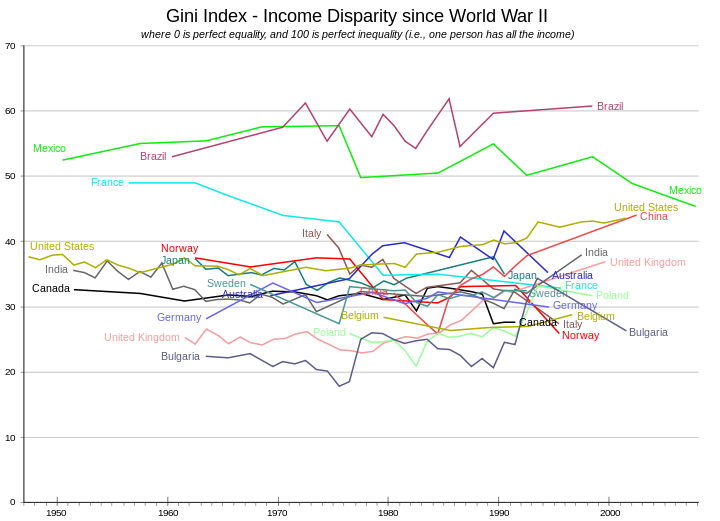
FWIW, this growth in income inequality did not happen in places like Canada, so you can’t say it is due to globalization.
[ ](https://upload.wikimedia.org/wikipedia/commons/thumb/0/01/Gini_since_WWII.svg/720px-Gini_since_WWII.svg.png)
In places like the US and UK inequality rose, in places like Germany, Norway, Japan and Canada it did not. My understanding is the growth in inequality led to about 1.5-2 trillion a year in GDP that would go to wages being moved to income for the top 1% and corporate profits.
---
### Author:  [@BrainGlutton](https://boards.straightdope.com/u/BrainGlutton)
#### Post date: [August 27, 2013, 12:32am UTC](https://boards.straightdope.com/t/what-can-be-done-about-wage-stagnation-in-the-u-s/667222/26 "2013-08-27T00:32:57Z")
> [@WillFarnaby](#):
>
> Inflation destroys real wage growth.
[Not a problem we have, now,](http://inflationdata.com/Inflation/Inflation/AnnualInflation.asp) it’s been trending downward since 1989.
---
### Author:  [@Johnny\_L.A](https://boards.straightdope.com/u/Johnny_L.A)
#### Post date: [August 27, 2013, 1:10am UTC](https://boards.straightdope.com/t/what-can-be-done-about-wage-stagnation-in-the-u-s/667222/27 "2013-08-27T01:10:49Z")
> [@Wesley\_Clark](#):
>
> Rebuild our health care system from scratch along the lines of nations like Taiwan, and decouple health care costs from employers.
But if we did that, the government tab for health care would be _half_ of what we’re paying now! How does that make economic sense? :dubious:
---
### Author:  [@foolsguinea](https://boards.straightdope.com/u/foolsguinea)
#### Post date: [August 27, 2013, 8:15pm UTC](https://boards.straightdope.com/t/what-can-be-done-about-wage-stagnation-in-the-u-s/667222/28 "2013-08-27T20:15:38Z")
> [@WillFarnaby](#):
>
> Inflation destroys real wage growth. Rising prices have accompanied increases in productivity. If we experienced increased productivity with sound monetary policy, you would see a rising real wage. We had a comparably sound monetary policy for decades in the US. During this period the middle class grew to attain levels of wealth never before seen. Maniacal inflationists Greenspan and Bernanke have delivered a one-two punch to the American middle class. The first being a destruction of real wages through inflation. The second being the destruction of savings through inflation.
>
> American policy makers dogmatic worship of inflation over the course of several boom-bust cycles powered by loose money policies is unequaled by any tale of cultism or religious zealotry in the history of the world.
Are you posting from an alternate reality? Or am I really historically confused myself? Evidence for Greenspan and Bernanke being _more_ pro-inflation than the pre-Volcker régime?
I think you do have a shadow of a point, if you mean we’ve been more concerned with maintaining a particular rate of inflation than with employment directly.
But it sounds like you want to fix everything from the Fed through the mechanism of keeping inflation low–_which is kind of what we’ve been doing!_ It’s Friedmanism, I guess: Fix the Fed and the economy will follow. I don’t buy it at this point.
If you’re arguing we should have 0% inflation, well, I don’t know if that’s workable.
_De_flation? Madness! No, really. Our ecomony can’t take it; it could barely take it when it was a natural effect under the gold standard.
---
### Author:  [@LinusK](https://boards.straightdope.com/u/LinusK)
#### Post date: [August 30, 2013, 5:49pm UTC](https://boards.straightdope.com/t/what-can-be-done-about-wage-stagnation-in-the-u-s/667222/29 "2013-08-30T17:49:51Z")
The easiest most efficient way to increase wages is to use market forces: increase employment. When you reduce the army of the unemployed, those looking for work, or who already have it, can bargain for a greater share of the value of the things they’re creating.
The way to increase employment is to increase employment. If the private sector isn’t doing it, the public sector should.
We need things in this country. Better schools, more teachers, more and better housing, better infrastructure, better justice systems, high-speed interstate rail, nationwide wireless connectivity, etc. Pick one, pick them all. Any and all of them will increase employment, thereby increasing wages.
---
### Author:  [@puddleglum](https://boards.straightdope.com/u/puddleglum)
#### Post date: [August 30, 2013, 7:07pm UTC](https://boards.straightdope.com/t/what-can-be-done-about-wage-stagnation-in-the-u-s/667222/30 "2013-08-30T19:07:40Z")
> [@](#):
>
> In addition to “aggressively increasing the minimum wage,” Mishel and Shierholz offer many recommendations, including: rapidly lowering unemployment through large-scale, ongoing public investment; restoring the collective bargaining power of low- and middle-wage workers; guestworker programs only being used to relieve documented labor shortages, and guestworkers having the same labor protections as resident workers; citizenship for undocumented workers who are currently vulnerable to exploitation; executive action so federal dollars aren’t spent employing people in jobs with poverty-level wages; and job quality and wage growth as the key priorities in economic policymaking.
Wages are prices and the way to increase wages is the same way you increase any price, lower supply or increase demand. Large scale public investment is hiring people to do construction. In order to higher all the unemployed at an acceptable wage you would have to at least double the size of the budget deficit from 900 billion dollars a year to 1.8 trillion. Who is going to lend the US that much money and keep doing it every year?
Restoring the collective bargaining power of employees? Where did it go? Union employment has gone down because companies that have unionized workforces grow slower and are less likely to survive downturns. The way unions work is to exclude people from employment and thus drive up the price for the other people. This will not work across a whole economy. Increased wages for union workers come at the expense of the non-union workers.
Amnsesty for illegals will increase the supply of labor by attracting more immigrants and allowing illegals access to more kinds of work. That will drive up wages for the previous illegals but depress them overall for legal workers.
Executive action to make sure poverty wages aren’t paid on federal projects will either spike the deficit which is already huge and unsustainable or allow fewer projects which will mean less demand for workers.
The only way to increase wages is to shrink the workforce by accepting fewer immigrants, and to increase demand by making it easier to form a business, easier to expand a business, and more profitable to own a business in the US than the rest of the world. Fewer regulations that kick in when a company passes a certain threshold number of employees would also create demand.
There is no way to increase wages by willing them or executive order, supply and demand are what determine wages not politics.
---
### Author:  [@Voyager](https://boards.straightdope.com/u/Voyager)
#### Post date: [August 30, 2013, 7:16pm UTC](https://boards.straightdope.com/t/what-can-be-done-about-wage-stagnation-in-the-u-s/667222/31 "2013-08-30T19:16:26Z")
> [@LinusK](#):
>
> The easiest most efficient way to increase wages is to use market forces: increase employment. When you reduce the army of the unemployed, those looking for work, or who already have it, can bargain for a greater share of the value of the things they’re creating.
>
> The way to increase employment is to increase employment. If the private sector isn’t doing it, the public sector should.
>
> We need things in this country. Better schools, more teachers, more and better housing, better infrastructure, better justice systems, high-speed interstate rail, nationwide wireless connectivity, etc. Pick one, pick them all. Any and all of them will increase employment, thereby increasing wages.
Now you got it. These can be considered as investments also, which will pay off in higher growth down the road, like the interstate highways system did.
During the bubble, when unemployment was lower than what was considered theoretically possible, the minimum wage in Silicon Valley was pretty much a non-issue, since there was such a labor shortage even fast food places had to bid up wages. And everyone did very well.
---
### Author:  [@Voyager](https://boards.straightdope.com/u/Voyager)
#### Post date: [August 30, 2013, 7:24pm UTC](https://boards.straightdope.com/t/what-can-be-done-about-wage-stagnation-in-the-u-s/667222/32 "2013-08-30T19:24:58Z")
> [@puddleglum](#):
>
> The only way to increase wages is to shrink the workforce by accepting fewer immigrants, and to increase demand by making it easier to form a business, easier to expand a business, and more profitable to own a business in the US than the rest of the world. Fewer regulations that kick in when a company passes a certain threshold number of employees would also create demand.
>
> There is no way to increase wages by willing them or executive order, supply and demand are what determine wages not politics.
What type of immigrants do you want to exclude? The low wage type - because lots of Americans will flock to the fields, right? (See what happened when Alabama tried this.) Or farmers will have to pay more, so food prices will rise. Ditto for other jobs.
Or do you want to exclude the high end immigrants like those in Silicon Valley who create companies and jobs?
And hiring, as we’ve told you again and again, is demand based. Who forms a company again with the idea that it will only grow so big, no matter what, in order to avoid regulations? Not any entrepreneur I’ve ever met.
And minimum wages laws mean your last sentence is nonsense.
---
### Author:  [@adaher](https://boards.straightdope.com/u/adaher)
#### Post date: [August 31, 2013, 4:05am UTC](https://boards.straightdope.com/t/what-can-be-done-about-wage-stagnation-in-the-u-s/667222/33 "2013-08-31T04:05:02Z")
In order to be convinced there’s a wage stagnation problem, we would first have to prove that native born Americans have not seen wage growth. If our wage stagnation is primarily among immigrants, then that’s a different type of problem.
We would also need to know if the problem is also occurring in the rest of the West. We know that income has increased tremendously in the Third World. If the actual problem is that a lot of the wealth is going to the Third World, then that’s not a problem, that’s a good thing.
---
### Author:  [@foolsguinea](https://boards.straightdope.com/u/foolsguinea)
#### Post date: [August 31, 2013, 10:14pm UTC](https://boards.straightdope.com/t/what-can-be-done-about-wage-stagnation-in-the-u-s/667222/34 "2013-08-31T22:14:23Z")
> [@puddleglum](#):
>
> Wages are prices and the way to increase wages is the same way you increase any price, lower supply or increase demand. Large scale public investment is hiring people to do construction. In order to higher all the unemployed at an acceptable wage you would have to at least double the size of the budget deficit from 900 billion dollars a year to 1.8 trillion. Who is going to lend the US that much money and keep doing it every year?
You fail macroeconomics.
Money supply is not GDP. Expenditure does not require borrowing. Tax-&-spend progressive policies do not shrink the size of the economy, and in some cases may even grow it. This is historically demonstrated.
And demand can be changed by price. Demand in practice can be unchanged by price if supply is low enough. The market is \*\*not \*\*a perfect machine that automatically sets prices based on impersonal inputs. Price is negotiated. Demand changes due to that.
> [@](#):
>
> Restoring the collective bargaining power of employees? Where did it go? Union employment has gone down because companies that have unionized workforces grow slower and are less likely to survive downturns. [del]The way unions work is to exclude people from employment and thus drive up the price for the other people. This will not work across a whole economy. Increased wages for union workers come at the expense of the non-union workers.[/del]
>
> _strikethrough added_
You’re partly right here, except for the part I crossed out, which is not always the case nor even generally so. There has been a real division in labor advocacy between groups like craft unions, that advocate only for their own, and groups like social democrats and Great Society liberals, that advocate for the common man in general. The dysfunctional unions you describe only unionized certain industries, did not fight for a living wage for all, and lost the people’s faith. They also hurt their own employers by demanding concessions from their employers that imposed costs competitors didn’t have. This is why publicly funded pensions will naturally tend to survive and private pensions fade away.
> [@](#):
>
> Amnsesty for illegals will increase the supply of labor by attracting more immigrants and allowing illegals access to more kinds of work. That will drive up wages for the previous illegals but depress them overall for legal workers.
Yes to the first sentence, maybe yes to the second; but these are delayed and indirect effects. Legalization and de-quota-fication of the migrant labor sector will allow more migrant workers to leave the country in the off-season (moderately strong short-term effect). It will allow them to fight more powerfully against abuses by employers (which will tend indirectly to drive up agriculture prices and agriculture-work wages across the board, not necessarily a bad thing in the present rich-city, bankrupt-farmer climate). It will cut off a major stream of money to Mexican organized crime (very big important good effect). And it’s _the decent thing to do._ Sometimes the actual direct effect of a thing is a reason to do it.
> [@](#):
>
> Executive action to make sure poverty wages aren’t paid on federal projects will either spike the deficit which is already huge and unsustainable or allow fewer projects which will mean less demand for workers.
Or, you know, progressive taxation. Keynesian economics isn’t really all deficit spending. It’s _supposed_ to tax overheated, inflated finance sectors as well.
> [@](#):
>
> The only way to increase wages is to shrink the workforce by accepting fewer immigrants, and to increase demand by making it easier to form a business, easier to expand a business, and more profitable to own a business in the US than the rest of the world. Fewer regulations that kick in when a company passes a certain threshold number of employees would also create demand.
Not true. Sounds more like a _Forbes_ wishlist. And you should know that there is no way in hell to make it, by fiat, “more profitable to own a business in the US than the rest of the world.” Other countries will also be trying such things. We could unleash a global campaign of terror to destroy all their economies, sure; then we could be “the most profitable” for a moment while everyone else is _on fire_. But the cost of doing that would make us poorer than we are now, and then profiteers would make far more money rebuilding those countries then domestic companies make here. Useless and stupid.
I have no idea how you connect fewer regulations to increased demand. Again, I suspect some _Forbes_ propaganda in place of thought. Maybe, though?
> [@](#):
>
> There is no way to increase wages by willing them or executive order, supply and demand are what determine wages not politics.
Falsified by history. The market is people. Supply and demand come from people, not impersonal forces, and price is not determined automatically by the market.
[Previous page](https://boards.straightdope.com/t/what-can-be-done-about-wage-stagnation-in-the-u-s/667222.md?page=1)