It could be interesting to get a guess about that from an AI…
I’m skimming their 2024 annual report. Calculators are now lumped into their “other” business segment, which, as a whole, accounts for 2% of their revenue. So, calculators are, at most, 2% of their revenue these days, and probably considerably less than that. Nearly all of their business is semiconductors and other electronic components, which are apparently a B2B business, rather than consumer products like the calculators.
TI makes other things besides calculators, though, such as analog electronic devices, embedded processors for industrial and automotive applications, and DLP products. Their Educational Products division might eventually go away, but TI as a company will likely be fine.
Hmm, I was curious about this.
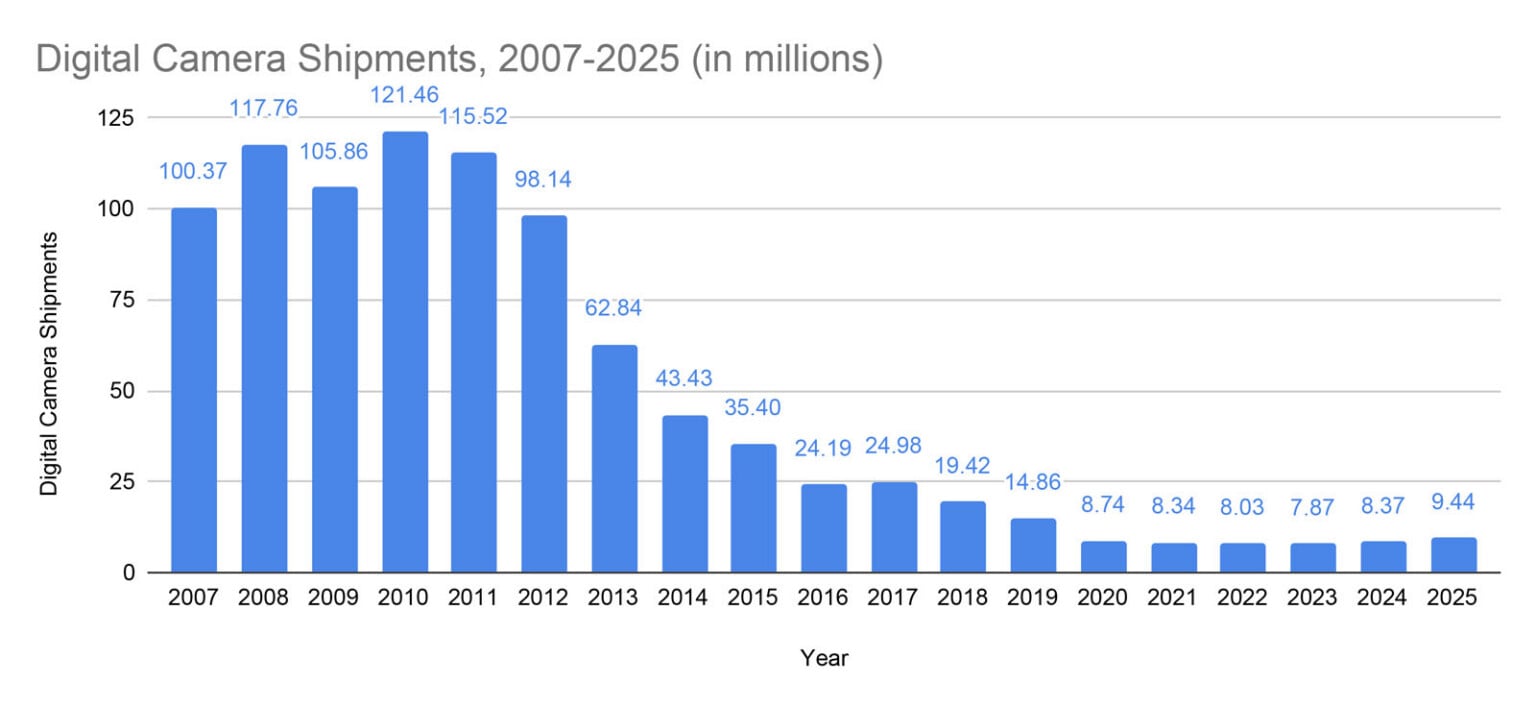
I thought standalone camera sales (of any sort) have plummeted since their heyday (and they have). BUT to my surprise, they’re actually creeping back up!
From Camera Shipments Increased for Consecutive Years for the First Time in Nearly 20 Years | PetaPixel
Well, I have one, because they’re pretty aggressively pushing them on teachers (lots of free samples). If one were to get a standalone handheld graphing calculator, rather than relying on a webpage or an app, it’s a pretty good one.
Their test status is less clear. The SAT and other College Board tests unambiguously allow them: The Numworks calculator is explicitly on the whitelist. Numworks says that they’re also allowed on the ACT, but what the ACT folks say doesn’t directly back that up. Rather, the ACT allows all calculators that don’t have CAS features, but some of the features on the Numworks might arguably be considered CAS features.
In actual practice, most standardized tests are administered by ordinary educators, and if you Google “Is Numworks allowed on the ACT”, the results are dominated by the statements from Numworks, and few teachers are knowledgeable about CAS or Numworks specifically, so if a student shows up with one, they’ll probably be allowed to use it. But I wouldn’t count on it.
Hm, that, I didn’t know. Seems odd that they’d pour so much marketing (and, I’m pretty sure, corruption) into such a small part of their revenue stream.
Many car companies as we know them today will go out of business or be absorbed by larger companies. Nissan comes to mind.
Chrysler as a company ceased to exist a long time ago, but now I wonder how much longer they will exist even as a brand. Under Stellantis ownership they’re down to only one model being sold under the Chrysler brand, the Pacifica minivan.
Looking at their website, it looks like it’s actually two: the Pacifica and the Voyager (which apparently returned to retail sales last year, after being fleet-only for several years).
But, yeah. Chrysler and Dodge, as marques, are the walking dead at this point. It seems like Jeep and Ram (the brand formerly known as Dodge Trucks) are doing OK, but it wouldn’t surprise me if Stellantis finally puts Chrysler and Dodge out of their misery soon.
Indeed, they’ve been in trouble for a while. They had announced a merger with Honda in late 2024, which was then abandoned a few months later.
Technically, yes, Chrysler calls the Pacifica and Voyager separate models. But IIRC the Voyager is really just a lower trim version of the Pacifica, so I think of them as the same vehicle with two different names (just like how decades ago the Voyager and Caravan were the exact same van, just with minor differences).
Interesting, and that makes sense, given that the 2026 Voyager is at a lower price point (and only one trim level) than the Pacifica. And, the pictures on Chrysler’s web site support that observation about the two “models,” as well: the shape of the Voyager is identical to that of the Pacifica.
I read someplace that, globally, there is more production in the auto industry than the sales justify, so it seems that the industry needs to shrink to fit.
Yeah, TI has long been a specialized semiconductor company. Since the early 2000s when they sold their defense division to Raytheon in fact.
I’d like to see how it breaks down between point and shoot cameras versus interchangeable lens cameras (dslr/mirrorless).
My suspicion is that there are virtually no p&s cameras bringing sold, but the others didn’t take quite the hit that p&s did. (but I’m sure they did tske a hit)
I mean the only real use cases for point and shoot cameras these days are for ruggedized ones and for places where phones are prohibited or inconvenient for some reason.
But smartphone cameras and the interchangeable lens cameras don’t overlap that much in terms of why people buy then.
You’re almost certainly right, but this makes me sad. My beloved Uncle Don, after he came back from World War II, got a job on the assembly line at Chrysler and worked there his entire career. This was back in the days when you could still do that kind of thing. My family always bought either Chryslers or Dodges for years out of family loyalty. Heck, my first car was a Dodge Omni. Not the most exciting little car in the world, but it served me well for several years.
Just out of pure nostalgia, I’m sorry to see the shape that Chrysler and Dodge are in today.
As to cars, and maybe a few other mass market products, there are some oddities where what we see around us as ordinary consumers isn’t reflective of the whole.
A specific example:
Buick sells very well in China. (At least that was true pre-trump and I’m not able to research the latest numbers).
Most Buicks are sold there and anyone wondering when was the last time they saw a Buick in their hometown and then wondering why the brand still exists is missing most of the worldwide sales story. based on China sales alone, Buick ain’t goin down any time soon. (Again caveat that’s pre-trump).
I do not know how much that is true of Chrysler / Dodge Pacifica / Voyager. But something similar might be happening.
of course the fact that Buick is (internationally) successful, can not be stressed enough and needs to be changed:
read some news a couple of weeks ago, here is a gemini resume:
As of early 2026, General Motors has confirmed a major shift to bring Buick manufacturing back to the U.S. to escape heavy trade costs. Here is the breakdown:
 The Big Move (Kansas City)
In January 2026, GM announced that it is moving production of the Buick Envision—its popular compact SUV—from China to the Fairfax Assembly plant in Kansas City, Kansas.
-
The Timeline: Production in the U.S. is slated to begin in 2028.
-
The Reason: For nearly a decade, the Envision was the only Chinese-built vehicle GM imported to the U.S. Recent trade wars and “reciprocal tariffs” hiked the price of the Envision by nearly $5,000 in just one year, making it too expensive to import profitably.
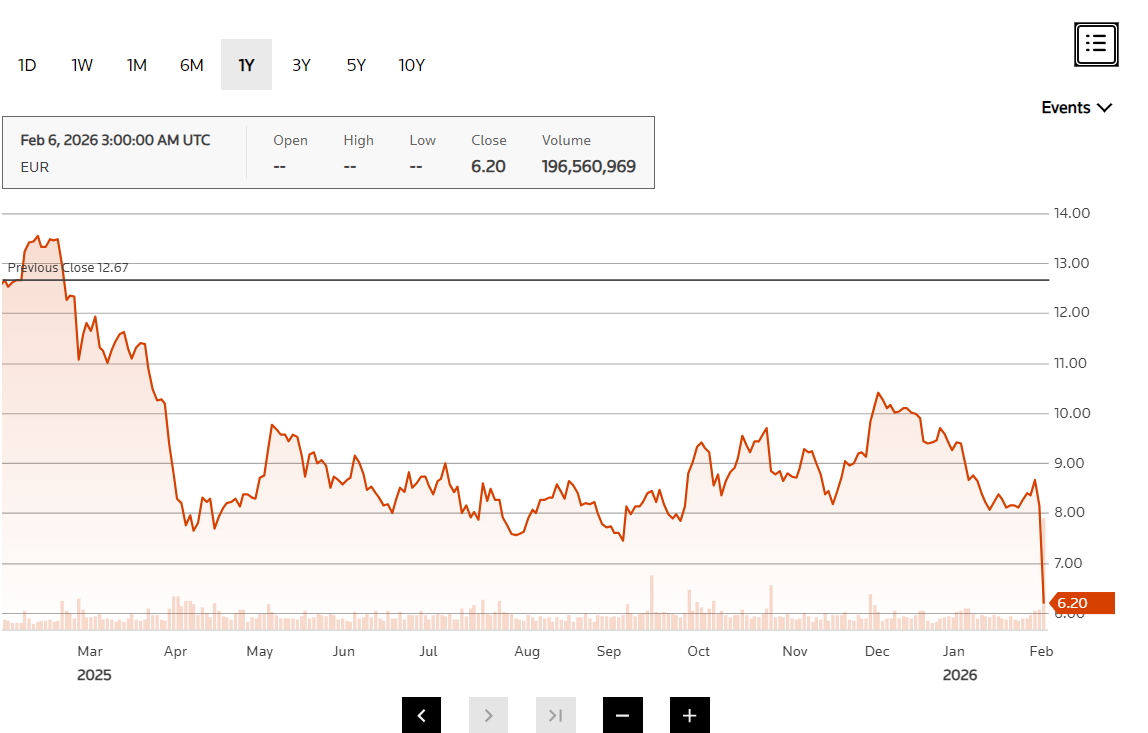
Oh - and speaking of “gripping a turd hard” … Stellantis is insisting on making it elbowing and shinkicking into our little list:
… losing 25% cap in one day, 50% in one year:
Would you stop giving AI answers as “facts”? I have no idea to the veracity of this one, but so many times I have seen the Google AI results be just completely 100% wrong that just taking them as truth when you don’t know any better is very dangerous.
Much less so, as I understand it. It appears that Chrysler sells few cars outside of North America.
Chrysler’s parent company, Stellantis, is European, and as far as I can tell, focuses on their other brands (Peugeot, Citroen, Fiat, Alfa Romeo, etc.) in the rest of the world.
Yeah. The history of Chrysler & what became Stellantis is complicated.
I never understood why any EU-based company wanted to buy Chrysler. It was rustbelt wreckage that could only have drowned any EU outfit smaller than VW. But some I-banker someplace sold some execs on a huge payday for them if they’d lumber their current employer AKA victim with a cast iron albatross. And here we are.
My WAG: they bought it for Jeep (and, maybe, for Ram Trucks). Just as, forty years ago, Chrysler bought AMC entirely because of Jeep.