Yeah, thats the question, what do they spend the higher taxes on.
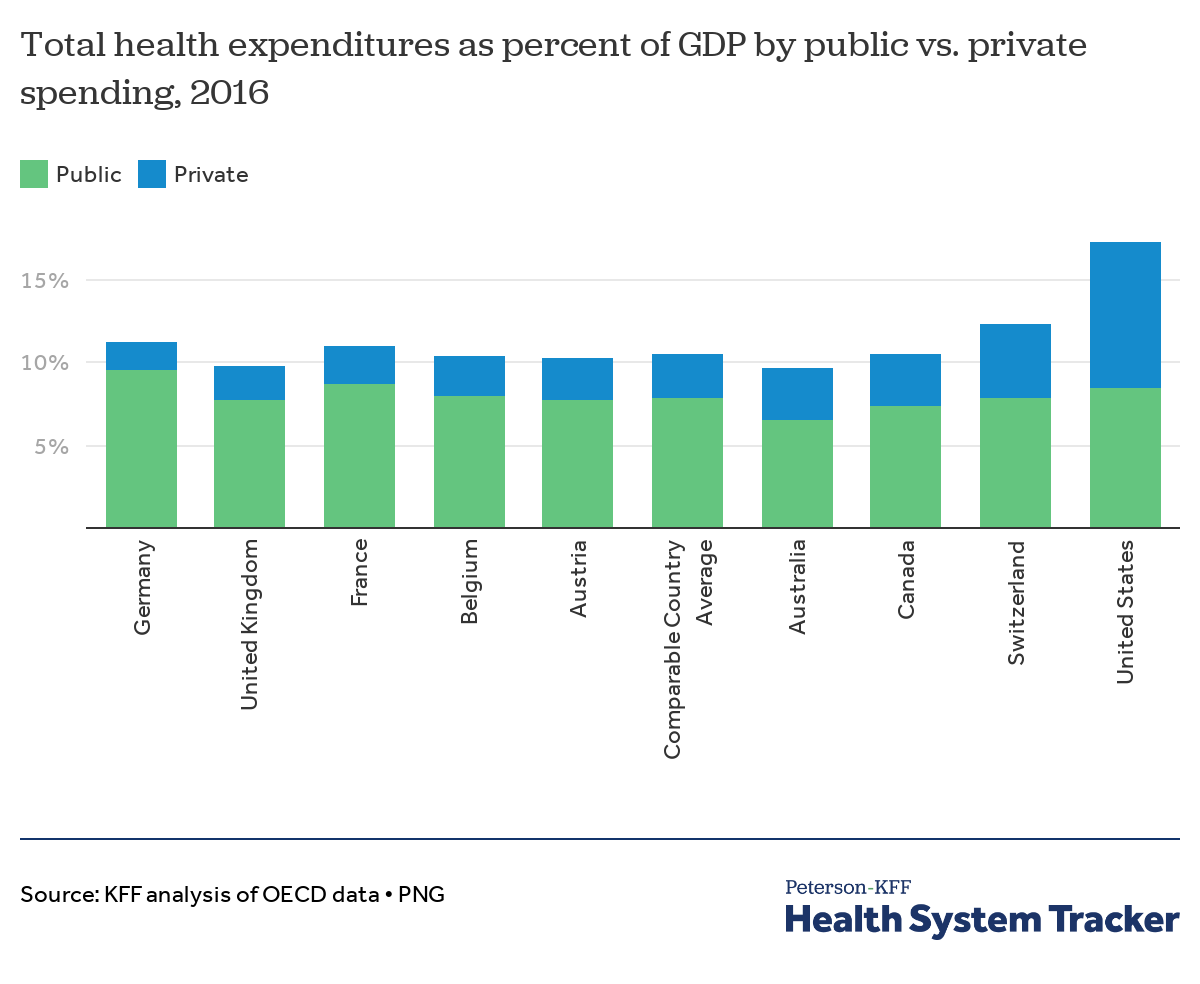
I never wanted to debate UHC. I said UHC wasn’t the reason, because spending is about the same. We all spend about 8% of our economies on public sector health programs funded via taxation. France, US, Canada, Germany, UK, etc.
I still don’t see how comparing taxes to GDP is wrong. An economy of 20 billion spends about 30% of their economy on pubic sector things, another nation wtih a 2.5 trillion GDP spends 46% of their economy on the public sector. Granted per capita income is not the same, but places like Australia, Denmark, Sweden, etc have a per capita income on par with the US.
Either way, I still am not sure what these other nations are getting for their higher taxes. It isn’t UHC (they spend the same as we do). Free college is a drop in the bucket. They spend less on military. Their R&D spending is lower too (but I’m not sure how much is public/private) I don’t ‘think’ its public sector infrastructure spending. I’m guessing social welfare is part of it, but do european nations spend 10% of their entire economy on public sector welfare on top of what the US spends (we also have a social safety net, just not as robust).
But they don’t spend more of their taxes on health care.
In America we spend about 30% of our economy via the public sector, and about 8% of our economy is public sector health care programs.
In France they spend around 46% of their economy via the public sector, and about 8% of their economy is public sector health care programs.
For every $100 in economic activity in both the US and France, each nation collects about 8% as tax revenue and uses it to fund health care programs. So the fact that France collects and spends about 46% of their economy as taxes while the US is closer to 30% doesn’t come down to the fact that France has UHC.
Also Brawndo has electrolytes. Its got what plants crave.
Again, you cant seem to stop comparing GDPs, when you asked for and need to compare what they spend their TAXES on. You cant find a cite that compares taxes?
Compare** taxes**, not GDP. That is what your Op asked for.
In Canada, welfare is a provincial responsibility. The pay is terrible, but…
In Ontario, the most basic welfare program is Ontario Works. They pay about $700 CAD per month for a single adult who is not considered disabled by welfare standards. The only large restrictions are you must be very poor (there’s an asset test and an income test) and there is no time limit. One CAD is worth about 75 cents US.
That’s not enough to live off of, unless you have subsidized housing, or a roommate, or live with family. Some welfare recipients are homeless (you just need a mailing address).
Note the lack of restrictions. Single employable adults can get on welfare in Canada. Single parents (probably the largest group) can barely make it because of this plus the child tax benefit (see below).
In the US, most states have General Assistance, which often pays as little as $200 per month. Most states (even California) put restrictions on these, making it nearly impossible to get on if you are a single employable adult. The federal government also has non-cash programs such as food stamps, which makes any sort of apples to oranges program difficult. It’s possible the typical American welfare recipient might be as well off as the typical Canadian recipient, but Canada will accept many people on welfare that the United States would not. That costs more tax revenue.
I did a quick check on the numbers for single people on SSI (US) and ODSP (Ontario, Canada) and they’re about the same once you correct for the exchange rate.
Canada has a federal child tax benefit. In the US, there’s a credit (some of it refundable) for families with children that could be considered an equivalent. A really long time ago the Canadian benefit worked the same way, but now it’s a monthly payment. Families making more than about $170,000 or so will not get this benefit, which means families making a median level of income would get this benefit. Unlike welfare, this automatically increases with inflation.
This is the United States equivalent:
I used the Canadian government’s benefit calculator to estimate the child tax payments for a family making a median income (I set this at $80,000 per year, the median is between $72,000 and $80,000), and assumed one child under six and one over six. The annual amount is $6,623.28 (roughly $5,000 USD), a little over $500 per month, or roughly $375 USD. A very poor family with one child would get a similar amount (at least $450 per month, and there might be some provincial funding as well, which comes out to at least $5,400 CAD or $4,000 USD per year).
The Canadian child tax system does not support adult children.
Quebec has its own child tax system (which overlaps the Canadian federal system) and they have an extra bonus:
Quebec (which has an even higher tax burden than the rest of Canada) has a really cheap daycare plan.
Assuming 260 business days that must be covered, that’s an annual cost of $1,898 to $5,200 per year. Obviously that’s subsidized, as no daycare could operate on such low levels of income. Taxes are paying for that.
Canada and practically every other wealthy country have paid maternity leave, with the US being one of the very few exceptions. However, this might be a case of apples and oranges. In Canada, maternity leave is a type of unemployment benefit, which the mother had to pay into beforehand. In addition, there is parental leave for after the baby is born, which either parent can take advantage of… but that’s also paid out of unemployment insurance. I understand that, in general, the government brings in enough money (they update the rates every year, sometimes downward) but in some specific areas, such as self-employed maternity/parental leave, the program costs more than it pays out!
Canada has a pension system that is … different from that of the States. I wouldn’t call it better paying, just more forgiving. The American system (according to this link) pays an average of $1,400 per year: What is the minimum Social Security benefit? Depends on career length
I tried to Google how much Social Security you could expect if you never worked but couldn’t find an answer. I could swear I saw an answer of $4,000 to $5,000 before, but my memory isn’t that great when it comes to numbers.
In Canada, almost every person who reaches 65 is entitled to Old Age Security which pays a bit under $7,000 per year. This is based on legal residency and how long you were here, so if you were born in Canada and didn’t live far away for decades you will get the maximum. (If your income is high, part of that gets clawed back.) But… most Canadians collect the Canada Pension Plan upon retirement, which cost about 5% of your paycheque when working and pays about 25% of your average wages (subject to all kinds of minima, maxima, etc).
The average CPP benefit is fairly low:
Even combined with OAS that’s only about $15,000 per year, each.
I understand that Social Security takes more but also pays more, which is why I say the Canadian system isn’t better paying. I wonder if Canada is unique in how little is collected and paid. (I took a look at the German system. Compared to Canada, they take more and they pay more.)
So what if you never worked? You can’t live off $7,000 per year. But you can (barely) live off of $16,000 per year. The federal government pays the Guaranteed Income Supplement, which pays up to around $9,000 per year, going down at a rate of 50 cents for every $1 of income beyond Old Age Security (this includes the Canada Pension Plan). Unlike OAS and CPP, GIS is based on your family net income. A retired couple would get about 1.5 times that amount, not double that amount. Unlike welfare, OAS, CPP and GIS are guaranteed to increase with inflation or the consumer price index.
GIS is notably higher than welfare payments. Homemakers will still get something, even if their spouses left them with nothing. Welfare recipients will see their income go up compared to when they were employable. People who were disabled and couldn’t work will get something, though OAS/GIS seem to pay not much more than provincial disability would. Old Age Security and the Guaranteed Income Supplement come entirely from general tax revenues.
Wesley, you keep saying this but it’s not a real comparison. Overall, the US spends 17-18% of GDP on health care (and growing). Other nations with UHC may spend 8% - good for them - but you can’t just throw out the part in the US that covers private spending. Let’s look:
USA public: 8%
USA private: 9-10%
Other Nation: 8%
The second nation is covering with 8% what the US is covering with 18%. So that does count. It’s much more efficient and covers more people in more ways. To just say the US spends 8% of public funds on healthcare is to commit and enormous exclusion from the data. This allows for more spending elsewhere.
Using France as an example - first one that popped to mind, I spend time there through family - let’s look at Education.
US: roughly 70 billion
France: roughly 78 billion
So with a smaller population (310MM vs 67MM) France spends more and more per capita. And taxpayers get more out of it. If the French had our educational system they’d riot and shut down Paris for months until it was resolved.
There’s also the matter of interest payments. France’s tax abatement is (in 2019) about 138B while the US is $325B.
It’s not a matter of spending, it’s what they spend it on and how much other spending is included. We may pay less, but we also get less and have to tolerate having government shuffle off expenses onto the backs of private citizens.
I’m a strong supporter of UHC and would support medicare for all in the US. However health care isn’t what other nations are spending all their extra tax revenue on since health care is cheaper in other nations.
I really don’t see why people are making this argument. 8% of our economy is collected as tax revenue and used to fund public sector health plans. Same as France, UK, Italy, etc. Yes in teh US we also spend another 10% privately, but that doesn’t explain what France does with its 46% tax rate vs the 27% tax rate in the US.
Also your education figures are way off. The US spent $706 billion in public funds on K-12 seduction in 2015.
I don’t know the figure for public college, but I’m assuming its around ~200 billion in public funds to fund public colleges and universities. So thats around ~900 billion in public funds to fund education in the US, about 4.5% of GDP.
I mentioned earlier, the following are rough estimates for public sector spending in various areas as a % of the economy.
5% social security
8% public health programs
3-4% military
2% infrastructure
4-5% public education (public K-12, in state college, etc)
The US spends about ~30% of GDP on public sector initiatives. Of our 20 trillion economy, we spend about 6 trillion in the public sector, funded by taxes. Pensions for the elderly and disabled, health care, military, infrastructure and education are big ones. Those come to about ~22-24% of GDP.
France has those same things, but collects and spends 46% of GDP. What is France spending the extra ~20% of their economy on? Does welfare for the poor really take up 20% of the economy? I find that hard to believe.
At the risk of an almost tautological oversimplification - France has a much larger (proportionally) public sector than the US. The French public sector represents more than half of GDP, including the same stuff as the US (education, military, justice system), but also a lot of stuff that’s private sector in the US. Examples - a large share of utilities, the largest telco, a huge public transportation network, large parts of extractive industries etc. This can be through outright management, where employees of an industry are civil servants, but also through ownership and investment in “private” corporations, where the state is a large or majority shareholder. The ‘safety net’ represents about half the budget (mostly pensions), the aforementioned public investment a quarter, closely followed by education then military.
On the other hand, over recent years successive French governments have been gradually trying to shrink the public sector, partly for budget balancing, partly as a backdoor way to transfer public wealth to their supporters. For instance, the state is currently floating an IPO for half of “Française des Jeux” which is basically the lottery plus a state monopoly on various other gambling products.
And purely anecdotally, this wealth transfer to supporters system also works in the other direction. In a notorious case a few years back, the french state bought out a failing fast food chain at a gross overvaluation - said fast food chain happened to belong to a friend of then president Nicolas Sarkozy Link in French for the seriously motivated
The UK spends well over 50% of tax revenue on welfare, health and state pensions. Education is another 13%. The figures do not include indirect taxation though: Sales taxes (on most non-food goods) are 20% and there are local taxes which fall far short of the total needed to provide local services (made up from general taxation). Fuel is heavily taxed with around half the £1.20 we pay for a litre going to the government.
A worker on £30k ($38.5k) would pay around £6k ($7.7k) in direct tax which would be deducted by their employer. Local taxes are typically around £1800 per household.
Since the entire thread is about public spending, not only can you throw out private spending, you must throw it out.
OP isn’t asking that complicated a problem people. But it gets complicated if you insist on on answering a question you’ve made up instead of the one being asked.
But the question has been answered. That apparently some people won’t be convinced until they get an answer indicating that some governments spend their budget on rainbow ice cream pooped by unicorns will not change reality.
No, people have answered different questions. Or offered guesses out of ignorance (e.g. you didn’t know or bother to check whether the numbers in the OP included state spending yet still felt compelled to post un-cited guesses with no numbers.)
But I suppose that’s the OP’s fault for not putting this on GQ.
So we know it’s not healthcare. Unsupported guesses thus far have included:
Welfare
Pensions
Education
Government ownership and operation of activities that are private here
Tax abatement
General safety net
Maternity/paternity/childcare/sick leave
Public transit
Infrastructure
Tax expenditures
Probably others that I missed.
And any and all need to be enough to counter anything we spend more public money on as a share of GDP. Like defense.
The biggest outlay in the Norwegian budget is pensions. And other social support.
There are two nice income/outgoings pie charts here. There is an English section, but it does not include the pie charts, so maybe google translate? If anyone has a similar thing for the US, it should make comparisons easier.
Those aren’t guesses, Ruken. If you want to take a look at the specific budgets of countries say so.
But I warn you: if you want to account for every penny in the Spanish budget, that’s several hundred thousand budgets, and they’ll be either in Spanish or in a more-obscure language!
Everyone is comparing % of GDP spent on healthcare, not % of taxes.
Yes, I know, % of GDP is easy to find, since the pro-UHC people (of which I am one) like to use that to show the USA already spends a lot of health care (govt spending, business spending and personal spending) so yes we could afford UHC.
But from what little i am able to glean, the nations with the Highest taxes do spend part of that on healthcare, but mostly a bigger better safety net.
It hasn’t. People have offered speculation but not as much concrete evidence.
Nations like Canada & Iceland, which are considered nations with a good social safety net spend 30-35% of GDP on taxes. Whereas nations like Denmark and France are closer to 45%.
As far as saying its because of things like electrical infrastructure in France, if that were true then people’s electric bill would be paid by taxation and people wouldn’t get electric bills. To my knowledge this is not the case.
I have no issue with a nation having higher taxes. I’d be fine with paying more in taxes (in the US) in exchange for medicare for all, more R&D spending, more renewable energy spending, free public college, mandatory paid vacation, maternity leave, etc. So this shouldn’t be a debate on whether taxes and government are good or bad.
I’m just curious what a nation like France or Denmark, where 45% of GDP is done by the public sector do with that money vs a nation like Ireland or Greece where it is closer to 30%.
Its still not relevant. If the US spends 30% of its economy via the public sector and devotes 8% of its economy to public sector health care programs, while a nation like Ireland collects 28% in tax revenue and spends 8% in public funds for health care while Denmark and France collect 45% in tax revenue and spend 8% for public health funds, that means places like the US & Ireland have about ~20% of GDP in public funds for non-health care issues while France and Denmark have 37% of GDP in public funds for non-health care programs.
So what is that 17% made of? A social safety net shouldn’t be that expensive, since most people aren’t poor. Also we have a social safety net in the US, even though it isn’t as extensive. Also nations like Canada have good social safety nets and they only collect about 32% of GDP as taxes. Germany has an extensive social safety net and they collect about 37% of GDP as tax revenue.
Free public college is cheap.
My impression is infrastructure doesn’t cost ‘that’ much either. Even much more extensive infrastructure should in theory only cost at most an additional 1% of GDP in public funds or so (based on the article I posted earlier implying EU spending should be increased to 700 billion, which would be 3.5% of EU GDP. So its lower than that, and not much off the 2% the US spends.