You can eat shoots from a garlic bulb/clove. Getting new bulbs from an indoor plant is unlikely.
Since my old Colocasia “Thai Giant” link is dead, here’s a viable one.*
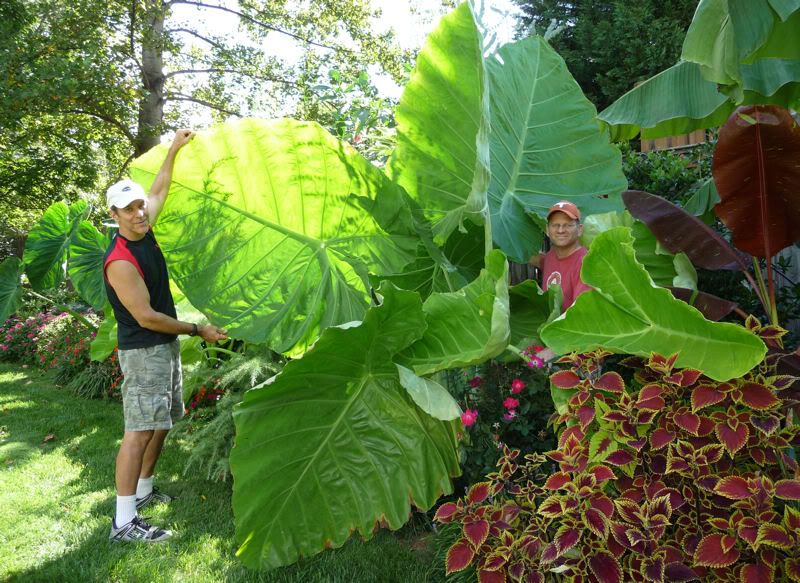
*waiting on warm weather to move my potted specimen outdoors.
You can eat shoots from a garlic bulb/clove. Getting new bulbs from an indoor plant is unlikely.
Since my old Colocasia “Thai Giant” link is dead, here’s a viable one.*
*waiting on warm weather to move my potted specimen outdoors.
3 days ago there was nothing. I had re-planted the frozen bulbs, I splashed a little water on the dirt every now and then and I left it by the window. It just sat there for three weeks, but now it begins afresh.
I think I’ll still call it Mauhihi. I thought maybe Son of Mauhihi or Mauhihi, Jr., since the original plant did lay down all its stalks and croak, and the bulbs looked like brand new bulbs and nothing like what I originally planted, but whatever. It still seems like the same plant to me.
I may experiment with leaving it in the smaller pot this time- maybe transplanting it led to it’s death? While it got quite tall last time, the root system didn’t seem all that deep and besides, it’s old pot is now occupied by baby basil. Since what I planted last time was supposed to be food and not a houseplant, I kind of expect a more splendiferous plant out of this iteration 
Years ago, I got an elephant ear bulb, and planted it outdoors (in zone 5b/6a) every year after frost. It would get HUGE, and then I would cut the leaves off, dig it up prior to frost, and store it in the basement. I also gave away offshoots. When I moved, I gave away the bulbs (or whatever they’re called) - and guess what? A rootlet must have been left behind in a pot of soil, and that little thing sprouted! I now have a bulb about the size of a fingerling potato. It would probably be larger, but I’m not in a place where I can plant it outside.
I grow my own garlic, and yesterday, I found a 1-pound bag of shallots for about $3 at an Asian grocery, and when it gets a little warmer, some of those are going to be planted too. Shallots are expensive because they cannot be machine harvested. I just hope the squirrels don’t dig them up. :rolleyes:
That’s a neat story about the elephant ear, nearwildheaven. This kind of plant seems very primitive to me, but OTOH they act like the toughest thing from Hawaii. We purposefully let ours freeze outside to kill the flies in the dirt. It seems not to have cared and is sprouting anyway. Why would a Hawaiian plant evolve to survive freezing?
If it grows at high altitude on the main island, it could possibly encounter freezing temps.
Taro is not originally from Hawaii. Some varieties are from southern India and southeast Asia, while others are from China. It’s possible that you got one of the Chinese versions.
But it may not be an evolutionary adaptation at all. The usual way that freezing temperatures kill plants is by the water in the plant tissues turning to ice and bursting the cell walls through expansion. It’s possible that taro is resistant to this for reasons other than adaptation to freezes. It may be that the root doesn’t store much water, and that this helps it survive freezing temperatures even though it doesn’t have to in its native climate.
Those in plant catalogs are generally USDA zone 6.
I wonder if the oxalic acid in the plant acts as a kind of antifreeze? Ethylene glycol (actual antifreeze) breaks down into oxalic acid and something else that I can’t remember at the moment in the body (which is one reason that it’s toxic).
If you’ve seen the “Dirty Jobs” episode where Mike Rowe plants taro, he’s introduced to a plant part called the apical meristem. I had no idea how that was spelled until I saw a post on Facebook from someone who used this as their username. 
I planted garden store elephant ears last spring and they were my most delightfully successful garden addition. The huge lush leaves are really eye catching and sort of shake their heads no in the breeze.
Pic 1
Pic 2
After buying them for big bucks, I was reading about their care and learned that they are (might be? Read contradictory explanations…) the same as grocery store taro. I got a couple a few weeks ago ($.99/lb) and noticed they had tiny buds after sitting on my kitchen counter a while. I planted them last weekend in pots to get started indoors but will transfer to the ground when the frost risk clears. A little tropical grove under my pine tree would be cool.
I don’t know much about taro, but often bulbs and tubers don’t like being transplanted while in growth, and will go dormant. If you don’t realize it’s stopped growing you might continue to water and fertilize hoping it recovers and all that happens is it rots because it isn’t using the water and fertilizer.


