My favorite is a little cup next to the cash register of a convenience store in east Texas. It said “Penny’s.”
Welcome aboard the SDMB, spazurek. Unfortunately your post contains some contradictions and fallacies.
First of all, it is nonsense to suggest that the only people who should be expected to understand the apostrophe are members of an aristocracy. You have no reason to assume that those you describe here as mavens are members of some self-appointed elite. Universal, free education has been available in my country for generations. The fact that more mistakes are being made in public use of English is not evidence of increased democratisation of the language, it’s evidence that a standard that had already been applied very widely has been allowed to atrophy through a gradual impoverishment of educational method.
You don’t need to read a book by Steven Pinker to understand that language evolves with use, but reduction into chaos is not evolution. At least you acknowledge that grammatical ambiguity is a problem. Then how do you suggest that such ambiguity is to be avoided other than by the application of conventions upon which the reader and writer can both agree? Whether you like to call these conventions rules, and whether they emerge from academic sources or by democratic consensus is immaterial.
Thanks for the reply, everton. Let’s see how I do in defence.
You refer to the fact that universal free education has been available for generations. You wouldn’t seriously argue that education was equally available to all in the 1950s, would you? Someone who dropped out of school to support their family, or who graduated in a district with few resources and correspondingly few committed teachers, just didn’t appear on the scene of public discourse at all; their grammatical inadequacies simply didn’t show up. The fact that societal and technological changes give some of these people a voice they never had before is not ‘atrophy’, it’s progress. If that means ‘teachers’ vs. ‘teacher’s’ goes the way of ‘thou’ vs. ‘you’, so be it.
The beautiful thing about language is that it evolves. If an ambiguity arises in a language because a grammatical distinction dissolves, the speakers of that language find a way to resolve it. And when a rule serves no funtion (could anyone ever thing ‘the cow’s are in the field’ meant the possessive?), it atrophies as it should.
The main reason I cringe at these sorts of grammatical nit-picking is the classism inherent in it. Let’s face it: violators of this rule are not by-and-large stupid or lazy (reasonable grounds for criticism), but ill-educated and/or non-native speakers. If you want to use grammatical violations as a beacon for where to re-distribute educational resources, great. But if you want to start drilling everyone in the policies governing accepted use of the apostrophe, don’t expect civilization to be stronger for it.
Nope - any word ending in an “s”, singluar or plural.
Nope - any word ending in an “s”, singular or plural.
Well, you’ve been taught wrongly.
According to Harbrace College Handbook, both the 4th and the 11th editions, the following is true:
"1. Ue the apostrophe and s for the plural forms of lowercase letters and of abbreviations followed by periods.
-
When needed to prevent confusion, the 's is used for the plural of capital letters and of words referred to as words.
-
Either 's or s may be used to form such plurals as the following: the 1900’s or the 1900s; two bs or two Bs; her and’s or her ands; his 7’s or his 7s; the &'s or the &s; the VFW’s or the VFWs."
(I have quoted from the 11th edition only.)
I also object to the misuse of quotation marks. An article in our local newspaper once said, “Students are home today but teachers are at school ‘working.’” To me that sounded as if we weren’t really working at all. I wonder how the editor of that newspaper would have reacted if I had published an article that said, “I saw the editor of the local newspaper leaving the hotel with his ‘wife.’”
Quiz on Friday.
Another point to consider is that this is a message board and not the “London Times” or “National Review”. The point you make about the people who violate these rules being ill-educated was my point also. And this makes me sad. When I grew up I went to an American Elementary School and Junior High School (and was in the gifted and talented program). From there I went to a German High School (the Deutsche Schule Washington to be exact) and the difference was like night and day. At the German School we were not just taught basic rules of grammar and spelling (in three languages mind you, because next to German and English you were obligated to take one other foreign language, with the choices being limited to French or Latin), but the general education we were given was at a much higher level than that of any American High School I knew of. In Math we started basic calculus and trigonometry in tenth grade. In Social Studies we spent half a school year on the Weimar Republic alone (focusing not just on Germany, but the state of other countries at this time also). We were obligated to take American History (I became fascinated with the War Between the Sates at that time). We were obligated to take at least one General Science class (with the choices being between Physics, Chemistry and Biology). In addition you were obligated to take either Art or Music.
I was sometimes surprised at the lack of general knowledge in my friends who went to American High Schools. They were very intelligent people who knew a lot about what they were doing in school at that time, but they didn’t have any general knowledge. It was like they were being trained to become what we in Germany call “Fachidioten”. These are absolute specialists who might be able to explain Einstein’s General Theory of Relativity to you in great detail, but then they would draw a complete blank if you mentioned something like “appeasement”, “Sudetenland”, “correct use of the apostrophe”, “Ovid”, “Schubert”, or “Matisse”. I had people seriously ask me if there were still Nazis in Germany (well yeah, there even are some in the U.S), and if we had cars (Uh no, those Mercedeses, BMWs and Porsches you see on your roads are built for export only. We use horse drawn carriages). These people were not joking!!! Now when I look at what I see in the American Media (Internet, TV, Movies, Newspapers, etc) it’s like the people are being dumbed down even more. Hell, the president can’t even say the word “nuclear” correctly. The German populace wouldn’t even vote for someone that pointedly stupid. You can say what you want about Tony Blair, Gerhard Schroeder, etc, but they seem like absolute geniuses compared to most American politicians.
The country I can most compare this too is Brazil. In Brazil there is an elite who has the means to get a good education, while the great masses can be considered barely literate. In my opinion the US is moving more and more in this same direction. With the possible caveat that even someone from a poorer economic background still has a chance in the US, while they probably don’t in Brazil. But it seems most people in the US don’t care about their own education anymore. I think the thing that makes this the clearest to me is how seriously some crackpots who won’t leave thier homes without their tinfoil hats are taken. You never hear creationists whining about what children are taught in school here in Europe. I guess the point of my whole rant here is that the things I see going on with general education in the U.S. make me sad. It is almost like there will no longer be a “middle class” when it comes to education. We’ll have the brainiacs who go to M.I.T and Stanford, and we’ll have the great unwashed masses who’ll go on Jerry Springer.
Sigh I wish you’d been there when I was having this argument, Mycroft.
Ahem. The current President of Brazil: http://www.brazil.org.uk/page.php?cid=1394
What are the chances that someone from that background could become President of the United States?
Probably very slim. The thing is that Lula most likely won because of this background and not despite of it. I think the people were just fed up with his predecessor Fernando Henrique Cardoso (or FHC for short) even though most of his policies and decisions were sound. In fact Lula has already said he’s not going to change them as much as some people expected. This may be one of the main reasons the Brazilian Real is on the rise again, after dropping to more than 4 Reais to the U.S. Dollar before the elections. Also, it took Lula four tries to finally beat FHC. He had a realy strong backing from the Unions which are quite powerful in Brazil. Plus, most of the population of Brazil has a similiar background to Lula, and I guess they just decided to finally vote for one of their own. FHC was definitely NOT one of their own.
But one thing Lula is definitely not (despite his background, I guess) is stupid. Heck, he’s probably a lot smarter than “Dubya”. And I don’t just mean street smarts. Lula made the most of the opportunities available to him, to educate himself. Then again, maybe I should point out that there is an error in the article linked, so I guess the Brazilians are stupid too. They say the following:
“When he was 7 years old Lula sold peanuts, tapioca (a typical Brazilian sweet made of coconut) and oranges on the streets of Guarujá.”
Sorry, but tapioca is not made of coconut. Tapioca is made from the pulp of the Mandioca tuber, which is then heated on a skittle like a pancake and can be filled with sweets (like coconut), or other things (I personally prefer tapioca filled with a nice cheese like the Brazilian
requeijao.
[Homer]
Hmmmmmmm…
Tapioca com requeijao…
[/Homer]
Sorry, I’m hungry now, so I’ll be back in a while.
There’s a risk that this might look like “picking on the newbie”. Please accept my apologies if it does spazurek - I don’t mean it that way.
Although it’s true that the standard of education was not uniform amongst all schools here in the 1950s it would have been unusual for a person to leave school to support a family before they’d been exposed to the basics of grammar, including use of the apostrophe. Written English has always been a core feature of primary education, and traditionally, basic literacy and numeracy would have been taught even if nothing else could have been. Much of this thread has involved arguments about the more exotic uses of the apostrophe, but of course nobody need feel that the average guy in the street should concern himself with the darker corners of the Chicago Manual of Style. The sort of mistakes I’m criticising here are those found on menus, placards, advertisements and public signs of all kinds. These wouldn’t have been restricted to a highly educated class in the 1950s any more than they are today - they would always have been written by people with at least a basic level of education.
It’s hard to find cites online to indicate that standards of English used in such instances have declined over time, and relying on anecdotal evidence alone is frowned upon in the GQ forum. It’s also true that conspicuous errors have been made in the past, such as in the railway name plate ffabris mentioned earlier.
However, the compulsory leaving age for pupils in England has risen from 12 years in 1899 to 15 in 1944 and 16 in 1970. Logically one might have expected to see an improvement in the general standard of education over time, and I have no doubt that that has happened in certain subjects, but my perception is that there has been a severe decline in written English since I received my primary education in the 1960s and '70s. If Mycroft’s experience is typical, the general standard in US schools may always have been lower than in European ones, which is very sad if true.
But jjimm has drawn attention to the fact that ignorance of basic grammar and punctuation can even been found in serious newspapers. That would never have occurred in the 1950s and while we might debate the reason why it is occurring now I find it impossible to accept that access to jobs in journalism has increased significantly amongst people who failed to complete secondary levels of education in English. This report says that new technology may be partly to blame, but my argument is that the educational standards themselves have fallen.
If the elimination of a distinction between teachers’ and teacher’s meant no loss of clarity then I agree it would be no worse that the change from ‘thou’ to ‘you’, but I don’t accept that to be the case. Furthermore I am certain that this loss of clarity does not reflect any functional obsolesence in the standard use of the apostrophe. For that reason I don’t believe it forms part of the harmless and customary flux of English usage. Not all changes are changes for the better.
As far as ‘the cow’s are in the field’ is concerned, I’m sure we could all think of examples where the intended sense is transparent in spite of the error. The same could be said for spelling errors. But we could also think of examples where misuse of the apostrophe would result in ambiguity - that’s the real reason why a convention developed in the first place, not to massage the egos of the classical elite. You say that “If an ambiguity arises in a language because a grammatical distinction dissolves, the speakers of that language find a way to resolve it.” My argument is that the only reason this distinction seems to be dissolving is because users of the language are being confused by widespread misuse of it, even in allegedly reliable sources. There is no need for them to find a way to resolve it, that way already exists.
No argument about spelling or grammar can be pitched as essential for civilisation, but that’s no reason to abandon the simple ambition of widespread excellence in standards of primary education. I’ve never knowingly criticised anyone who made mistakes in written English when it was not their native language either. I’m not accusing anybody of being stupid or lazy, I’m complaining that they are ill-educated (just as you agree), but also that that problem is worse than it used to be.
One thing I will say on an optimistic note is that the Education Department over here has acknowledged the problem and has introduced several initiatives to combat literacy and numeracy problems.
Quoth Walloon:
So we’re all in agreement, then, about how to use our ss?
What’s happening is that, while Cecil is no doubt winning the wider war against ignorance, he’s suffered a bit of a tactical reverse on this particular front.
To be honest, I didn’t read this whole thread. Is there still a General Question on the table after all that?
Don’t think so, Manhattan, but it is interesting nonetheless. If you moved every answered GQ to discussion or GD, they’d get pretty messy.
As for the point of language evolving, of course language evolves. One of the side effects of the Internet making mass communication so simple and rapid is that the more obscure parts of the language that a lot of people don’t understand, not to mention differences between similar words, is much more obvious than in spoken word. Mistakes are simply more visible. For instance, I never knew just how little some of my close relatives knew of the language until I got e-mails and IMs from them. People I’ve known for 20 years without questioning their linguistic skills suddenly revealed themselves to make incredible mistakes in things as simple as “are” and “our,” much less more complicated parts of grammar, spelling, and word use.
Part of it is the nature of computers… we tend to type fairly informally, so swapping sentence structures, dropping punctuation, and the like are acceptable. Adding in shorthand and mickey mouse spelling (the ever-lovely “r” “u” “4” “skillz” etc) become more and more common. First, no one comments when people drop caps in shorthand. Second, people abbreviate everything, like I just did to “caps.” Third, you start dropping words you’d usually use, truncating sentences, using more terms that are more vague (Such as saying “Don’t know about…”). Fourth, people start dropping punctuation, or just misusing it.
After all, we get words that are mutilations of other words constantly… either imported from French or Spanish and beat into submission (Odd example off the top of my head, “ten gallon hat”)… hell, look at what Americans did with the “-ise” suffix.
I suspect a large portion of American adults couldn’t pass basic grammar exams these days. Foreigners studying ESL, on the other hand, are more likely to remember grammar rules, since they think about them when forming their sentences. I know I think a lot (another non-phrase that entered use) more about Russian or Spanish grammar than I do English.
As for it being important or not, spazurek, I think it is important to keep some attempt going at standards in grammar. The day I pick up Newsweek and see a headline like “President Bushes speech sez i told u so to canada and canada sez were not intimidated” is the day I snap and start taking people out with me. Grammar exists for a reason, and it isn’t to nitpick people on bulletin boards.
Not that I want to threadjack, but what is it about his background that makes him unlikely to become Pres. of the US? (Other than the fact that he is Brazilian, of course.  )
)
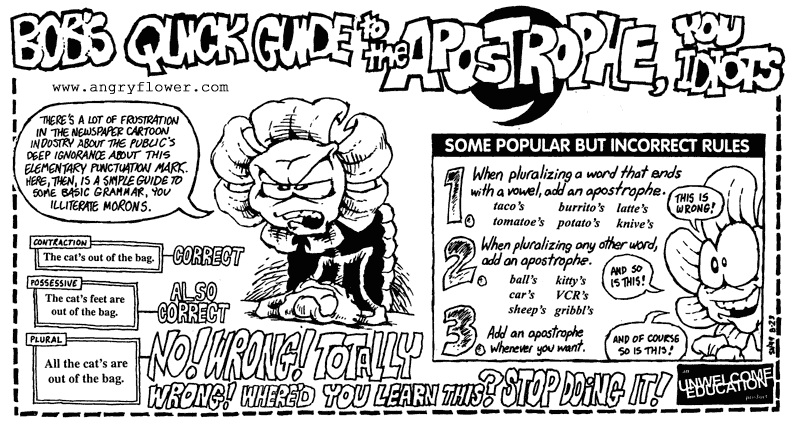
I think you guys will enjoy this:
Bob’s Quick Guide to the Apostrophe, You Idiots
What amazes me is that two different people have incorrectly spelled “apostrophe” in a thread about the apostrophe!!!
I think you made some errors here. It should be “prez dubya was all like i told u so to canada and canada was like duhhh were not intimidated beeyotch”