Highlights from a day at a busy watering hole in the Cretaceous era.
And the Jack the Ripper murders.
Both would be rated X for extreme violence.
Highlights from a day at a busy watering hole in the Cretaceous era.
And the Jack the Ripper murders.
Both would be rated X for extreme violence.
I think you need a stable spot to put all three legs of your tripod…
.
So many great events here, but this one got a chill running down my spine.
The crumbling of the ice dam that unleashed Lake Missoula to do its mischief would be pretty exciting.
Really, any early performance of any Elizabethan or Jacobean play would be awesome, but I think I’m going to go with either the first known performance of Measure for Measure in 1604 one of the two performances of The Merchant of Venice before King James I in February 1605. Reasons: 1) these are both verifiable events that definitely took place on a specific date, so there’s no ambiguity about whether there’s “compelling evidence” (like there would be if I picked Love’s Labour’s Won or something); 2) they’re both really interesting, tonally complex plays where people like to argue over how particular moments would have been performed, and how “comedic” or “serious” it’s supposed to be, and how the audience might have responded; and 3) we’d get bonus footage of a royal court in all of its holiday pageantry.
I’ll choose a sporting event.
I want to see Don Bradman batting in the Bodyline series of 1932-33. For those who do not know Bradman is probably the biggest statistical outlier in sport. He was a cricketer who played for Australia between 1928-1948. His batting average in test cricket (the highest form of the game) was 99.94. It’s been 74 years since his last match and the next highest batting average is 61.87. A load of great batsmen across history are in that 50-60 bracket but none have come close to Bradman. It is also worth noting Bradman missed out on a batting average of 100 in his final match when he needed to just score four runs in the second innings to get there. He was dismissed without scoring.
That final ball dismissal is on camera.
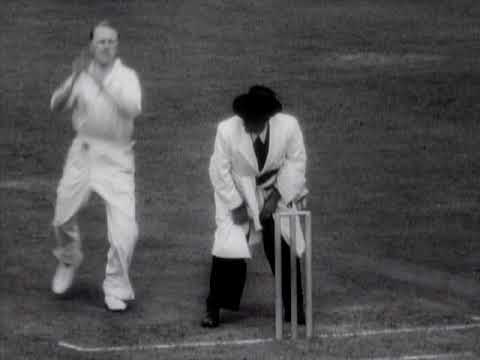
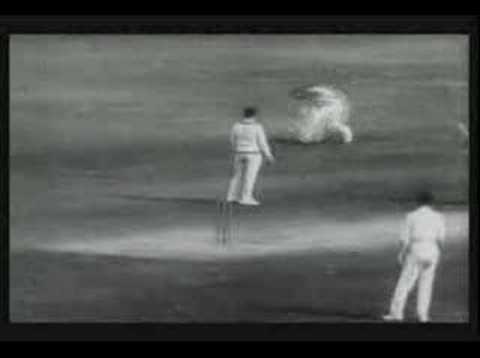
And there is some footage existing of him batting but it is only the odd shots captured for newsreels of the day. Nothing that shows ball-by-ball of his matches. That kind of coverage didn’t exist until long after he retired.
I want to go back in time and witness what the tens of thousands of people who packed the grounds saw when he scored centuries, double centuries and even triple centuries. I want to see the quality of his strokeplay, his footwork, balance, power and how it compares against his contemporaries playing in the same match, but also how it compares to the modern day. Was he so far ahead of his time that you could transport Bradman into the modern day and he would be world-class now? How fast were the quick bowlers? How crafty were the spin bowlers? Would a great fast bowler then be considered slow now? Was he just so far ahead of his peers in the sense that he was like a professional playing in an amateur era?
Those are the questions that fascinate me about Bradman. You cannot look down on his accomplishments even if you are a cynic about the standard of play in that era simply because if it were that easy why didn’t anyone else rival his statistics at the same time. And I specifically choose the Bodyline series in 1932-1933 because that was a tactic used by the touring English team to defeat Australia entirely to curtain Bradman. Bodyline was when the English quick bowlers deliberately bowled short-pitched balls that would rise aiming to hit and hurt the batsmen (no helmets in those days) rather than hit the stumps. That would intimidate, injure and inevitably dismiss the batsmen because even if they got bat on the ball in the split second you have to play a shot to a ball rising at chest height it leaves you cramped for room. It would generally only go in one side of the field which is called the leg-side (left hand side of the batsman) that is packed with fielders waiting for a catch. That tactic was hugely controversial, seen as against the spirit of sportsmanship, and became illegal.
Yet Bradman still averaged 57 in the Bodyline series. A long way down from his career average showing the English tactics worked (if Bradman took a big hit then naturally so did everyone else who had a much lower ceiling) but an average of 57 which was seen as a failure for him would be legendary for anyone else.
And Klieg lights. There were no photons at the BB.
I’d like a film of Nero during the Great Fire of Rome. Did he have a Bic lighter on him? And what was he fiddling? The Devil Went Down to Georgia?
That reminds me…I would like to see the massive waterfall that formed at the now Straight of Gibraltar to re-fill the Mediterranean Basin.
Oh yeah!
Abraham Lincoln delivering the Gettysburg Address. Really, any recording of Lincoln speaking just to hear what he sounded like.
The assassination of Julius Caesar.
My grandpa, who I was close with (the two of us would stay up all night drawing!), drove an ambulance.
Between the enemy lines in France at the height of World War One.
He’d never talk about it; so, needless to say, I’d love to see him in action.
That’s an answer I can get on board with. Viewing Cretaceous period life would be awesome. In fact, I may cheat and make my movie a series of chapters, each featuring a variety of periods extending back to the Permian era, with those strange-looking marine lifeforms (some of them are too wacky to have existed). 
It would be interesting to see just how close the artist-rendition depictions of prehistorical life compare to the real thing.
I’d want to be in the audience.
Field of the Cloth of Gold
Battle of the Delta
Coronation of Elizabeth I
Battle of Agincourt, including THE SPEECH.
I imagine it was similar to QE II’s coronation with similar pomp and circumstance.
Sure, but better clothes. That I want to see.
What did the Elizabethan era dog say about its collar?
“ruff ruff”
The Joffrey Ballet staged an accurate reenactment on the 100th anniversary that I attended. I was familiar with the music, but the dance was very, very different (and a bit repetitious) than what I was used to.
The sporting event I would like to see filmed was a basketball game played on March 2, 1962 in a small arena in Hershey, PA.
I’d like to see a microscopic film of the first (and only?) instance, and following 90 minutes, of abiogenesis on Earth, ~3.5-billion years ago. Seeing the emergence of life from non-life on our planet would be a mind-boggling experience, especially with a Pink Floyd soundtrack.