Huh. I’ve had many power outages, and a few, “can’t get out of the house due to snow” situations, but I’ve never seen a fault of the municipal water. I guess, a lot of nearby communities got a “boil the water” order. (I brought bottles of tap water to every event u went to for a couple of days.) But i can boil the water, or buy bottles, for a short event like that.
I keep bottled water for a lot longer than 3 months. Honestly, I’ve never looked to see if there’s a use-by date. I only toss it if the plastic is going, or i remember it being very very old.
(I don’t use a lot of bottled water. But i like the shape of the Poland Springs bottle as a reusable water bottle. So from time to time, i buy a six-pack. Then i use one of the bottles until i lose it, or it seems worn, at which point i dust off a new bottle and use that one. I drink the stuff in it the first time, then refill from various water taps.)
I’m not sure the risks are local anymore, but they’re some of the reasons we keep so much fresh water on hand. I wish I understood municipal water systems well enough to know how much an outsider can actually do. With enough info, could the system itself be damaged (and rendered inoperable) for days or weeks? Could hackers actually poison people this way?
If the system is damaged for a week (which has happened to nearby communities, and could happen to my water supply) people:
boil the water
get water from friends in nearby communities
buy bottled water at the grocery store
Demand for water is enormously elastic. The amount we actually need is a tiny fraction of the amount we use when it’s freely available. And some needs (like washing clothes) can be delayed by days with only minor problems.
It’s not that I’m sure my municipal water supply won’t fail, it’s that i believe i can make due for a week without it, without needing a personal water stockpile. It would be inconvenient, but less so than maintaining a week’s supply of fresh water all the time.
I thought there was a small risk of widespread problems when the calendar turned over at y2k. (And i intentionally only stockpiled 3-7 days of stuff, assuming that if disruptions lasted longer than that i was screwed, no matter what precautions i took.) And i worried about supply-chain problems affecting grocery stores during covid, and stockpiled enough stuff that we never had issues. So i did stockpile for those events. (Although i didn’t stockpile water during covid. I considered it, but didn’t see any likely path towards losing municipal water.)
But the events you point to didn’t strike me as likely enough to be worth stockpiling. Now, if my town lost water as often as it loses power, it would be worth it to me to stockpile water. Like i keep flashlights and candles in the house for power outages. But it would have to be somewhat predictable for it to be worth stockpiling water for me.
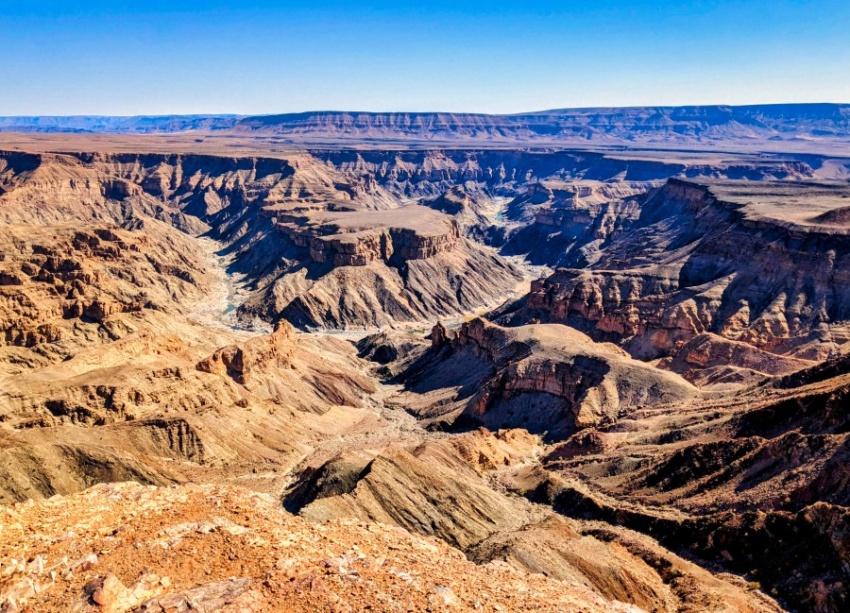
Not that I would recommend it for everyone, but I have happily survived for a week’s extremely hot and dry trek down Namibia’s Fish River Canyon* towards the end of the dry season when there was no running water at all… just some stagnant pools filled with muddy water. Half our group just drank it straight, the other half used fancy water filters. We all lived.
As for stockpiling, due to our 3rd world government, pretty much everyone has a small stockpile because we have had periods where water is running low, after a drought - and our key water infrastructure is ancient and leaky at the best of times.
But rather than address the infrastructure, the govt. from time to time in times of need, cuts off water supply to entire suburbs in order to conserve water…
I think some bottled water brands (such as Poland Spring) offer water in 25 fluid ounce aluminum bottles, although Googling, there is a polymer coating that might degrade. Some such products have a shelf life of two years or so.
That’s $37 for 2 1/4 gallons of drinking water, good for fifty years. You might instead buy bottled drinking water in gallon plastic jugs and swap them out every year or two. It would take a while before you exceeded the cost.