In spite of the view from your safe and secure tower, the sad fact is we have had capitalism taken over long ago. Most of this generation has never experienced competitive capitalism. Companies, gas stations and markets fought for business. Price competition was the norm. Marketers gave out green stamps or dishes to get your business. They fought teach other with price cuts and better service. They don’t have to do that anymore. Can you figure out why?
No you can’t. It would not fit into that narrow slice of distorted reality that you live in.
There is going to be a billion dollars spent on the next election. The bulk of that will go to TV and radio. Do you think they will fight for public financing of elections? Do you think they have an interest in keeping things as they are?
Since 6 corporations own almost all the TV stations. radio stations , magazines and newspapers, do you think it would be easy to get all views presented?
GE owns TV networks. Their stations never mentioned the story of the taxes they avoided. Odd isn’t it? Could there be a reason? Wasn’t it a big story?
They filter the news to their advantage. They all do it. Since they are owned and operated by the extremely powerful and wealthy, the people don’t get real news or the facts.
Hell the tea baggers are financed by extremely wealthy people. They are being used and played for fools. But they will walk into a voting booth and vote against their own interests. That gives you a distorted sense of fair elections. The people on top have no qualms about gaming the system. They have been doing it better and better every year.
emacknight:
In the past big companies ran things like gas stations, department stores, automobile factories, etc… but many of the things that people bought were made by small businesses, or individuals. Now that machinery and computers and technology exists… most of the things we buy (at least our big purchases) are all made by huge - overwhelmingly huge - corporations. Our needs have grown to want more advanced technologies, but this focuses more and more wealth into few and fewer hands (those that own the fewer and fewer big companies).
You would say that this is good, right? The big companies are more efficient? Do you believe there are any downsides to this? Don’t you think this naturally leads to corruption, manipulation, etc in both the economic realm and the political realm?
Isn’t it getting harder and harder to start up a business from scratch? Isn’t the barrier to entry getting higher and higher as technology and people’s demands increase? Is this good, bad, neutral?
Big companies are actually less efficient. They have more layers of management and everything takes longer. that is why IBM went outside to make their first PCs. They had to get it going in a hurry and knew that doing it inside was going to take longer and be more expensive.
Yes, I think I will continue to argue that less unemployment is better than more unemployment. I know you might disagree, but I think it’s good to have more people with jobs than fewer people with jobs.
I guess it says everything that needs to be said that you’re now saying that less unemployment is NOT better than more unemployment, when for months you’ve been complaining about unemployment.
But there are certain technologically advanced things that you need a large-sized company to make possible. Do you disagree? These large companies will concentrate wealth, lobby/bribe politicians, hire wage-labour… and be somewhat inefficient. But who else will make iPods, flatscreen TVs, automobiles, etc? There are certain markets that small companies simply cannot get in to.
ETA: And this will only get worse over time (or better, depending on your view): There will be fewer companies, and they will become bigger.
I believe that there is a difference between the sort of tariffs that Jaq is proposing and the sort of tariffs imposed by Smoot Hawley which raised U.S. tariffs on over 20,000 imported goods to record levels.
I am not saying that all big business is wrong or unneeded. You can not startup an auto company without a huge investment for instance. They of course should be closely watched by regulators.
I object when telecom companies are allowed to buy up their competition. Our cell phone coverage is being supplied by fewer and fewer companies. Try shopping around and see how much difference there is.
In some European countries their phone service and internet is far better than ours and costs a fraction. they actually have lots of companies competing. That is not the American trend. No merger gets rejected. They just keep swallowing the competitors up until all the coverage and costs are the same, high cost and poor quality. They don’t innovate either.
Of course with market concentration go political power. Our elections require huge amounts of money. The door opens for them to supply money for political power. The citizens power diminishes more every year. We are screwed.
But look at NASA. There can only be one NASA, since it costs so much. Technology is headed in that direction. Eventually you’ll have only a handful of companies creating everything of significant value - since the investment required will be beyond anything everyone else can put together.
What happens then? Doesn’t capitalism need competition to function well? Or if people are being taken advantage of by big companies, they can always just say no, no? I mean, you could just choose to not get a cell phone, for example. Of course that won’t work in practice, since our society is now formed around things like cell phones.
I’d hate to come to the conclusion that the only way to do big business is to let a company have a monopoly, and then have government regulate that monopoly. That just sounds terrible for so many reasons and on so many levels.
cite?
Smart Enterprise Exchange - This is not new. It has been discussed an cited many times.
http://www.billshrink.com/blog/5787/internet-penetration-costs/
You should have linked to this graphic, and then also understood that this is an AVERAGE. A more interesting graph would be one that parses the US into states or even further parses individual states. Something like this, perhaps.
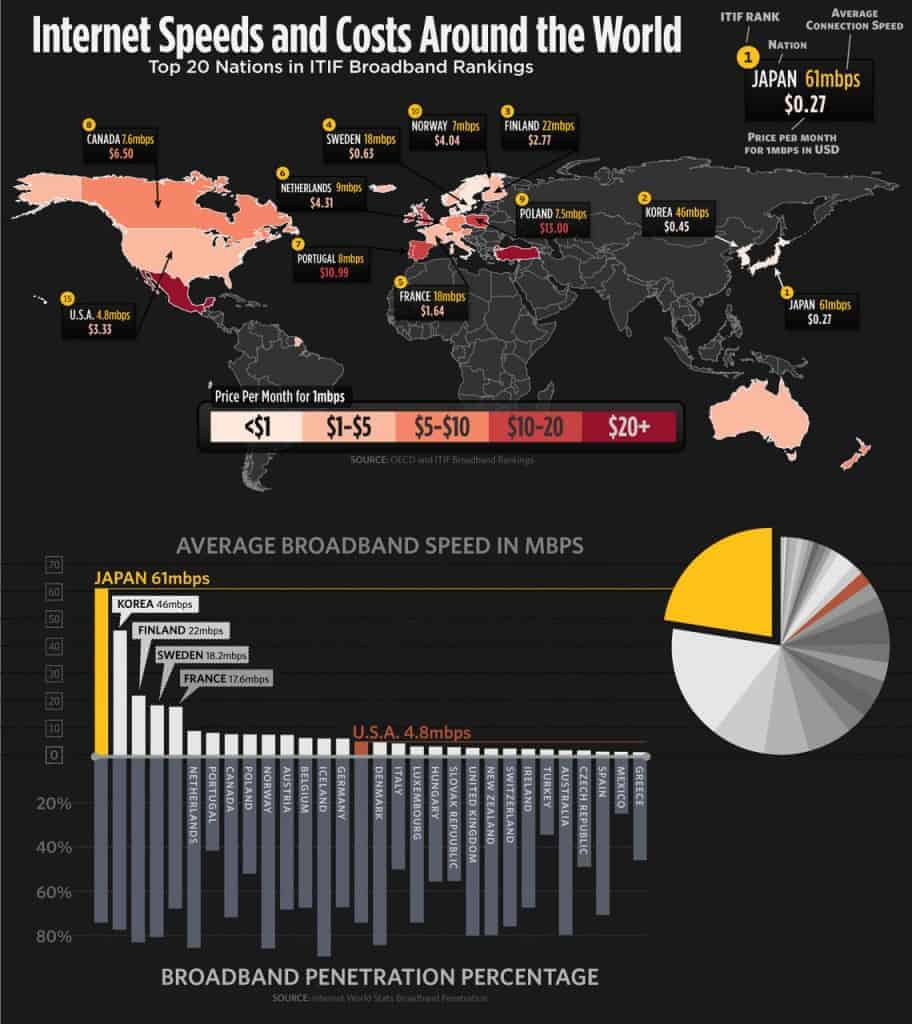
-XT
This idea of hitting reset, or redistributing wealth, hinges on the transfer of money from the rich (and perhaps financially savvy) to the poor and financially inept. You might as well skip the middle step and give the money directly to the State Lottery Commission.
It’s fine to the sympathetic towards the poor. I’ve spent 5 years working with non-profits trying to be more than just sympathetic. But creating a system of blame and deflection doesn’t’ help anyone.
So right now, if you took a survey of those earning less than 20%, handed them $1million, how many do you think could pick a profitable piece of land? How many would lose it all to a time share or swamp?
Again, I’m going to site 2002-2007 as an example of what happens when you let everyone buy what ever they want. The result is a few people get extremely rich, and the rest [let themselves] get suckered out of everything. Who the hell pays $300k for a shitty 1920’s 1.5 story??? You’ll hear me say that a lot because some asshole tried to sell me one in 2006 and although I feel a little guilty I laughed diabolically when I saw the same house struggle to get $40k at auction in 2008.
The lax lending standards between 2002 and 2007 are the best example of why there are rich and poor with such a large gap in between.
Let’s just say “empirical observation.” Those that were poor and given money remained poor. Those that were rich and lost money soon regained it. Reading Outliers will show you Bill Gates and Steve Jobs lucked out in their teens allowing them to become super rich. But they also had to maintain that. It’s not enough to just write one great soon, you need to put out another in 6months, and every year after that.
If you’re proposed ROR is less than 4% you shouldn’t do it, there is a reason “no one else will invest.” That should tell you something about the business you have planned. Granted, if your business can generate enough to pay you a salary (let’s say 40K) that’s a sweet freakin return, way above 4% (depending on start up).
Remember what we’re talking about: taking money from the rich, giving it to the middle class, so they can start a business. If I give you $100k in cash right now, and the current interest rate 8%, and you said you were going to start a business that will return less than 4%, I would slap you and take back the $100k. Why? Because you are going to lose money to taxes, then to inflation, and at the end of the year you will HAVE LOST MONEY!
In simpler terms, if I offered you a CD/bond/savings account with 8%, 4%, or 0% interest, which would you put $100k into?
Which is exactly why they don’t deserve to do it, and why no one will invest in it. They’re trying to run a charity and they’re not even going to be successful at that. A lot of people have been bitching about profits, but you need to have something in the bank for when things go bad. BP is paying out billions for that oil spill, which means they needed to earn billions in profits to cover that loss.
The second lesson from the financial crisis is that you can run on zero margin. If it takes all of your earnings (plus bonus) to make your mortgage payments you’re fucked.
Again, I’m going to say, if no one else will invest in such a business, it’s a pretty good indication that you shouldn’t either. Put your money into something safe and go work for someone more successful.
No, but your own admission you’d have crappy businesses returning less than 4%, which means no productivity and no efficiency. How is that business supposed to grow? Update? Weather a downturn? Next year they’ll need to replace something, anything, and they’ll have no cash to do it.
Except that business will always have an easier time leaving the country, by your logic it’s best to tax those that have the hardest time leaving, ie the middle class.
I don’t buy that. I’m sure most people say they want to work for themselves, but I’ve done it, my father did it, and it ain’t pretty. Few realize what’s actually involved, and most think you can run at zero profit.
We seem to have the same friends. A lot of them took layoff packages over the past couple of years to start their own business, and many ended up going back to work while running the business on the side. Those that continued all had one thing in common: spouse working full time and getting health care.
You don’t need to replace capitalism, you just need to fix health care and the rest will follow.
So what pill do you swallow? What I hear is a lot of people bitching that they can’t get capital, and so they settle to be a wage-slave. Truth is, their a slave to consumerism, hence the term “living pay cheque to pay cheque.” Like you, I have friends that get massive car loans, massive bank loans, massive mortgages, then complain they’re suffering to get ahead. If you want a pay raise but don’t feel like working harder, stop paying $120 per month on cable. And for the love of all that is holy stupid buying lottery tickets.
Americans don’t want stuff made in America, it costs too much. But all that crap is (was) designed in America. By people that went to school until they were 30. Then went back and got another degree part time.
I guess you could say that. My impression is that the US got extremely wealthy selling to other countries, and that changed. And currently the US hasn’t figured out how to make money now that other countries are developed and functioning on their own.
Again, the point of machinery isn’t to create jobs, it’s to free up labour and/or reduce the cost of production thereby freeing up capital. New jobs follow as the result of new labour and capital.
Old technology should be made obsolete, otherwise I have to make a cliched statement about banging rocks together.
If it helps, then yes. The invention of the tractor meant that it only took a couple of people to get more corn from an acre of land–way more than those few can consume. That means everyone else previously involved can sit around and eat corn for free if they so desire. It also means that they can spend the day learning engineering/science/art instead of harvesting corn. What some refer to as breaking the poverty cycle.
Stop saying lost, it’s depressing. Technology frees up labour and reduces costs.
No, people now have more to offer because machines are doing more of the work. Productivity is increasing. Americans (as **Le Jacquelope **will remind us soon) are the most productive people in the world, way more productive that people in China. Thanks to technology individuals are offering more. If it used to take 10 people to get 20 bushels of corn from an acre of land, it now takes 1 to get 80. That person has way more to offer now that technology has improved. So instead of getting 20 bushels we can now get 800 from the same 10 people. The problem you’re witnessing is that we don’t need 800, so 5 of those people need to do something else.
That’s one distorted view. What I’ve seen is that their land was ridiculously unproductive, frankly they just weren’t very good at growing stuff. They barely made enough to survive and it wasn’t even their land. Add to that a long rainy season and you ensure poverty for generation after generation. Your impression is based on the belief that everywhere else has agricultural productivity that matches the US. The result is really very different. You won’t see far equipment, you’ll see kids with stuff that looks like it’s from biblical times.
We shouldn’t feel good about buying crap from sweatshops. But we also should lie in the other direction and ignore benefits that exist. Not everyone wants to be a subsistence farmer.
Which is more your perception than reality. Tax revenue comes from the upper 5%, and frankly I don’t even know why we bother taxes those below $50k, it’s not even worth the cost of printing the tax form.
In conclusion: I’m all for taxing the rich (and upper middle class), but good luck figuring out where to redistribute it too. The way I see it, the rich are simply going to figure out new ways to get it back (ie lottery tickets). That’s why there are rich people and poor people.
The US is shooting for 4 mps speed in 2020. That is our goal. If we achieve it ,it will make us dead last on the international speed lists. Shooting for the slowest is not a great goal to aim for.
But 94 percent of America has access to only 1 or 2 internet ,cable servicers. That is not utilizing competition at all. Yet we placidly sit by when another provider buys up the competitors, claiming larger scale will make them provide faster and better service. Cable companies are always at the bottom of customer satisfaction lists. the service is terrible and will not get better. It has no reason to.
http://news.cnet.com/8301-13578_3-10317118-38.html
That’s not true at all. There is only one NASA because space exploration doesn’t make any money.
NASA, in the context of big business, is not exceptionally expensive. Last year NASA’s budget was $18 billion. That’s a lot of money, to be sure, but it’s substantially less than Wal Mart spends in four weeks. Toyota’s already spent more than that and then some this year. But those businesses have competition because operating stores and selling cars makes money. If you can spend $18 billion but make $19 billion, people wil lget into that peice of action. If spending $18 billion is guaranteed to lose money why would anyone do it?
Okay, I should have been more clear and precise. The middle class would not be left out of a redistribution. In fact, since there are more working middle class than rich or poor, they would get the vast majority of any redistribution. I don’t mean to focus on the poor, since they are a minority and need services more than they need raw cash.
(Many poor and lower middle class people work 70 hours a week, however, and I’m sure a bit of a raise in their earnings would help everyone involved. Those that would squander their money on lottery tickets are certainly in the minority.)
But the lower middle class who work long hours would get some extra wealth. They could start their own businesses, finally save up enough to get some retraining, etc.
If I open a restaurant and make only enough profit to pay myself 40k, that’s not a big return. Most (external) people wouldn’t invest in my business, if I could only give them a few thousand extra back (let’s say, for this example, 4%). Investing in mutual funds could give twice as much, and investing in safe GICs would give equal return with much less risk. But other people would also be employed, and receive jobs (and pay taxes).
If taking 0% meant I could still pay myself a modest 40k, and have my business exactly break even, I would most certainly take the 0%. Most middle-class people I know would do the same. I’d rather have my own business make me 40k than take a wage-slave job for 40k and invest some of that into 8% savings. People want to work for themselves.
You see, people would invest their own money in their own business, even if it just broke even (and paid them a modest “salary”). But I’d never be able to convince a stranger to invest in my business. If the going rate is 8% interest, then they won’t give me any money if I project anything less than that.
But businesses that have a lower rate of return still:
- let me run my own business and pay myself, instead of working for another person (even if my income decreases as a result)
- keep my extra profit for myself, if I want to (if there is any in the future)
- hire other employees, and offer a service to the economy
“They don’t deserve to do it”? Seriously? Heaven forbid capital helps people out, instead of maximizing some vague faceless “economy”! The economy should function so that it best serves the populace, not the GDP.
Are you suggesting that a 4% local business that pays it’s owner 100k, and has 10 employees, is a “waste” when you could have the option to invest in an 8% megacorp that pays people minimum wage and funnels money out of the country and into the hands of a dozen filthy rich individuals?
It may be a waste for a faceless investor… but in the case of redistribution, the investor would be the individual citizens themselves, and many would take much less than 8% if it meant they worked for themselves.
Also, what are you talking about with regards to “zero margin”? Do corporations have savings in case of trouble? I thought they just get loans and refinance their capital? Please clarify your comment.
I don’t want to. Many people don’t want to. People want to reap the rewards of their own work (especially in case it turns into a 50% return). Why would I work for someone else… when if my good work results in THEM making hundreds of thousands of dollars and not me?!?
-
In general, those that make it to the top in 5-25 years are more there because of skill and ingenuity, than those that are there right now, who are just riding the momentum, and slowly killing their own companies.
-
In regards to my other example, a 4% business that pays me 40k+ isn’t crappy to most people, especially if they could only make 40k working for someone else (who is making profit of them to boot). If there’s a downturn, I’ll deal with it the same way larger companies deal with it.
2b) Why does my own self-run business, with for example 3 employees, need to grow? Why? Can someone please explain this economic need for continual growth? I never took more than a couple economics courses, so I don’t understand. If the business pays me and my employee’s salaries, then why does it need to grow? Why does it need to pay 8% instead of 4%?
Companies that can be taxed, should be taxed. Rich individuals should be taxed as well. The lower middle class should be left alone. You mention 50k somewhere below. I agree this is a good place to draw the cutoff line.
I don’t know how to argue with that. Most people I know, friends, acquaintances, people from elementary school up to graduate school, all want to start their own business and work for themselves. (Either with them as the sole “employee”, or a small business with 3-5 other employees.) They want to profit off of their work, instead of busting their asses, and watching the owner of their small company pull in millions off of their labour while they themselves sit at 50k/year.
I mean if there are studies and research to show that most people actually would prefer wage-slave labour, then please provide some reading material. I’d be shocked to find that this is the case (though I’d read it with great interest!).
Redistribution should help fund healthcare. (And schools, and university, …and food if necessary.)
-
The odds of winning the lottery if you do not buy any tickets is exactly 0. The odds of winning if you buy one, is 1:a-few-million. Therefore, by buying lottery tickets you increase your chances of winning by infinity! This logic is flawless, and I stand by it!
-
Yes, consumerism is terrible. I’d fight against it somehow, but it seems to be a failure of the human species, IMHO. I used to think it was mainly a cultural thing… but it seems to be present everywhere. Not everyone falls into it, but most do.
-
Yes, I will concede that most people could live cheap, and save up enough money for a business in a few short years. Would people take loans to start businesses instead of taking loans for cars and homes… ? I don’t know. Would banks give money to a projected 0-4% business when the going rate is 8% though? Probably not.
Problem is, the American middle class is getting relatively poorer for the sake of the developing world’s middle class, which may be getting richer. Some don’t see this as a problem, however. What I think is the problem, however, is that the rich are insulated from this transition, it’s only the American middle class that suffers.
Do you blame the stagnation of the American middle class on lack of ingenuity? Consumerism? Those being put out of work can’t seem to find something to do with themselves. Is education/training to blame?
But clearly that labour can’t find anything to do right now. Who is to blame? What should be done?
Yet whatever it is they want to offer, someone else (either another country with lower wages, or a megacorp with cheaper products/services) is offering it for less. So what now?
This is the problem that I don’t see an answer to. But I would love to find one!
Are you kidding me? Seriously? :smack: Productivity is irrelevant if people’s standard of living goes down. The GDP can go up all the way to the moon, but if people’s lives are getting worse… what’s the point? If the wealth in a skyrocketing GDP doesn’t “trickle down”, then society is not better off.
Who cares if their lives were primitive… they had food on the table, and lived easy-going lives. Now they work 70h/week and have less food on the table than before.
I understand. But farming is often better than sweatshopping.
People making below 50k should not be taxed, I agree.
It should be redistributed towards free education (not philosophy and art history degrees, mind you, but degrees that industry actually needs). It should provide food for those that can’t afford food. And housing for those that can’t afford housing. People point out the consumerist poor who work minimal hours, or not at all. What about the poor that work 70h/week? Redistribution should help them.
It should go to starting new “lower return” businesses that give independence to the working class. If they succeed, they can reap the rewards of their labour… instead of (as presently) the rich guy who owns the company, who’s already rich, and is now richer.
Now, what if I told you that in order to redistibute the wealth the way you want, providing the services you want, and to avoid taxing the people you like, we instead tax business.
Do you still want to start a business if now you can only afford to pay yourself $20k?
To avoid waiting to go around in a circle, what you also need to note is that your business isn’t making any money, so what taxes are the government supposed to get? You’ve created a shelter where you avoid business taxes buy paying yourself an exorbitant salary which now isn’t taxed. How do you plan to pay for all those services you promised me?
Which is great, I have nothing against small business. As long as you truly believe all those people working slave-wages now have the skill/desire/luck to run a successful small business. I’ve been to countries where that’s the norm, not sure I prefer it.
My only other input here would be to point out how hard it is to do it all yourself. At some point you’d want/need to hire someone, but now everyone is out there starting their own business. I guess we could all be independent contractors. Then each our our “businesses” are earning zero, paying no taxes, but giving us $40k a year. Sucks for the government, but if that’s the society you want I’m on board.
I’d still recommend that you avoid a business if your plan can return more than that. You’re better off working for a wage and getting interest off your investment. But you seem intent on having your own business so carry on.
If you’re income decreases, do you consider yourself better off? A lot of people eventually get out of the small business life because the swings are too erratic to cope with.
Uh oh, now you’re becoming one of those rich people. I’d like that profit to help the middle class start a business.
Without the potential for reward, do you still want a business?
You mean wage-slaves? Where do you plan to find these people now that they’re all starting their own business?
Capitalism is many things, but not altruistic. It might be that helping the faceless economy is actually the best way to help the populace. There are a lot of failed countries that tried avoiding/replacing capitalism, I have yet to see one work.
Well, I guess if you put it that way I have no choice but to agree with you. But what if, on the other hand, that megacorp brings in foreign investment? And is able to hire 15 employees instead of 10, and offers low low prices with no payment financing?
And what happens in a few years when your 100k a year owner is now “filthy rich” and pays people minimum wage. Revolt?
Technically speaking, you can’t run a business at a loss for more than a few years before the IRS comes after you.
Corporations are expected to return a profit each year, and then expected to provide growth each year. Repaying debt is part of that, and you’ll notice that companies with high debt to earnings ratios get less and less investment. They then use those profits to pay share holders (dividends) or reinvest in the company. If their oil well should blow up, they’ll need cash to pay all those oil soaked birds. That comes out of their profits, hurting their stock.
Because every year your employees are going to demand a 3% salary bump, and a Christmas bonus. The Christmas bonus needs to be bigger each year too. Every year the cost of doing business goes up with inflation, you need your business to grow in response to that. Lastly, if your business is making any money at all, someone else is going to want that. You need growth to protect yourself from the growth of others. Otherwise you get bought out and become some one elses wage-salve.
I’m going to remind you that you said that when you are rich and own a company. My guess is you’ll sign a different tune, something along the lines of, "I earned this through hard work and dedication.?
And the reality is that’s pretty much how it goes. Look at the stats for the number of Americans not paying any income tax. Look at the list of tax credits and benefits that kick in below $26k.
The mess happens when you factor in sales tax which affects the poor disproportionately. Sin taxes, gas taxes, and various flat fees like drivers licenses and vehicle registration.
And what happens if I tell you that I’m taking half your profits to give to someone else? Still interested in being your own boss?
What happens if your employees strike and demand that you pay them twice as much?
Some times it’s really nice not being the boss.
I haven’t found any yet. But remember you said yourself people don’t want to work 70 hours a week for very low pay. Which tells me right off the bat they aren’t cut out to be self employed. First thing you learn is that you don’t get to clock out at the end of the day. If you stop your earning potential does too.
Right.
The problem is that consumerism is a double edge sword. It is what drove American society. The freedom to create and subsequently sell, without government intervention spurred innovation. The desire to buy drove people to find new and creative ways to earn income.
Personally, it was cheap credit that broke the connection. In the rest of the world cheap credit wasn’t available, so it seemed like growth was slow. But in the US anyone and everyone could have all the credit they wanted, so it seems like growth was high. When the credit ran out the US was fucked and a lot of other places were fine.
Case in point, Canada didn’t allow cheap and easy mortgages. This pissed off Canadians because it meant slower economic growth compared to the US. But when the credit crunch hit, US houses lost their value, but Canada continues to have a housing boom.
You sort of answered two of your own questions. People just aren’t willing to save, they don’t want a small business more than they want to new two year lease on a bigger car. And it’s not that banks won’t lend the money, they just don’t think you’ll be able to pay them back–and they’re right, you probably won’t.
To compare American middle class with the developing world is laughable. The US has a looooong way to go before they’re that poor. I’d recommend going to the developing world, and checking out what “middle class” means.
No, the rich suffer too. There are just fewer of them so you don’t hear their screams.
I blame cheap credit, but that’s a very lengthy discussion. I also “blame” the fact that the rest of the world is getting more developed and less dependent on the US. Starbucks stopped growing last year, why do you suppose that is? Market saturation, increased competition, change in demand. The US (and it’s middle class) are facing the same problems. The US as a country now has to compete with dozens of other countries, many of who were bombed to shit during WWII. Or suffered crippling political instability from do-gooders hoping to replace capitalism with something that felt warm and squishy.
Well, I guess you could revolt. I suppose it’s too late to suggest saving for a rainy day, but in advance of the next recession that would be my proposal. I’m not going to say any more because it makes people angry.
If megacorp can offer the same product for less you’re screwed, no two ways about it. It might also be that mini-corp can also sell for less. Doesn’t really matter, fact is you aren’t competitive, so you fail. What would like as an alternative? Government protection?
You need to be competitive at what you do, be in a small business or your job.
It was anything but easy going.
Have you done either? When you picture farming, what do you envision? Riding a tractor on a sunny day? Or pulling a plow in the sweltering heat? Yes, I mean literally pulling a plow, the thing a tractor does. In most of the world people pull the plow because they can’t afford an animal to do it for them (which incidentally would cost someone their job). That’s the alternative to a sweatshop. They aren’t built in places were farming is easy and people are well off. If they weren’t working in the sweatshop they’d be sweatshopping in a rice patty field. (I like that term). And note they still wouldn’t own the field.
They don’t really, but that’s another thread.
Who is the judge of that? Central Bureau of Training?
Okay, we do, now what?
We do, now what?
How sure are you that you want a lot of “lower return” businesses? It means people are still poor. They are still making very little money. What’s your plan then?
Well, according to your statement below, you don’t want people making less than $50k to pay taxes (I’ll address that notion below). So, for now, I’ll just use the: :dubious:
I see this argument a lot, especially at my side law firm from potential Clients looking for a break on the rates. I always see this argument as code for ‘people want to be lazy’ (Now, I’m not accusing anyone here of taking that mentality). In addition to my primary job, I own two small businesses. The pay is very modest, but the work is very hard effort-wise. People with no capital, offering only their labor, will way often than not get a better deal working for someone (i.e. the Man) in terms of money, benefits and quality of life than starting their own business, in my experience. I do acknowledge exceptions for those with specialized knowledge or skill. In fact, i find that the more common someone’s labor, the more they feel entitled to things beyond mere wage.
However, the bigger point is: do you know how hard it is to save up $100k cash money? Even people in the top 10% (top 5%, not as much, but still somewhat difficult) of America’s wealth would have a difficult time to produce that much cash without a lot of effort or liquidation. Taking that much cash out (by that, I mean, making investment liquid) is taking a lot of risk (and paying taxes). Anyone putting that much cash together, going through that much effort is definitely going to want a ROR better than a government bond.
Yeah, your outrage should be directed at the government. And, if you want to see results, then you should be willing to open your wallet and pay more taxes. Also, don’t be surprised if people have different standards and different thresholds of what they’re willing to pay. The function of the economy (if there is such a thing) is to efficiently allocate capital and resources. For ease of discussion, capital is money ($), resources are people. So, don’t complain if people don’t have enough capital, they have their own resources. If their resources aren’t valuable or wanted, don’t blame the economy.
Who employs more people, the local business or the mega corp? Who (in this example) is providing a better rate of return for the capital?
Do you have your own business now? Why not? If so, did you make more as a sole proprietor/owner (basically, no 3rd party shareholders) or working for the man?
Because you will be automated/out-competed out of a job/business. Inflation will eat into your wealth, unless you are so self-delusional to see that happening. But, in most cases, people you transact with will just take their business to someone cheaper. The reason you grow is because of innovation in delivering more value or reaching more market. If you don’t do it, your competitor will. [That’s the short answer, anyone not familiar with business or economics might have some issues.]
Starting your own business is ridiculously difficult, especially, if it’s not a family business. People always want to do it, but most don’t because of the risk of failure. Again, people realize the extent of their own laziness, so don’t follow through with it as working for The Man provides a better return.
I would call those taxes. See my notion on taxes above.
American middle class, whoever that is, is relatively poorer because their labor is less valuable. Most likely, they are being automated out of a job. In the case of engineers and other technical people I work with, they do a lot of low-level, little value grunt work that can be done more cheaply in India. But, hey, if you can do data modeling, ETL, data migration, actuarial sciences, risk modeling, then there is a high paying job for you.
My theory is part human psyche and part government. The human psyche part is that wages are sticky, and it’s difficult for a person to uproot and move. The government part is that some laws make it difficult to do business, and government actions or in-actions can cause uncertainty in the business landscape. With as huge as a depression we just had, the effects of these phenomena are definitely going to make things much worse.
Ok, look at it this way, if things didn’t go down the toilet in 2007/08, and remained largely the same (normal business cycles) through to today, we would be calling this the best decade ever and George Bush would be hailed as a genius and The. Best. President. Evah!!11!!11  I had my reservations before the last two recessions. I was right about the extent to one, and was shocked at the magnitude of the latest one.
Yes, you have a distorted view. Life for farmers, until recently with modernized equipment, and subsidization, is hard. Much, much harder than working at the factory. Why do you think so many people went to the factories?
I can probably find literally 10 million Chinese or Indians who would disagree with you. Every trip I take to India or China makes me feel better that these people’s lives are getting better. Why aren’t people returning to the farms now? Why is it that it’s mostly migrant workers doing the picking in California?
And, here is why I responded in the first place. $50k is a lot of money. This is a very high standard of living for any country, and higher than the US. It’s possible to provide this lifestyle to the USA, but there would be no (or next to none) government services – … —
Ok, I just did the math, it’s impossible. That’s over 14 trillion dollars.
How do you decide value? You don’t. If you could, you would have a crystal ball and for all intents and purposes, telling the future. You might as well run a communist society. I’m all for free education. If you want business to stay in the area, then you have to provide them incentives to stay in the area, and that largely means tax incentives. You better hope they offer valuable work that isn’t manual labor intensive. If you want to risk some planning (and really, who doesn’t), then you better look at strengthening our competitive advantage.
And, this doesn’t make any sense. In this case, instead of being outcompeted by other companies, it will be by other companies in other countries. What’s next? Protecting markets and raising tariffs? Good luck with that. At best, you will have a stagnant, slowly crumbling country as the rest of the world passes it by.
No, the election system is a scam in this country.
We need campaign finance reform so everyone has an equal say and equal power.
Those that have more wealth, by extension also have more power to sway public opinion, and does not provide fair and equal power to all American’s to have an equal say.
If you say that the funding has no effect on the masses, then why do the majority of the votes in this country go to the parties being heavily funded?
Do you believe in the power of marketing?
If you don’t then perhaps someone should go tell those corporation’s their wasting millions of dollars a year on fruitless advertising campaigns.
http://www.alternet.org/story/150544/5_despicable_things_about_at%26t's_mega-merger_with_t-mobile?akid=6806.52542.qupvzJ&rd=1&t=2 Here is an article explaining how mergers result in higher prices , worst service and less innovation . These oligarchies are anathema to capitalism. But some of you are unable to process such a simple truth because you accept the lies of big corporations. Capitalism is dead. The corporations murdered it.
Sway public opinion? Sounds like the problem isn’t campaign finance laws but the public at large.
It also sounds like you’re bitter, not that opinion is swayed, but that you can’t sway it. that you can’t sway public opinion but someone else can.
Because there are only two parties, where else would the votes go?
Perhaps you have a higher opinion of the huddled masses. Personally I don’t think it matters how much you spend, the only thing people give a shit about are guns and abortions, and occasionally everyone comes together to excluded gay people. What other message is there?
Yes, and it’s not about how much you spend, it’s about targeting your audience.
Think about it this way: let’s pretend the top 1% of Americans have 99% of the wealth. So they spend billions influencing 99% of the electorate? Is it really that hard to convince poor people to vote in their best interest? Some how they turn out in droves to do just the opposite. Search for the thread “why do poor people vote Republican.”
How did you manage to end up with two parties that only represent 1% of society.
The problem isn’t the marketing, it’s the audience.
And that’s just it, they don’t waste a penny of it. Every cent is specifically targeted to exactly the group they’re trying to influence.