Well, now I’ve made use of the website that shows when it’ll appear for me again, so we can once again hit the hot tub and see the show. Looks like tomorrow night has a show, and Monday night will have two of them!
I’ll check it out, thanks! Sadly, I have no hot tub though. 
well, jump on the ferry from Muskegon to Milwaukee and drive north a bit and join us!
Virtual like button!!
Saw my first Space-X satellite train just now thanks to the help of that page. I didn’t know if I would see anything because my property is completely surrounded by tall oaks, but they ended up passing nearly directly overhead. I didn’t get to see the full estimated four minutes the exposure, but still had a pretty good view.
Thoughts from video.
How high up are they? Why do they look as if they move fast? Do they move faster than regular satellites in the sky? Do they have propulsion?
I’m no expert, but googling tells me they’re 370 miles up, travel at 17,000 MPH so that’s why they look like they move fast, they circle the globe in 90 minutes, and there are over 4000 of them and they have ion propulsion engines, using solar panels to power the engines.
Thanks.
Wow, that’s pretty fast.
(My opinion of the founder of the company that made them is unchanged, though. I think if I was insanely rich I’d hire some people who’d be able to do some pretty cool stuff too.)
Voltones.
A couple of points, in case it isn’t obvious. Anything in a circular earth orbit has a specific speed that is entirely a function of altitude – the lower the orbit, the faster the necessary speed to stay in orbit. The lowest earth orbits of around 100 miles altitude require a speed of just under 17,500 mph. At 370 miles up, the required orbital speed is 16,920 mph. The sole purpose of the propulsion engines is occasional gentle nudges to keep each satellite in the desired position. Geostationary communications satellites also have thrusters for the same reason, and so does the Webb space telescope, although in the latter case it’s because it’s in a somewhat unstable sun-earth L2 orbit a million miles from Earth.
I share your opinion of the founder of SpaceX. I will say, though, that whoever came up with the idea, the Starlink concept was brilliant, aside from its astronomical and space-junk downsides. The total cost, including launch costs, of a single conventional geostationary communications satellite is enormous – on the order of around $500 million. And for two-way communication (such as using them for internet access) they have very significant latency because of distance. For Starlink to have 4000 of their little guys in LEO providing low-latency internet access is really quite remarkable.
Hmm, thanks.
I’m going to assume it was an underling’s idea.
Sneak brag!
Note that the ‘string of lights’ effect is only part of the Starlink constellation, an effect that occurs shortly after the satellites are launched, and before they manoeuvre into their long-term orbits. Gradually, each satellite will ‘peel off’ from the string and take their place in the world-wide network of satellites that covers most of the world.
Because they have so many satellites up there, the Starlink planners have taken some considerable effort to prevent reflections reaching the Earth from the satellites in their final orbits. The panels and surfaces of the satellites are oriented so that the reflections mostly miss the Earth, and so they are largely invisible.
However, there is another side to this …
the satellites can be briefly visible at certain angles, usually when they are in the night sky just above the horizon, and when the Sun is around 40° below the horizon. There are so many satellites up there that an observer might see several satellites flare sequentially one after the other, making it look like one object moving back and forth in a so-called ‘racetrack’ configuration.
Since the Starlink satellites have been in place, reports of ‘racetrack’ UFOS have been quite common, often reported by pilots who are high up and can see these things more clearly. Here’s Mick West, explaining why these reports are (mostly) caused by Starlink satellites on station.
BTW, I want to thank Qadgop for starting this thread and inspiring me to actually try for a sighting. It looks like last night’s passage that I caught was the last good one for this cluster.
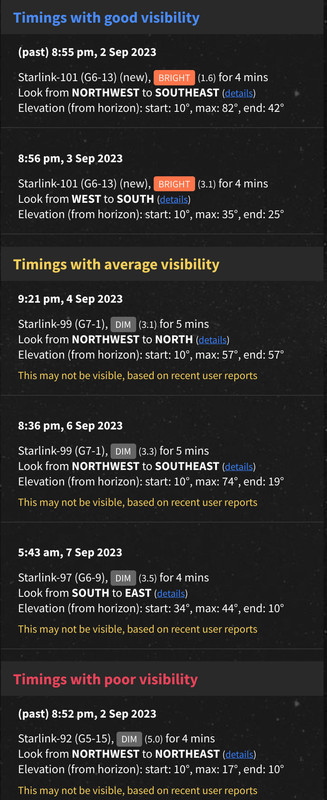
Yeah, I noticed that too. There’s one over me in about 15 minutes but it’s not super dark out. I’ll see if I can spot it.
I, for one, would like to see his long form Earth Certificate.
No sign of 'em, but it wasn’t even quite nautical twilight here yet. I could make out the Big Dipper and other brighter stars but no signs of SpaceX. The website did say sighting 'em would be less like likely tonight.
Oh well, I’ll try tomorrow. There’s a later one about 8:45 P, so it’ll at least be nautical twilight by that time, if not astronomical twilight.
It is a lovely night out on the beach, though. Low 80’s, light breeze keeping the bugs away, low humidity.
Note that the tracker gives magnitude. At my location it dropped from 1.6 last night to 3.1 tonight.
Yeah, it was 2.2 tonight, which is what they call for tomorrow night later. So with more dark tomorrow night, maybe I’ll see it.