somebody tell RFK
Also not true for capital gains.
We sold a 2nd home, and if I could have kept my income under $96K, we wouldn’t have had to pay capital gains on the profit from the house sale. As it was, we had to pay something like $20K in taxes. This is one of the rare step-function tax situations.
Capital gains tax rates
Net capital gains are taxed at different rates depending on overall taxable income, although some or all net capital gain may be taxed at 0%. For taxable years beginning in 2025, the tax rate on most net capital gain is no higher than 15% for most individuals.
A capital gains rate of 0% applies if your taxable income is less than or equal to:
- $48,350 for single and married filing separately;
- $96,700 for married filing jointly and qualifying surviving spouse; and
- $64,750 for head of household.
Swallowing chewing gum, as opposed to spitting it out. I’ve heard tales since childhood how gum will stay in your digestive system, sometimes for years. My mother, a nurse for over thirty years, told me that swallowed gum ended up in your appendix. Well, at 61, either this is baloney or I’ve got a ball of gum the size of a basketball in my lower GI tract.
Speaking of vegetables there is the myth that spinach that has more iron than other vegetables and even meat. (This myth is what inspired its use by Popeye to gain superhuman strength.)
I still occasionally hear people claim it is illegal to drive barefoot even thought it is legal in all 50 states.
It also not illegal to drive with a car’s interior light on
I believed that one!
Driving with interior light on.
I once read that this myth started when a in textbook giving the nutrients for different foods, the decimal point for iron in spinach was printed wrongly, so that the value stated was ten times higher than the real value. Somehow, the myth remained.
Spinach is good and healthy food, nonetheless.
Good lord, I believed this until I read this post. Ignorance fought!
Except… that’s also a myth!
There were a bunch of different measurement errors -and a lack of understanding of how iron absorbance worked for humans- which led to spinach being thought to be an unusually good source of iron, but the idea that it all started due to a study with a decimal point error was made up years later.
Spinach isn’t a very good source of iron though, that much is true.
Ah, dammit, it’s myths all the way down.
There are several of those step-function situations in US income taxation.
@Velocity is right for the vanilla case of pure W-2 income with only nominal investment income.
But capital gains as you say, plus taxation of social security benefits, IRMAA, AMT, and NIIT are all situations where you can get an inversion such that more pre-tax income → less post-tax income. There are probably a couple more, but if so IIRC they’re rare.
And as noted by @Chronos, lots of benefit programs have withdrawal thresholds that create an inversion situation where more pre-tax income leads to less (post-tax income + benefit payments)
In all these cases the gotcha is that slightly surpassing a threshold triggers a large bump in tax (or withdrawal of benefit) and hence large decrement in after-tax income. But as you continue to increase income above that threshold, you’ll make back in income what you lost to increased tax, and if your income goes up enough, then once again more pre-tax income → more post-tax income. Then if your income keeps increasing past that point, eventually you bump into the next threshold item and suffer a different setback. 
Looked at another way, depending on the mix of your income sources, there are several small ranges that are traps out there. Where (simplified made up example) pre-tax incomes between $50K and $52K are especially undesirable. Incomes of $49.9 or $52.1 both have better post-tax incomes than anything in the $50K - $52K range.
Sigh. It’s always something.
The crazy part, though, is that so many people complain about the (nonexistant) tax bracket step, and nobody at all complains about the actual steps that exist.
Also, Mexican food gives you the shits. “Ugh, I think I ate a bad burrito”.
“Glass is really a liquid and that’s why old glass window panes are thicker at the bottom.”
No, not a liquid. Old panes are thicker at the bottom because old manufacturing of glass made consistent thickness difficult. They mounted the panes with the thickest part at the bottom for structural and aesthetic reasons.
Congress stole trillions from Social Security. Yes there was a surplus, which was by law put into US treasury bonds. Now that there is more money being paid out than taken in, those bonds are being cashed by the trust fund like any other investor. Not a penny was stolen, but people insist that Congress somehow stole the money.
One situation is simple. The other is both complex and arcane.
If you know enough to correctly understand the complex real one, you also know the simple fake one is plain false. If all you know about US income taxation is that you hate it, it’s easy to imagine a trap that catches everyone, even you. Especially you.
I’d bet nearly everyone making the fake claim sincerely is a basic W2 earner and has no idea any of that other stuff even exists. And frankly, no reason to know it exists.
Of course some folks just love to repeat things they know to be untrue just because it’s a fun story to repeat, or it’s a good hook to hang their free-floating cynicism on. The kind of thing where folks called on it would shrug and say “If it isn’t true, it sure ought to be.”
Which aren’t good reasons. But they are reasons human nature tells us to expect.
“Daylight Saving Time was invented to give farmers more daylight hours to work in the field.”
I’v never heard that before, the reason I’ve always heard is that it’s for saving energy, with the bonus of giving people an extra hour of daylight in the evenings for outdoor activities. Don’t know if that’s the correct assumption.
Not outdoor activities as much as shopping. The United Cigar Stores Company was the Walmart of it’s day and shoveled a ton of money into lobbying for DST using energy savings as a thin veil for its true aim to give customers an extra hour to shop after work.
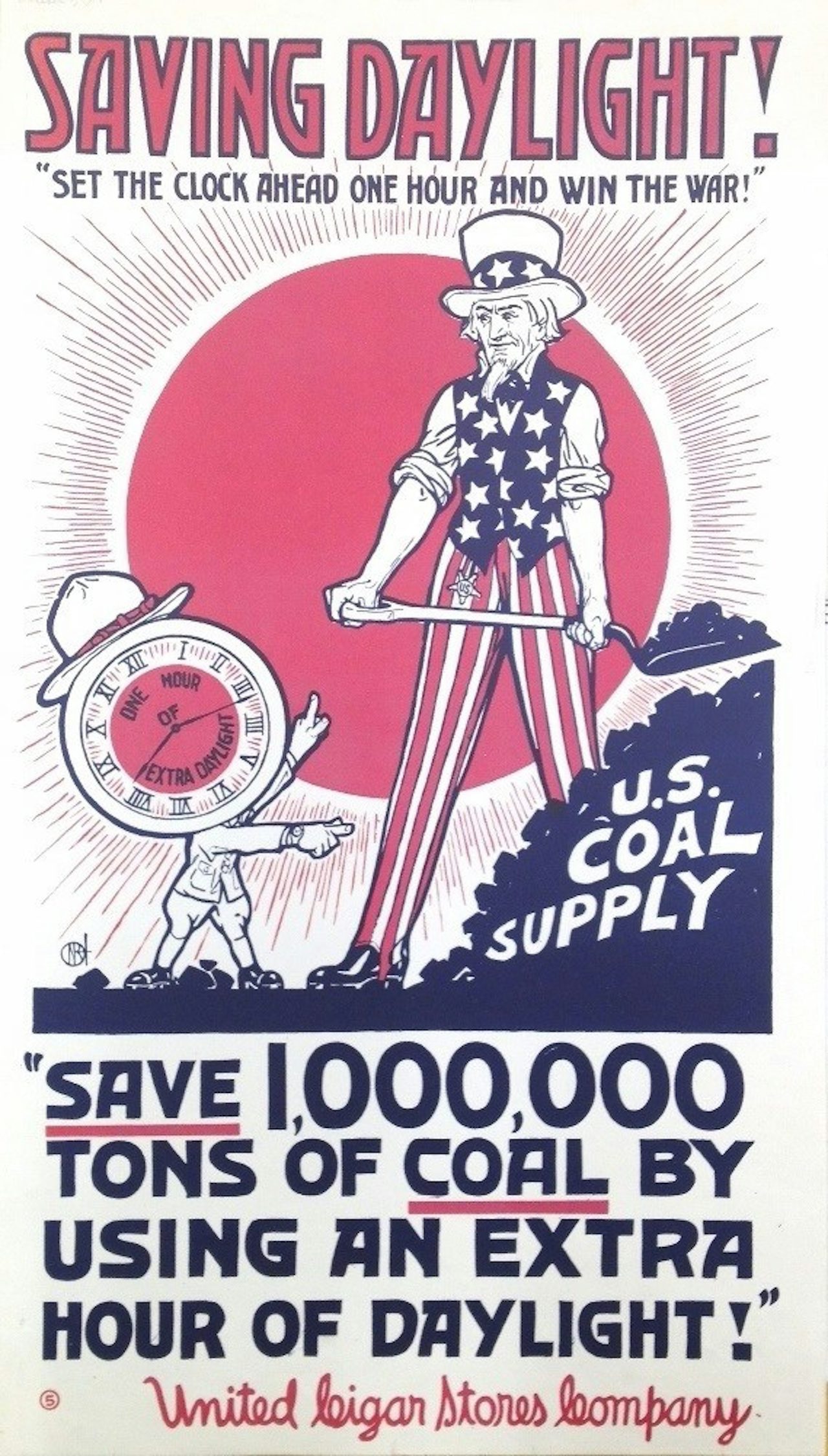
Ah, that’s different than here in Germany, because at the time daylight saving time was introduced here (1980), stores still couldn’t even open until that late but mostly had to close at 6:30 PM (there were some exceptions for stores at railway stations and airports, but very few), so time for shopping was never a concern here.