I agree that a revenue-neutral plan that lowers one person’s taxes will raise someone else’s. But, the article that Elindil’s Heir linked to, and that I was commenting on, doesn’t make the revenue-neutral claim. Here’s the relevant paragraph:
He’s still wrong. The complexity that he complains about, the 6.1 billion hours and 10 million words, has nothing to do with the graduated rates and different tax brackets.
Filing your taxes basically breaks down into two steps.
Figure out how much money you made during the year. You take your salary, and tips, and interest, and gains, and losses, and farm income, and income from rental properties, and deductions (standard or itemized), and depreciation, and whatever else, and you fill out all the forms and worksheets, and you’re left with a number that represents your Taxable Income. For the sake of argument, let’s say this takes an hour.
You take your Taxable Income and look it up in the tables in the tax booklet and find out how much tax to pay on it. This takes 30 seconds.
A flat tax would cut that 30 seconds down to 15.
Now, flat tax proponents may want to simplify the rules defining income along with dropping the graduated tax brackets, but there’s no reason they have to go together. We could have a complicated flat tax, or a simple progressive tax.
The only question I have is whether the author really doesn’t understand this (in which case I have no problem dismissing everything he says about taxation and the debt), or if he’s being deliberately deceptive. It’s rather like Tom Sawyer whitewashing his aunt’s fence; making false promises to people in order to get what he really wants. If that’s the case, it only works because most people don’t really grok what the lines on their tax forms mean; and the flat-tax advocates are taking advantage of the very complexity they say they want to abolish.
I can tell you from experience that itemizing take a helluva lot longer than an hour. If it doesn’t, odds are fair that you’re better off taking a standard deduction.
I’ve read op-ed pieces that suggest that the IRS just eliminate filing of tax returns for most taxpayers*. The idea is that most people’s income, dividends and so forth is reported directly to the government by banks and brokerage houses. So the IRS can calculate what you owe (or are due back) and send you a postcard with their results. If you agree, sign the card and send it back. If not, you can file.
Note that I said “most taxpayers.” I know that there are some people who have income or expenses not reported on W2s, 1099s and such forms. But for instance, in my case, it’s all payroll, interest income or stock/mutual fund dividends or capital gains/losses.
Right. But at some point who do borrow from to waste money on worthless things? I can understand borrowing money for a canal, a bridge, a dam, an Internet. But borrowing money to piss away with inefficient and counterproductive policy can’t last forever.
2 hours, 4 hours, whatever; that doesn’t invalidate my point, it makes it stronger. Changing to a flat rate for all taxpayers at all incomes would do nothing to end the complexity that people complain about. The folks who say otherwise are trying to sell you something.
The factual answer to your question is that with the exception of major wars and depressions, the US Government has run a deficit since the 1960s.
I suspect one of the reasons we allow debt to get so high is because we can. As the de facto reserve currency of the world (more USD are held than Euros, Pounds, Yen, Yaun, and every other currency combined), we can incur larger amounts of debt without devaluing the dollar.
IOW, we can print money because the money itself has value globally.
Ourselves mostly. Mostly in the form of government issued securities, bonds and other instruments.
Well, yes and no. The Invisible Hand refers to the long-term ascension of human society due to the free markets maximizing resources to the combined wants and needs of people acting in their enlightened self-interest. Then again, in the long term, everyone’s dead.
In the short term and on local scales, you can have bad actors taking advantage of market failures, asymmetrical information or network externalities to dump pollution in common spaces, cut corners in a dangerous manner or commit fraud.
Regarding disasters and shortages, you are correct about “profit making opportunities”. Why is that a bad thing? The way markets work, if a local disaster creates a shortage of bottled water and drives the price up, it will attract more people selling bottled water. Now sending National Guard trucks full of water from other parts of the country might be a better short term solution, but charging a lot of money for something isn’t inherently “evil”.
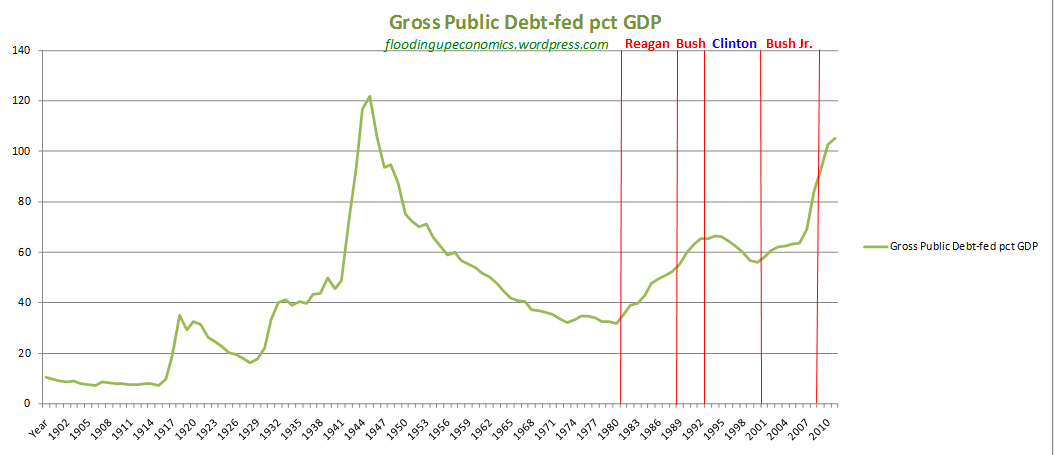
Gdp to debt ratio peaked after ww2, declined until Reagan, then it started shooting up again. It declined under Clinton a bit, then shot up under w and Obama.
Both parties now enjoy spending and cutting taxes. Republicans want to cut taxes on the wealthy and businesses while increasing military spending. Democrats want to cut taxes on the poor, working class and middle class while increasing spending on domestic programs.
Lots of it though is just reaganomics and the great recession. If not for that we’d probably be in a much better place financially. I thought towards the end of Clinton’s terms that Greenspan was getting worried the US would pay of too much of its debt.
The over-rated Ayn Rand enthusiast did babble words to that effect, but the main GOP support for fiscal imprudence came from its Starve the Beast agenda. We’d hear a lot less ignorance on this topic if right-wingers had the wherewithal to examine graphs like this one.
Trying to teach elementary economics or fiscal policy to right-wingers is an exercise in frustration. Consider this:
One wonders which specific worthless waste he’s referring to here.
Is SocSec the worthless waste? These funds are given to humans, not plunged down an oubliette. The administrative overhead is less than one-tenth that of private pensions. Conservatives give lip service to the idea that wealthy retirees don’t need the added SocSec dollars: if they understand that much, why not support taxing the wealthy?
Is Interest on the debt the worthless waste? Surely the U.S. should meet its obligations, no? (Some even think the interest cost would be less if it weren’t for saboteurs like Ted Cruz for whom lowering sovereign debt ratings fits with the Starve the Beast agenda.)
Is Medicare the worthless waste? A poor retiree who gets life-saving medicine he wouldn’t otherwise won’t feel that way. True, Medicare pays more than it should … due to the GOP’s need to turn the program into a boondoggle for drug companies. Healthcare for our veterans? The rightwing makes much of any problem in that system, but overall it provides good cost-effective care.
Are the scientists at the E.P.A. the worthless waste? That agency spends $25 annually per American. Would we be better off if pollution control where left to the invisible and magic hand of the market?
Is “foreign aid” the worthless waste? Food stamps? Pell grants?
The Cheney-Bush war against Saddam was a tragic blunder that cost trillions of dollars — is that what Octopus meant?
Salaries of IRS agents? Is that the worthless waste? I could go on, but let’s give right-wingers in the thread a chance to show their actual plans for balancing the budget without raising taxes.
Wow. Absolutely wow! This is what you come up with? A gaudy presentation full of sophistry? Did you expect us to leaf through it?
I didn’t study it in detail: the first click I tried (“Prada for your Pooch”) was to a $210,000 Community Development Block Grant. These are federal funds allocated by local governments — I thought “conservatives” liked such an approach.
Was your site intended as some sort of joke? I’m not sure which is more laughable — the pdf itself, or that someone would link to it in a serious debate.
If it’s good enough for the US Senate it’s good enough for octopus. We probably don’t need all the carriers we have either.
We may stay the global reserve currency forever and not need to worry about owing money in someone else’s currency. If that’s the case we don’t need to worry about debt do we? We control the currency. I wonder how the British felt when the tides shifted?
This is all non sequitur. You seem to have switched from “Much federal spending is worthless waste” to (I’m guessing) “You libtards don’t think debt matters.”
Since I’d never vote GOP and think the 2nd-Amendment fanatics are fools, I may qualify as a libtard — and I think debt matters.
I was intrigued by your “worthless waste” post — which you now seem to be distancing yourself from — because I don’t think right-wingers who complain about the deficit have the slightest clue what they’re talking about.
Fiscal responsibility refers to trying to balance the budget, e.g. as Clinton did in the 1990’s. In the Flakey report you linked to — most of which, like “Prada for Pooches,” was farcical hype unworthy of a Senator (* see below) — the only big item is $1 billion per year associated with radioactive waste at Hanford. But
[ul][li] Whatever mistakes may be associated with that,fiscal responsibility seems tangential. The irresponsible thing would be to leave radioactive waste unattended.[/li][li] The Hanford site will have to waste $1 billion annually*** for three thousand years*** to equal the cost of the Cheney-Bush War against Gog and Magog.[/li][li] Your cited nonsensical list of “worthless waste” suggests that you understand the real problem is lack of revenue. As mentioned upthread, as recently as 2000, some (e.g. Greenspan) claimed to be worried that diminishing debt would pose a problem! It was the Cheney-Rove decision to finance their War with tax cuts ( :smack: ) that led to the present problems.[/li][/ul]
Reread the above; drink a couple of cups of coffee; and see if you can retract your claims or post something more coherent.
Do you think linking to rubbish like the Flake farce gives you credibility? :rolleyes:
There was a couple of years in the early 60s, but to find a relatively long period of Gov’t surpluses you have to go back to the 20’s. Historically, the US Gov’t usually runs deficits even back to the 1800s.
Some find it more meaningful to measure debt as a percent of GDP rather than in absolute dollars. With this metric, there was significant debt reduction during the 1990’s.
The entire Interstate Highway System was primarily designed to enable the logistics of moving troops in the event of a ground war on our soil. A railway system already existed adequate to meet the need for the freight movement of civilian commerce.

 A gaudy presentation full of sophistry? Did you expect us to leaf through it?
 — and I think debt matters.