Yeah. I gave up on that game.
Might want to give Last Epoch a try if you liked the older Diablos, before it fully enshittifies.
Heh, it’s well on its way, apparently… I don’t think I’ve ever seen this before:
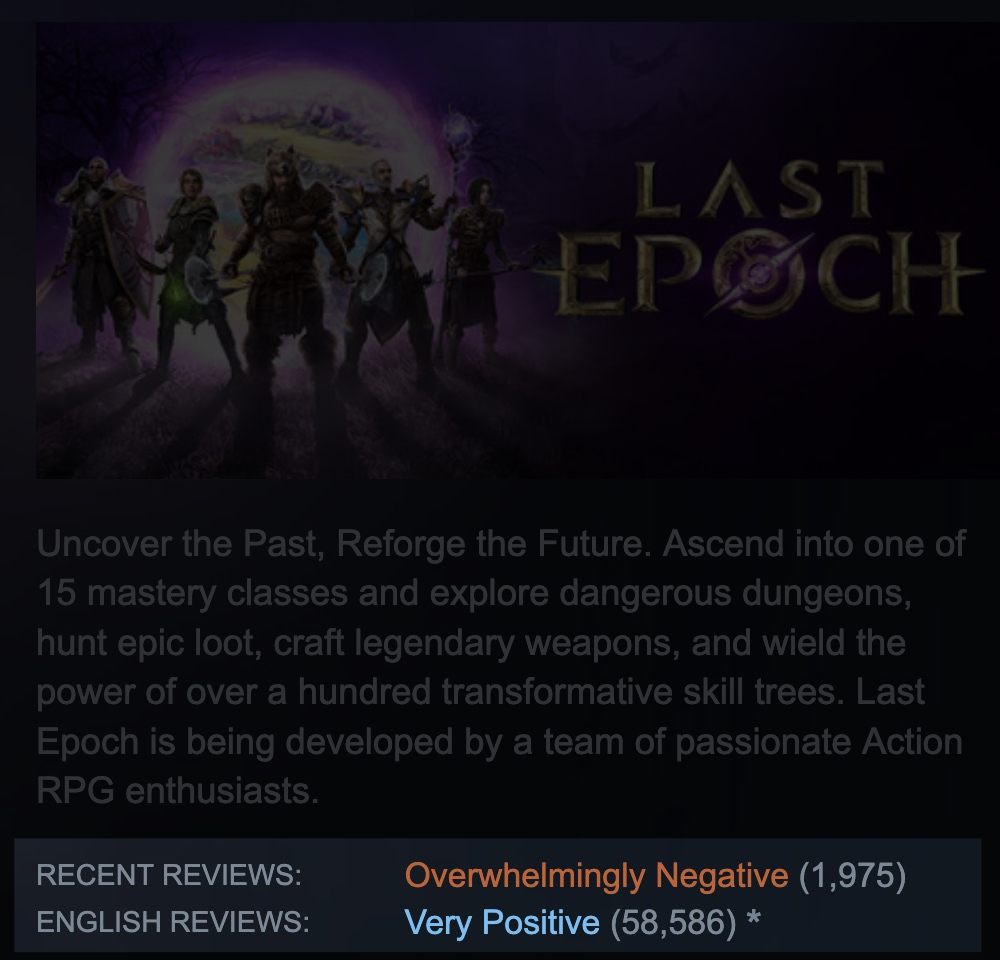
People are understandably really unhappy about Krafton.
The older Torchlight 2 is excellent too: Save 80% on Torchlight II on Steam (the subsequent titles were bought by the Chinese and enshittified). Or Grim Dawn if you liked D2. It’s $4 right now.
Call me ignorant, but I’m not entirely sure how the presence or absence of DRM affects me.
I also don’t see how you own a game on GOG any more than you own a game on Steam. If GOG decides to take a game off its server, you won’t be able to play it, DRM or not.
I hope I’m not stating the obvious, here, but:
DRM (digital rights management) is the technology that lets companies “rent” you digital titles, whether it’s a game or an ebook or a movie.
DRM means that when a game launches, it will first phone home to check to make sure you’re authorized to play it. It does this by fingerprinting your particular account and/or device and/or hardware setup and only allowing X number of unique activations and then checking with the mothership to see if you’ve exceeded that quota.
Without DRM, you can copy a game/book/movie/file as many times as you want, using it on as many computers as you want, for as long as you want, without any checks.
When you buy a game on Steam, you are really renting it for the long term. If Steam goes down, you’ll have a max of 30 days to keep playing that game offline, after which it will cease to function even if you still have a copy of it. This is because of Steam DRM.
When you buy a game on GOG, there is no DRM. Once you download it, it’s yours forever, and even if GOG shuts down and the whole Earth gets nuked, you can still play your own copy on Mars.
It’s like the difference between the old Napster MP3s (if you remember those) vs the later copy-protected iTunes audio files. Without DRM, you can copy the digital file and use it anywhere, as many times as you like.
With games, this also means that through GOG, you can buy one copy of a game like Divinity: Original Sin or Baldur’s Gate and share it with 3 other friends and you can all play multiplayer together (through direct IP connections) even if GOG were down. It’s a trust-based purchasing system instead of an intrusive monitoring technology.
If you bought a Steam copy, then each person would need their own — again due to DRM — and the game would no longer launch if Steam shuts down.
So DRM is the component of a game that allows distributors to retroactively rescind a game from customers. Without it, as long as the customer retains the actual bytes of the game (on an external backup, for example), they can keep playing it forever.
A few things -
- How often does Steam go down? Because I can’t remember that happening very often.
- If Steam does go down, I’ll have a month left to play a game. A month is fine - I usually finish a game within a month, then I uninstall it and download something else. I don’t have anywhere to store games on at home even if I wanted to.
- If all else fails.. everything’s available on the internet if you look hard enough. Neither Steam, GoG nor God Himself can prevent me from playing a game I paid for.
I mean, you’re preaching to the choir here. I still buy all my games on Steam because I don’t care about DRM. But for some people, it matters — philosophically, if nothing else. DRM-free means you can actually own the game, rather than renting it.
Yes, you can always just pirate games. But I like to support the creators when I can. I prefer the convenience of Steam, but some people like the ethics of GOG better. And it is a different offering, that’s all, even if it’s not personally valuable to you (nor to me).
I mean, if you only want to rent a game for a month, DRM is not a problem. It tricked me for books because i often want to open up a book years after the first time i read it. This is why I’ll only buy DRM-free ebooks. Why even pretend I’ve bought it if i haven’t? I’m happy to use the DRM-protected library service, because them in only borrowing the book for a couple of weeks.
Or then there’s the case of City of Heroes. It’s an MMORPG, so always-online is kind of inherent to the game design (you can choose to play solo, but you’re still in a world with a bunch of other people in it). Then, the company that owned it shut down, and the game disappeared… Then, someone (presumably one of the original developers, but I don’t think it’s publicly known who) started up their own copy of the server software, and kept playing it with a small group of friends… Then, they opened up that server to everyone… and then, eventually, they negotiated with the original company for the rights to officially keep on doing that.
What I mean is that I rent it for a month, but every year or two, I can download it again for another month for free. Were you getting books they wouldn’t let you download again? That sucks.
No, “tripped” is a typo, and I’m not sure what it was supposed to be. But i won’t buy drm-protected books.
Ameritrade and E-trade were booming in the dot com era as online stock trading took off.
Commissions have definitely dropped since then.
Ameritrade is now part of Charles Schwab and has much better service than it did in the dot com era.
I have just a small account at E-trade and can’t remember the last time I had to contact them but I have not heard horror stories
The experience of using many companies has become worse.
I like Spotify. I understand artists have their concerns. It was and is still a great way to listen to new songs and beloved classics. More recently, it is a great way to enjoy audio versions of books that seem interesting, but too expensive, bulky or “single use” to want to add to my collection.
Straightdope.com is not a big company, but the experience here is similar to that of two decades ago - no small feat in a world which is greedier, less civil, more polarized and which places less emphasis on knowledge and learning. Thank you, mods.
I use Spotify and like it well enough, but what I don’t like is that it sometimes inserts random songs into my playlists. I haven’t been able to figure out how to get it to stop doing this. I am a paid subscriber.
That might be Smart Shuffle? You can turn it off: Shuffle play - Spotify
To disable Smart Shuffle:
Tap your profile picture at the top.
Tap Settings and privacy Settings.
Select Playback.
Switch Include Smart Shuffle in play modes off Toggle switched off.
Thanks. I was wondering about that.
I’m confused, and I second @Alessan’s question. Where were you getting books where the DRM prevented you from downloading them again later?
Although it happens only very rarely, DRM technically does enable distributors to retroactively remove a purchased/rented item from your account, as happened with the Kindle version of — oh, the irony — 1984 that Amazon forcibly removed from all Kindles.
Steam has done that at least once too: Steam Removes Game 'Order Of War: Challenge' From User Libraries - Forbes
It doesn’t happen very frequently, usually only as the result of some dispute over distribution rights with the content’s publisher. But that it can happen is enabled by DRM. Such shenanigans could not happen with DRM-free media, since the distributor would have no way to claw the content away from you (unless they physically forced a deletion from your computer and backups, which would be a whole other minefield).
All in all it’s not a huge risk, but it’s non-zero.
The other thing about DRM is that just because a company isn’t shitty today doesn’t mean that it won’t be tomorrow. Kindle’s DRM recently changed and was made more difficult to remove; if you previously relied on Calibre to remove DRM from your ebooks to read on other devices, that was no longer going to be possible. However, they backtracked somewhat after customer uproar, and so now they will allow some DRM-free downloads of certain free books.
Similarly with Steam, today it’s not very enshittified because it’s still a small private company. But if Gabe has a heart attack tomorrow and the company loses that sort of leadership, who knows what would happen… maybe Microsoft would swoop in and buy them up and make offline play Windows-only or shut down Proton integration or whatever.
When you buy something on Steam, you are granted a temporary license for it, per the user agreement:
The Content and Services are licensed, not sold. Your license confers no title or ownership in the Content and Services.
And they can change the terms any time they want, and all you can do is delete your account and stop using Steam:
Furthermore, Valve may amend this Agreement (including any Subscription Terms or Rules of Use) unilaterally at any time in its sole discretion. In this case, you will be notified by e-mail of any amendment to this Agreement made by Valve at least 30 (30) days before the effective date of the amendment. You can view the Agreement at any time at http://www.steampowered.com/. Your failure to cancel your Account prior to the effective date of the amendment will constitute your acceptance of the amended terms. If you don’t agree to the amendments or to any of the terms in this Agreement, your only remedy is to cancel your Account or to cease use of the affected Subscription(s). Valve shall not have any obligation to refund any fees that may have accrued to your Account before cancellation of your Account or cessation of use of any Subscription, nor shall Valve have any obligation to prorate any fees in such circumstances.
I’m not saying Valve is an evil company today, but if they ever want/need to become one due to financial pressures, DRM gives them full control over your library.
It wasn’t that long ago that Google shut down Stadia completely and users lost access to all their games overnight. In that case, Google was nice enough to give everyone a full refund for everything they ever bought. But they were under no obligation to.
That isn’t the case with DRM-free media; it’s yours to keep as long as you can back it up on your own.
eBay seems to have gotten somewhat better over time overall, even if customer service isn’t as good (?). Granted, I’ve never been a huge eBayer, but it used to be that they just provided the basic online auction functionality, and you had to work out the payment, shipping, and the rest yourself.
Now they have pretty good search capabilities, and if you bid on something/make an offer/buy-it-now, they actually mediate the payment and shipping for you and the seller. For a fee of course, but it’s super convenient compared to how it used to be.
What do you mean? Isn’t that what they’ve done since the beginning, through PayPal?
I remember you having the option to do Paypal or something else, but they didn’t arrange the shipping for you.
Of course, I use eBay in little bursts about every 7-10 years, so it seems more easy than it used to be.