All true, but there are (extremely rare) exceptions. Holland, MI recirculates water heated by the waste heat from their power generation plant through a system of pipes under the downtown sidewalks during winter. But that’s a limited use case – northern state and only in winter. Still, it does show that we could be doing a lot better than we are.
You’ve made me think of something:
Could a data center and a water treatment plant basically be co-located? To put it a different way … is a data-center-shaped water filtration plant possible (if expensive)?
While a huge amount of water is in one place anyway for water treatment, take advantage of it to cool servers.
I assume that heating the water so much is effective in sterilizing the water from biological agents. Add in some heavy metal filtration, and whatever else is required to produce potable water. I don’t have all the details, but it makes superficial sense. You need someone who doesn’t know the rules and doesn’t know the assumed limitations to spearhead this kind of effort, though, a modern Howard Hughes type.
“Mr. Hughes, you just can’t build it that way!”
“Why not?”
“Because … because … I mean, you could, but it’s hard and expensive!”
“Bollocks! Here’s 20 billion burning a hole in my pocket. I’ve got some Saudis on speed-dial who are prepared to kick in another 100 billion. Make it happen!”
Even in colder climates, heating still isn’t much of a municipal benefit. A lot of urban structures need air conditioning even in the winter. It’s a case of the square-cube law: Buildings generate heat proportional to their volume (from people inside, lighting, computers running, etc.), but they shed heat proportional to their surface area, so for large enough buildings, passive heat shedding can’t keep up. I suppose you could build your datacenter near a bunch of single-family housing, and heat the houses that way, but the houses would pretty much need to be built right from the start in a way to take advantage of that. And now, those houses would be screwed if data demand drops and the center closes.
Except that most factories also produce jobs. Data centers mostly don’t.
“There’s always work at the water treatment plant/data center  “
“
Combining a tax-paid municipal infrastructure with a private data center would create a bigger headache than it solves, IMO.
You can’t feed water back into the mains like you can excess solar power. Drinking water mains are designed for one-way flow.
Even if it were possible, do you really want a profit-driven factory pushing their wastewater back into the drinking water mains? Do you really want to trust Amazon’s pinky promise that they’ll clean up their effluent to drinking water standards? Would you want to live downstream of that?
The datacenter water issue is fine as it is. Stop trying to make it actually dangerous.
They absolutely do. Just because you don’t see hard-hats walking into the facility and hear the whistle blow at shift change, doesn’t mean that someone’s not building, watching, monitoring, maintaining, and controlling the whole thing.
Let’s be honest here. Data centers have been around since most of us were children. Nobody ever cared about them until 2 things happened:
- They started to show up everywhere, presenting ugly boxy disruptions to the landscape
- They became associated with AI, which gets a lot of hatred for reasons both rational and irrational
These concerns are sublimating into complaints about water and power for reasons I can only guess at, but I figure folks see it as more persuasive than the finer points of copyright law, job destruction, enshittification of apps, the threatening march of progress, whatever. Most people don’t get excited about that stuff, but they do get excited about ugly boxy buildings going up adjacent from their equestrian ranch where they thought the neighbors would obligingly leave their property as undeveloped scenic grassland forever. They get excited about the prospect of their power and water rates going up. They get excited about iNfRa eLeCtRoMaGnEtiC fiELdS or other weird fringey stuff.
Make sure data centers pay their taxes, and pay higher marginal rates for water and power, and make sure they conform to local environmental regs. Tighten those regs if needed. Abolish the tax abatements. If you do that, then you’ve got a clean local factory that gives back what it takes. It’s way better than a prison or a paper mill or golf course. Solve real problems, get real benefits.
“Sorry, that’s covered by our NDA.”
It’s not a killer app or complete solution to anything, but waste factory heat is of course usable in all sorts of ways with the right urban planning.
That’s why I said they “mostly” don’t produce jobs. There are a few. But only a few. I’m not saying that municipalities should ban them; I’m saying that they shouldn’t be getting the typical big-business incentives, because those incentives are usually aimed at bringing jobs into the community.
Due to the Great Lakes–St. Lawrence River Basin Water Resources Compact, you can’t just “take” water out of the Great Lakes. More info here and here.
You’re ignoring the real reason, which is the exponential growth of data centers and their electrical and water usage. Sure, they’ve been around forever, and people weren’t so concerned when they represented 1.4% of the total U.S. electrical usage in 2014 (cite). In 2023 after their usage tripled and they were taking 4.4% of U.S. electricity, people started to get more concerned. By 2028 when it’s projected to be 6.7-12% of U.S. electricity and using water that isn’t available, people will be severely impacted, and it’s not because of irrational AI hatred or aesthetic concerns.
Regarding using the municipal water supply to cool the data center, there’s no scenario where running clean drinking water through the data center equipment and back out makes any sense. No matter how fresh and clean and brand new the data center’s equipment is, none of the computing equipment is “food safe.” There’s various types of metals used in the water blocks that could accumulate to toxic levels after passing through the thousands of servers. The rubber/synthetic hoses can also leech out chemicals. The residual chlorine disinfectant, or the orthophosphate used to coat pipes to reduce lead exposure, in municipal water may not be compatible with the server equipment, leading to corrosion of chemical breakdown.
The only way to realistically make this work is to have a heat exchanger that the municipal water passes through to absorb heat from the data center water through metal plates/baffles/fins/pipes/whatever ensuring the water never mixes. However, the amount of flow through the water main would need to be very significant, so like @bordelond suggested it might need to be near or even colocated with the filtration/pumping station to have enough water moving by constantly to satisfy the cooling needs. Also the downstream customers may not appreciate their “cold” water being warmed up. Even without data centers injecting heat into our municipal water supply, I find Cincinnati’s water to be disappointingly warm starting in about April.
How does the profit from doing it and eventually getting caught, compare to the fine they can give to the company.
This appears to be a big misunderstanding of how the water is used. Is your impression that they run water through the equipment to cool it directly?
Municipal water is not actually in contact with the equipment. That would not just pollute the water, it would damage the equipment. Most centers use evaporative cooling where hot air is passed to the cooling system, the water absorbs the heat and evaporates. This leaves cooler air but also requires large amounts of water to evaporate.
Up-thread there was some discussion about extending a data center’s closed-loop cooling system to include the municipal water system in order to use the municipal water system as a giant heat sink.
Several issues were raised, including @jjakucyk 's point that it can’t be connected directly to the municipal water system – it needs to be cleaned first.
Sure, but even in such a system, the water isn’t going through the racks directly. That’s not how closed-loop systems work, either.
Those will have their own loop and municipal water is used to absorb heat from that loop. The closed loop fluid doesn’t pass through the equipment, either, nor is that fluid in direct contact with municipal water.
Got it, thanks.
The municipal loop would still be going through on-premises plumbing. It would still need to go through the water treatment plant to get reused, no?
A useful diagram of evaporative cooling loops:
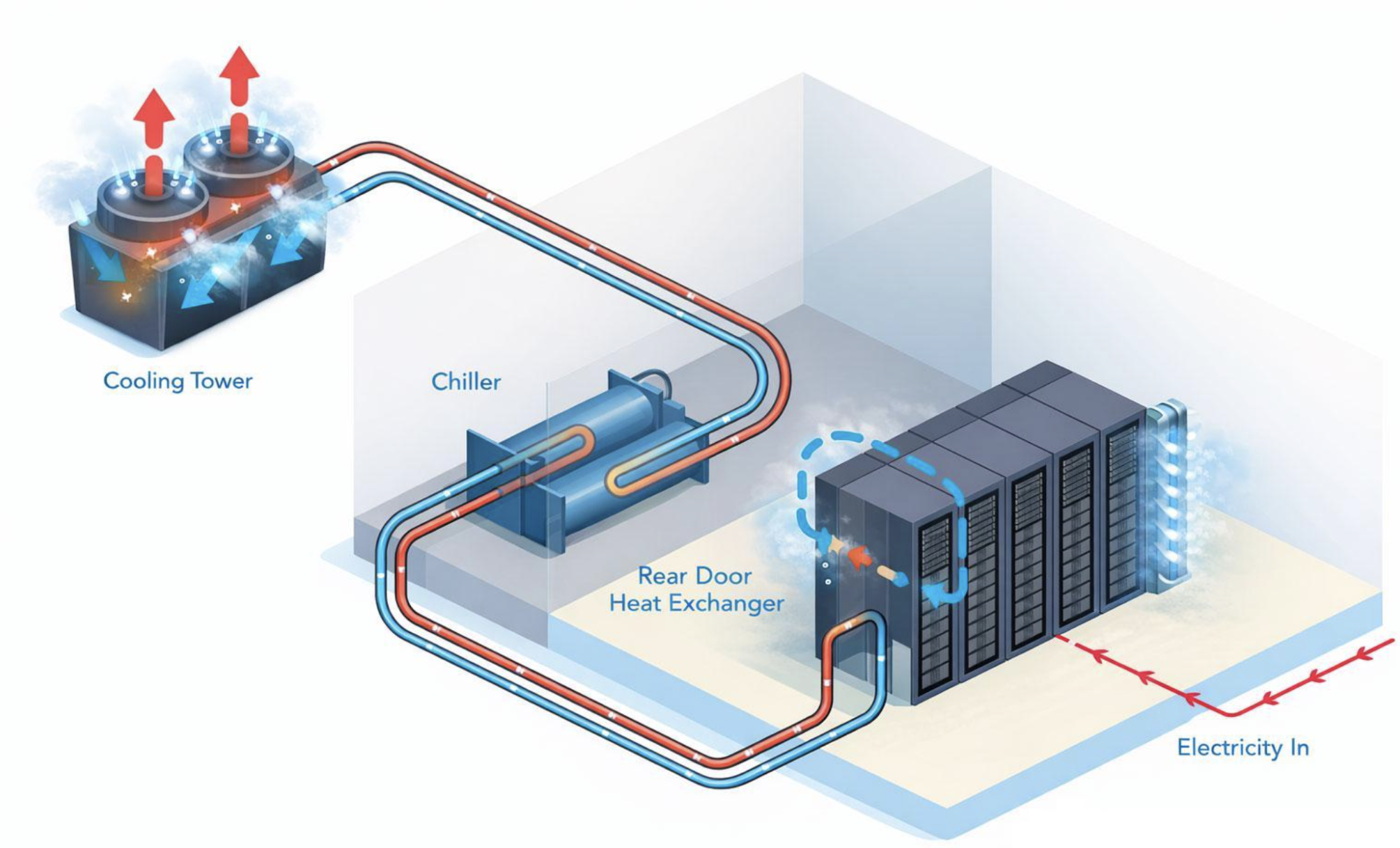
Some of the water in the cooling tower is “lost” from the chiller loop due to evaporation, some condenses and goes back into the loop. The bit that gets lost from evaporation needs to be replenished. That loop never touches the the servers, it exchanges heat with the server loop via the chiller/heat exchanger.
More or less. If such a system could be implemented and how is what some posters were asking, along with the drawbacks. Kind of depends on how you do it.
It wouldn’t necessarily have to go through standard building plumbing, i.e. could be an independent loop of its own, but there are still issues with buffering that heat and dealing with the downstream effects. And likely wouldn’t be all that efficient, either.