Ah, gotcha.
That would capture some of the heat, but it would still waste the water, wouldn’t it. And like others have said, and the more I think about it, homeowners might not be too keen on having warm/hot water as the default anyway.
No. Think about it like this. You have the hot water from the data center and you run it in a metal pipe out to the street. Then you take your metal pipe and coil it around the metal water main under the street and solder or weld them together so you have good thermal contact. The cooler water in the main will then suck the heat out of your data center pipe. The data center water just goes around the coil and then through another pipe back to the building. The municipal water just keeps going by in its own pipe.
In the picture below[1] imagine the big vertical pipe is the water main, and the coiled pipe is the data center loop. The municipal water is flowing from top to bottom and it gets warmer as it picks up the heat from the data center loop. The data center water is flowing around the coil from bottom to top dumping its heat into the water main. In reality it would be more efficient to reroute the water main into an outbuilding or vault or something where it can go into a tank or other heat exchange device with better thermal transfer properties, but the principle is the same.
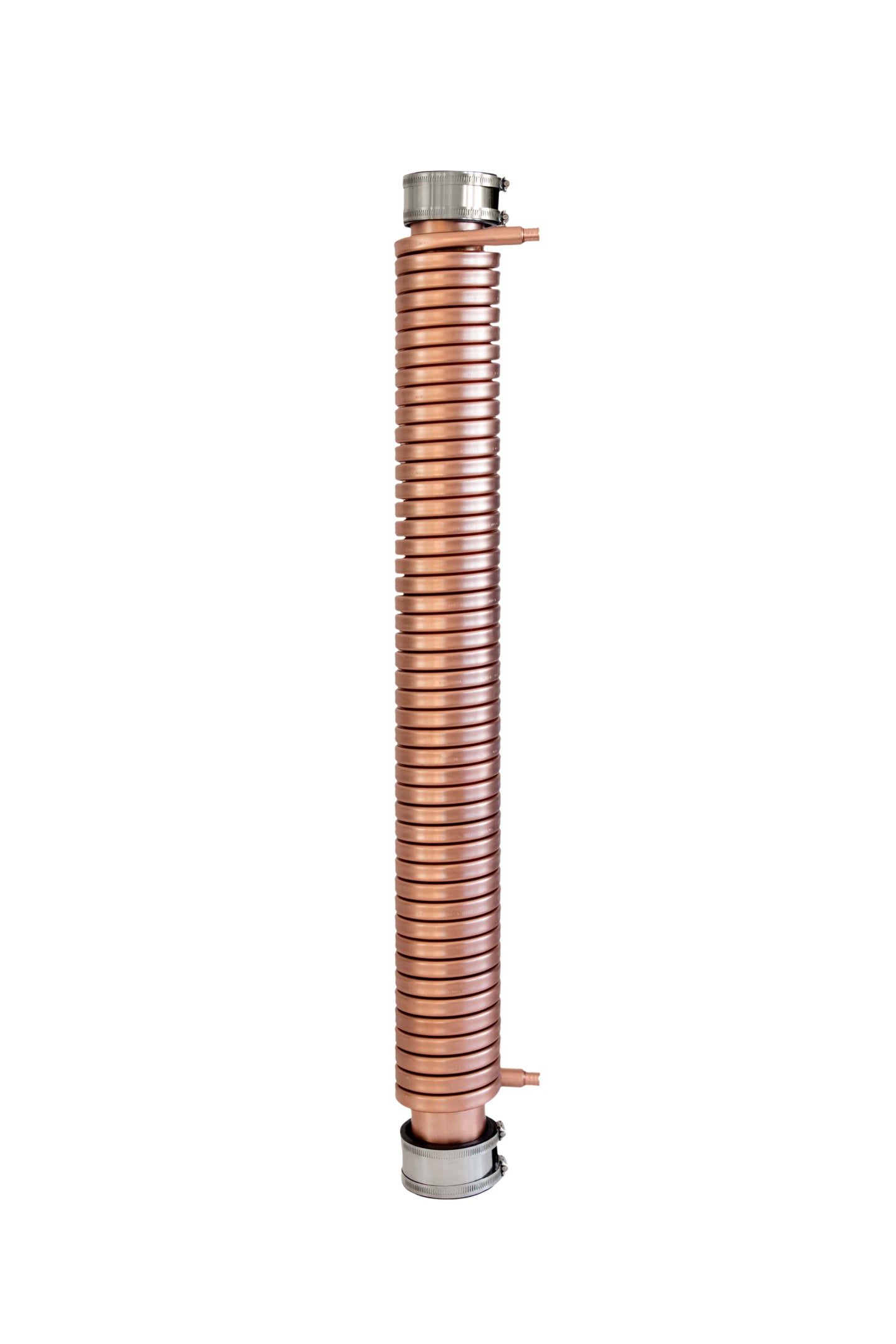
This actual product is a shower drain water heat recovery device. As the warm water from the shower drain flows down the big pipe, cold municipal water comes in the bottom of the coil and captures some of that heat on its way to the water heater, so the water heater doesn’t need to work as hard. ↩︎
The problem with any non-evaporative method is the sheer quantity of tepid water that needs to pass through such a heat exchanger to sufficiently cool the sorta hotter water in the data center’s isolated cooling loop. The delta T and the quantity required are inversely proportional.
First you’d need a heat exchanger system the size of a football stadium. And it’d take the entire clean (“drinking”) water flow of Los Angeles to cool even 2 ordinary data centers. Which gets even worse when you notice that the data center cooling requirement is fairly even 24/7/365, but household and commercial water consumption is not at all steady over the 24 hour day. The flow at 2am still needs to be adequaute to cool the datacenter.
So while @jjakucyk just did a great job of explaining the concept, everybody upthread talking about non-evaporative methods is missing the scale problem. Which turns into a cost problem.
Sorry, I’m with you now. I’m familiar with heat exchangers from my work in the Navy and nuclear power plants, but hadn’t read you correctly the first time. Sorry about that.
Citation needed.
In a dry climate like Los Angeles you do get a big boost from evaporation, but I’m betting the water isn’t going to be much cooler than 50-60º F. Sure that’s better than the 90º you might get with just a normal “dry” fan coil, but that’s also close to the temperature you’d expect from the municipal water main. Maybe LA’s water is a bit warmer, but it’s going to be cooler than the air. So you just have to see how much water/flow a typical evaporative system for a data center uses and what the total pipe size would be for that. A water main of a similar size would probably be adequate to cool it.
Absolutely not. If you start with 1 gallon of water at 60F, you get 250 BTUs of cooling if you raise the temperature to 90F. You get 8,837 BTUs of cooling if you evaporate it. You would need 35 times the volume of water, not a water main of a similar size.
I’m saying 90ºF would be the “cold” water supplied by a dry fan coil unit in outdoor air (in a climate like LA), whereas you’d probably get 60ºF water from either the municipal water supply or an evaporative cooling tower. The hot side of the data center loop is probably going to be at least 120ºF, but no higher than boiling, so probably a max of 180ºF.
Now, some quick Googling reveals that evaporative cooling towers deliver water that’s only 5º to 8ºF lower than a dry system in the same conditions, which isn’t what I initially though. That doesn’t sound like much, but this paper (PDF) references a study that shows evaporative cooling towers are roughly twice as efficient as dry ones. I’ve seen other stats going up to 4x as efficient. That’s significant for sure, but it’s not orders of magnitude different.
The 250 BTU vs 8,837 BTU comparison is incorrect because you’re not evaporating/boiling all the water in one pass. Only a small fraction of the water evaporates, most of it just circulates back to the cool the server equipment (or air conditioning plant). This other paper (PDF) says that 2% of the water evaporates, but you’re likely to also purge (blowdown) another 1% or so to prevent mineral and biological buildup. One of the example situations is a 20,000 gallon per minute (GPM) flow rate which requires 583.5 GPM of replenishment due to evaporation and blowdown, or about 3%.
That’s a huge flow rate, on the order of what you might need for a college campus or a 40-ish megawatt data center (feel free to check my math on that, the numbers seem to vary widely). Still, you can get 20,000 GPM of flow in “only” an 18" diameter pipe. For reference, the pipe that connects Cincinnati’s water treatment plant with its main pumping station is seven feet in diameter. Interestingly, the 37 million gallon per day (GPD) capacity of that plant is only equivalent to 25,964 GPM, so it’s moving quite slowly through the system compared to a high-density cooling tower situation. Also that’s just for the original plant built in 1904. Today the waterworks supplies 120 million GPD to 1.1 million people, which is 83,333 GPM, but there’s many separate facilities.
It makes it sound like there’s only enough capacity to cool four large-ish data centers, but the municipal water is much colder than what you’d get out of a dry or wet cooling tower, and that’s where the numbers really matter. I’m at the limit of and my ability to do the math on that one though. The 5º to 8º cooler water you get from a wet cooling tower definitely helps with the efficiency, but the other factor is that the dry cooling towers need a fair bit more power because they need a lot more fans. There’s also a bigger capital investment in the dry system because of all those extra fans and coils.
Basically they screen out the big crap, treat it with chemicals that cause some things to flocculate out of solution, then filter it through a specific sort of sand/gravel filter, adjust the pH so it’s not corrosive to pipes, and then they disinfect it with chlorine, UV light, or some other stuff. I’d imagine the big question would be how hot the data center would have to make the water in order to effectively disinfect it, and what effects that would have downstream. Nobody really wants to get 90 degree water out of their cold water tap, after all.
It would also be highly dependent on the level of flow; a hyperscale data center using 15,000 GPM of flow wouldn’t raise the output temp of somewhere like Dallas Water Utilities’ East Side Treatment plant (500+ million gallons per day / 13.75 million gallons per hour) too much. But that’s a HUGE water treatment plant- like in the top 20 in the US sized.
Plus, you’d have to have ironclad agreements with the data center to make sure they didn’t do anything that could compromise the drinking water quality. I suspect any water utility worth their salt would demand inspection rights as-needed, as well as pretty serious periodic audits/inspections to make sure that the data center isn’t cutting corners or doing anything janky.
Exactly. The problem with a large data center is the sheer volume of cooling required, the amount of megawatt/hours of energy that needs to be disposed of - continuously. And as mentioned, the amount of water required to shed that heat goes up dramatically if there’s no evaporation.
House heating might be a good idea in a place like Norway, where there is a cool-ish ocean nearby with North Sea breezes coming onshore. Less useful in LA. Again, and what about summers? Not to mention the cost of infrastructure (and maintenance) to feed every house in the area. (That classic steam from manholes in NYC is leaky pipes). Obviously, the same applies to dual feed systems. Updating feed and plumbing for a whole area is expensive, and presumes people have a use for a lot of hot water.
Dumping the heat in the ground? Usually the cycle is the reverse- you are using ground heat to generate power in the cold environment, or during the summer storing the heat in the ground to retrieve in the winter. Continuously pumping a lot of heat into the ground eventually reaches a steady state where the area round the pipes is the input temperature and it slowy falls off the the edge, depending on the heat conduction speed. Then very little heat gets dissipated.
As for heating reservoirs, as I showed above, with a 150MW data center you are heating the equivalent of 14 Olympic pools to greater than hot water tank level every day. That would not be good for the fish in the river, assuming the government cares.
Today I learned that there are two b’s in Hubbert!
Hubbert peak theory - Wikipedia
I never read it called “peak” before. In the 70’s we were much less formal.
This is what happened to the cod industry, and all shore-fishing. Fish take increasing, fishers saying “there is no effect on fisheries – we’re actually taking more than ever!”, then take falling off a cliff.
Classic explanation of the cod depletion is a chapter in Farley Mowat’s book Sea of Slaughter which documents the destrucction of the North American environment, particularly the Gulf of St. Lawrence.
Some fundamental differences between fish which are a self-renewing resource, surface water which is a different kind of renewing resource, ground water which is renewing only across millennia, and fossil fuels which are probably never-renewing. And if they are renewing it’s only on the scale of tens of millions of years.
All four types can be consumed into scarcity or oblivion if we try hard enough. It just takes different kinds of trying on different scales.
Fish stock destruction usually involves driving the nutrient cycle down to the point where the system can no longer sustain itself, and lacks the capability of restarting the cycle. Not just depletion of the fish, but the other actors in the nutrient cycle.
Oil requires organics, preferably algae, and thence kerogen, before a long cook creates oil and gas. Right now we don’t have algae in the quantities needed - so right now little or no new oil precursors are being laid down for later. Peat bogs are about as good as it gets now. Left alone they may well turn into coal. Don’t hold your breath waiting.
Back in the days of peak oil there was a whole movement that claimed that oil was not of biological origin - abiotic oil. The claim being that oil was the result of inorganic processes deep down, and that this was ongoing - and thus oil was a forever fuel. I do remember some more fundament religious views being proposed - basically that oil was God’s gift, and that if the oil started to run out “well God will just create more oil.”
There does seem to be some evidence that vegetation of sufficient extent creates enough of a local microclimate that it actually rains more. Depends on a lot of factors. But it isn’t impossible that bad stewardship of water resources and the landscape can send a region down a one way trip towards desertification and irreversible loss.
Nvidia claims that the new Rubin AI server is 100% liquid cooled, and the coolant can function at 45C (113F). This is a closed loop system, so the coolant is circulated through all of the hot parts of the computer. They claim this means that the coolant can be maintained at operating temperature with only passive cooling, though in some locations chillers may be required on the very hottest days.
Supposedly everyone should be excited to replace all of their AI hardware that is sitting unused in warehouses because the datacenters to hold it aren’t built yet with this new hardware that will require different datacenters that only use 60% of the electricity and 0% of the water of the old datacenter.
This does remind me of a couple of things from my past. I used to work with a bunch of physicists (lattice QCD) and they had some nice grants for compute. On a few occasions I was reminding them to never purchase gear until they actually needed it. As advances on all fronts, be they compute, memory, storage, or even long term storage in tape libraries would outpace stuff they bought and didn’t, use leaving them with a poorer outcome.
There was a paper published in one of the physics journals (decades ago) that asked an interesting question. If you had a five year grant to purchase a big supercomputer system for a specific computation, what is the best tactic to get the results the fastest? Assuming the money would by a compute system today that would take five years to complete the job. The answer was to wait 3 years before purchasing. The computation would be done at the 4.5 year mark with the faster system. (Numbers from memory, so likely not quite accurate.)
Moreover you exit the task with a 1.5 year old system not a 5 year old system.
Clearly AI is intended to make money from the outset, and isn’t a five year task. IMHO the current AI build out frenzy isn’t going to end well for at least some players.
So, basically the wait equation? Works ok, if the underlying assumption of the growth rate and relative cost does not change much.
That was the case for computing devices for decades. But less so at the moment. Yes, waiting now is a probably good idea but if the plan was made 2 years ago to wait until now, that plan has blown up in somebody’s face.
This is an absolute non-starter. As soon as potable water leaves the public mains, it absolutely cannot be allowed to go back, under any circumstances. In fact, we require that large users install backflow preventers to ensure that the public mains cannot be contaminated. The liability is simply too great.
Besides odor issues, sewage is also corrosive. That’s why clay tile pipe was used historically and plastic pipe (typically PVC or HDPE) is generally used today for sewers.
However, plastic does not make for a great material with which to construct a heat exchanger.
That might also depend on the extent to which it’s practical to start the computation with one computer system, and continue it with another. And also on how parallelizable the problem is: If you buy a new, faster computer halfway through the computation, can you now use both the old computer and the new one on it simultaneously?
Of course, computation tasks that take years to complete are rare. The longest I’ve encountered was, IIRC, six weeks, and computers don’t advance enough in six weeks to make it worth waiting at all for a better system. And nowadays, for any such project, you would’t be buying a computer for it anyway; you’d be outsourcing it to a cloud company, who’s continually upgrading their hardware anyway. I.e., a datacenter, like the ones we’re talking about here.
Paris uses water from the Seine to cool hospitals and other buildings. Slightly warmer water is returned to the Seine. The river water remains separate from the cooling water. Could be used for data centers…