What mostly happened was the end of the 70s. Following Johnson’s guns and butter policies that drained money to pay for Vietnam, Nixon was hit with the gas shortage of 1973 and Carter got the sequel in 1976.
The result was giant inflation, as reflected in this chart of mortgage prices.
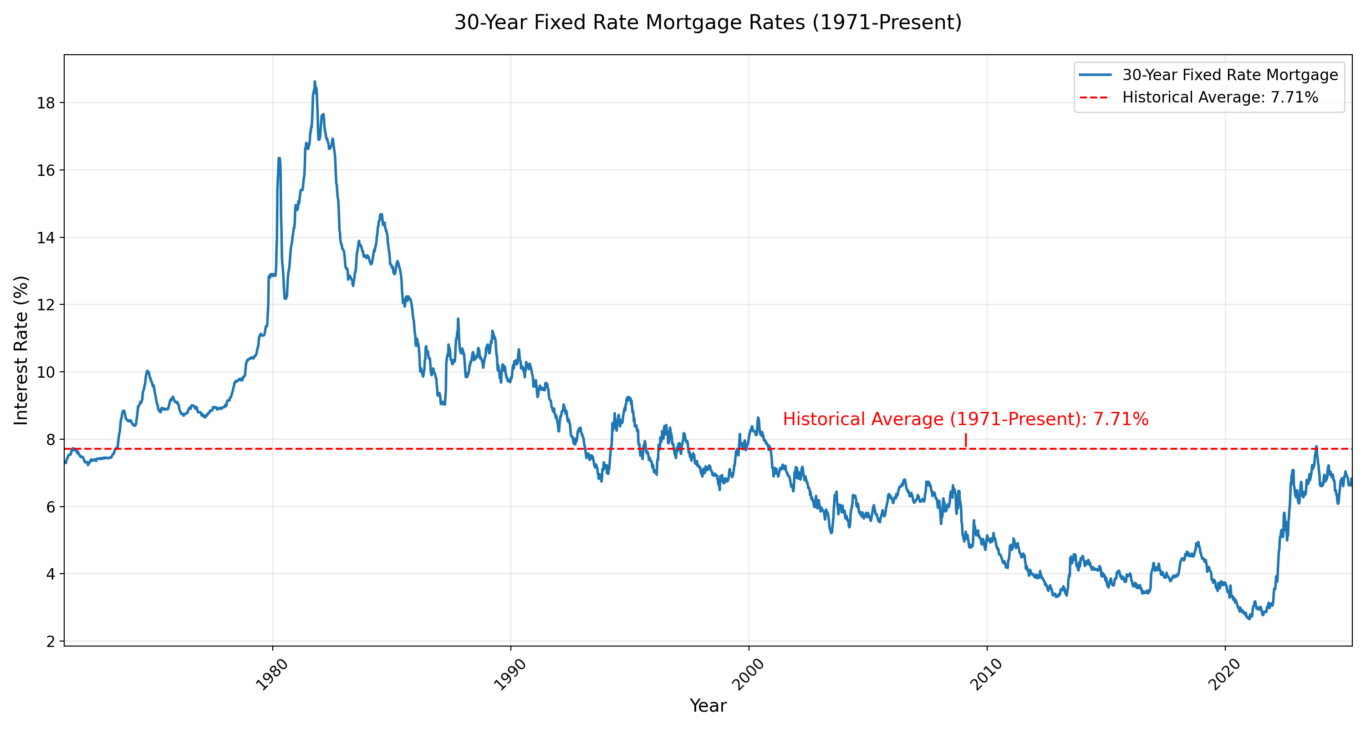
Paul Volcker was appointed as chair of the Federal Reserve by Carter in 1979, but had the most impact in the 1980s when Reagan, proselytizer of small government, backed his austerity program. That immediately threw the U.S. into a severe recession and saw the unemployment rate soar from 6% to 11%.
Nevertheless, austerity broke the back of inflation. The stock market, in the S&P 500, more than doubled over Reagan’s two terms. Optimism is definitely important in economics, despite what the rationalists say. The public also likes to see day-to-day improvement, whatever the long-term costs.
Nevertheless, again, the rosiness of the Reagan years masked the deep damage that was being done to the underlying economy. Post-Reagan, unemployment began to increase again, another recession started, and the deficit tripled from 1980-1990. All of these had been predicted but ignored. George H. W. Bush was forced to break his promise and raise taxes, a good and necessary change. It cost him the election in 1992.
Nothing outstanding happened to the economy as a whole in the 1980s. A look at a GDP graph shows a virtually unbroken 45° increase since the 1960s in current dollars. Stuff that looms large over the short-term is smoothed out into overall growth.