# Why did so many things start going wrong economically in the US starting around 1980
**URL:** https://boards.straightdope.com/t/why-did-so-many-things-start-going-wrong-economically-in-the-us-starting-around-1980/532120
**Category:** Great Debates
**Created:** [March 11, 2010, 4:40pm UTC](https://boards.straightdope.com/t/why-did-so-many-things-start-going-wrong-economically-in-the-us-starting-around-1980/532120 "2010-03-11T16:40:40Z")
**Posts on this page:** 20
**Page:** 1
### Author:  [@Wesley\_Clark](https://boards.straightdope.com/u/Wesley_Clark)
#### Post date: [March 11, 2010, 4:40pm UTC](https://boards.straightdope.com/t/why-did-so-many-things-start-going-wrong-economically-in-the-us-starting-around-1980/532120/1 "2010-03-11T16:40:40Z")
I’m sure Reaganomics and movement conservatism (which both started coming to power in the late 70s and early 80s) played a role.
But there has to be more than that. The congress wasn’t, as far as I know, overtaken by movement conservatives until the 90s. And I don’t get why health care costs have gone up too so dramatically during the same period.
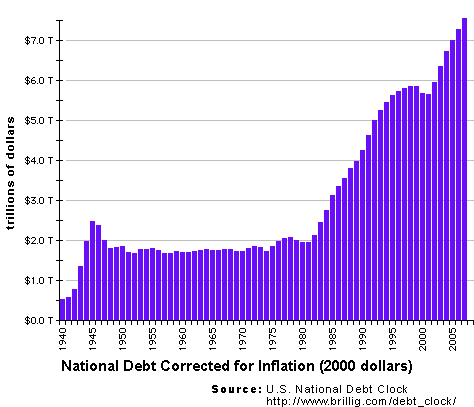
National debt: Fairly minor until 1980.
[ ](http://www.brillig.com/debt_clock/inflation.gif)
Personal debt: It used to be fairly stable, then in 1980 it grew dramatically
[http://blogs.reuters.com/rolfe-winkler/files/2009/12/household-debt-slide.JPG](http://blogs.reuters.com/rolfe-winkler/files/2009/12/household-debt-slide.JPG)
Worker productivity and compensation: They grew together until around 1980, then compensation stopped growing with productivity
[ ](https://i158.photobucket.com/albums/t106/OnlyObvious/EconomicTrends/EPI_Productivity_vs_Compensation.jpg)
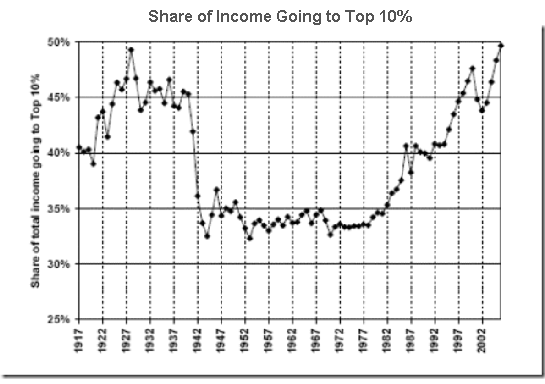
Income inequality: It went down with FDR and stayed down, then starting in 1980 started shooting up
> **[Skitch | Evernote](https://evernote.com/products/skitch)**
>
> Get your point across with fewer words using annotation, shapes and sketches, so that your ideas become reality faster.
[ ](https://www.oftwominds.com/photos09/income1917-2008a.gif)
Health care costs: US spending on health care was in line with other OECD nations from 1960-1980. Back in 1980 we only spent 9% of GDP on health care (compared to 7-8% for European & Canadian countries). However from 1980-today we jumped 8 points (from 9% up to 17% of GDP) while other countries only went up 2-3 points. Canada went from 8% to 11% of GDP in the same time period that our health spending went from 9% to 17% of GDP
> **[U.S. Health Spending Breaks From the Pack | Physicians for a National Health...](http://www.pnhp.org/news/2009/july/us_health_spending.php)**
>
> An orgaization of 16,000 American physicians advocating for single-payer national health insurance.
So starting around 1980 our economy changes. Health care becomes unaffordable, personal and public debt skyrocket, income inequality grows, wages stagnate, and probably other things happened too.
So what were the causes? Most importantly, why did US health care costs remain close to other OECD nations up until 1980 or so, then skyrocket?
---
### Author:  [@suranyi](https://boards.straightdope.com/u/suranyi)
#### Post date: [March 11, 2010, 4:57pm UTC](https://boards.straightdope.com/t/why-did-so-many-things-start-going-wrong-economically-in-the-us-starting-around-1980/532120/2 "2010-03-11T16:57:37Z")
I’m not sure your premise is correct. Things were pretty bad in the late 70s. Things were pretty good in the late 90s.
---
### Author:  [@jasg](https://boards.straightdope.com/u/jasg)
#### Post date: [March 11, 2010, 5:05pm UTC](https://boards.straightdope.com/t/why-did-so-many-things-start-going-wrong-economically-in-the-us-starting-around-1980/532120/3 "2010-03-11T17:05:40Z")
As a member of the boomer generation, I’ve always wondered if we took the 'We want the world and we want it now." a bit too far…
(I’m terrified of what the AARP will do with that mantra)
---
### Author:  [@kenobi\_65](https://boards.straightdope.com/u/kenobi_65)
#### Post date: [March 11, 2010, 5:19pm UTC](https://boards.straightdope.com/t/why-did-so-many-things-start-going-wrong-economically-in-the-us-starting-around-1980/532120/4 "2010-03-11T17:19:47Z")
> [@suranyi](#):
>
> I’m not sure your premise is correct. Things were pretty bad in the late 70s. Things were pretty good in the late 90s.
Absolutely. IIRC, the OP is a young man; if so, he didn’t live through the 1970s and 1980s.
The U.S. economy was a _wreck_ through much of the 1970s, and early 1980s. The oil crisis in '74 or so was a big jolt, and we had several recessions, and serious inflation, during that period.
My parents started a small business in 1979. Between the time when we broke ground on a building in the spring of '79, and opening the doors in October of '79, the interest rates on the business loans which they had taken out _doubled_.
OTOH, the economy grew very strongly through most of the 1990s. I recall some economists, at that time, seriously wondering if the economy had changed to the point where recessions might be a thing of the past.
One factor in the growth in personal debt over the last 30 years is the availability of credit. Modern credit cards only really became common during the 1970s, but it was in the '80s and '90s when the marketing of the cards became more aggressive.
What has also happened is that the consumer perception of debt has changed. A generation or two ago, being in debt was seen by most people as something to be avoided. If you wanted to purchase something, you saved up until you had enough money for it. For many people, that is no longer the case: if they want something, they buy it **now** , on their credit card.
---
### Author:  [@Hentor\_the\_Barbarian](https://boards.straightdope.com/u/Hentor_the_Barbarian)
#### Post date: [March 11, 2010, 5:24pm UTC](https://boards.straightdope.com/t/why-did-so-many-things-start-going-wrong-economically-in-the-us-starting-around-1980/532120/5 "2010-03-11T17:24:50Z")
> [@suranyi](#):
>
> I’m not sure your premise is correct. Things were pretty bad in the late 70s. Things were pretty good in the late 90s.
I swear this place drives me crazy! Did you see all the links? Click on them, and square your off-the-cuff impressions with the data you’ve been given.
Great Debates continues to be a place where people eschew empiricism in favor of their preferred view of the world. Spit out an unsupported opinion and you’re fine. Bother to get data and offer it in support of your position, and it won’t make a lick of difference. I find that fact to be far, far more offensive than any name calling could ever be.
---
### Author:  [@kenobi\_65](https://boards.straightdope.com/u/kenobi_65)
#### Post date: [March 11, 2010, 5:40pm UTC](https://boards.straightdope.com/t/why-did-so-many-things-start-going-wrong-economically-in-the-us-starting-around-1980/532120/6 "2010-03-11T17:40:25Z")
> [@Hentor\_the\_Barbarian](#):
>
> I swear this place drives me crazy! Did you see all the links? Click on them, and square your off-the-cuff impressions with the data you’ve been given.
>
> Great Debates continues to be a place where people eschew empiricism in favor of their preferred view of the world. Spit out an unsupported opinion and you’re fine. Bother to get data and offer it in support of your position, and it won’t make a lick of difference. I find that fact to be far, far more offensive than any name calling could ever be.
Alright, then…
[The U.S. suffered a particularly bad recession from 1973 through 1975, during which high unemployment was coupled with high inflation (“stagflation”). Even though the recession ended in 1975, inflation remained a serious problem though the rest of the decade.](http://en.wikipedia.org/wiki/1973%E2%80%9375_recession)
[The recession in 2001 ended a 10-year period of expansion of the U.S. economy, the longest uninterrupted period of economic growth in U.S. history.](http://en.wikipedia.org/wiki/Early_2000s_recession)
Wesley asked, more or less, “why did things suddenly get bad starting in 1980”? What we’re saying is:
- Depending on what measures you look at, things were pretty bad before 1980.
- Depending on what measures you look at, things were pretty _good_ through most of the 1990s.
---
### Author:  [@kenobi\_65](https://boards.straightdope.com/u/kenobi_65)
#### Post date: [March 11, 2010, 5:47pm UTC](https://boards.straightdope.com/t/why-did-so-many-things-start-going-wrong-economically-in-the-us-starting-around-1980/532120/7 "2010-03-11T17:47:02Z")
> [@kenobi\_65](#):
>
> [The recession in 2001 ended a 10-year period of expansion of the U.S. economy, the longest uninterrupted period of economic growth in U.S. history.](http://en.wikipedia.org/wiki/Early_2000s_recession)
Just to be accurate…this was the longest such expansion period since the National Bureau of Economic Research began tracking these things.
---
### Author:  [@Wesley\_Clark](https://boards.straightdope.com/u/Wesley_Clark)
#### Post date: [March 11, 2010, 6:06pm UTC](https://boards.straightdope.com/t/why-did-so-many-things-start-going-wrong-economically-in-the-us-starting-around-1980/532120/8 "2010-03-11T18:06:02Z")
> [@kenobi\_65](#):
>
> Absolutely. IIRC, the OP is a young man; if so, he didn’t live through the 1970s and 1980s.
>
> The U.S. economy was a _wreck_ through much of the 1970s, and early 1980s. The oil crisis in '74 or so was a big jolt, and we had several recessions, and serious inflation, during that period.
>
> My parents started a small business in 1979. Between the time when we broke ground on a building in the spring of '79, and opening the doors in October of '79, the interest rates on the business loans which they had taken out _doubled_.
>
> OTOH, the economy grew very strongly through most of the 1990s. I recall some economists, at that time, seriously wondering if the economy had changed to the point where recessions might be a thing of the past.
>
> One factor in the growth in personal debt over the last 30 years is the availability of credit. Modern credit cards only really became common during the 1970s, but it was in the '80s and '90s when the marketing of the cards became more aggressive.
>
> What has also happened is that the consumer perception of debt has changed. A generation or two ago, being in debt was seen by most people as something to be avoided. If you wanted to purchase something, you saved up until you had enough money for it. For many people, that is no longer the case: if they want something, they buy it **now** , on their credit card.
True, there were problems in the 70s and other eras.
But from the data I found, it seems many things were fairly stable (private debt, public debt, health care costs, income inequality, productivity/compensation) then around 1980 things started changing on all fronts. Public and private debt started growing, health care (which had until then grown at the same rate as other OECD nations) started growing 2-3x faster than other nations. Productivity gains did not result in more wages. Income inequality rapidly grew.
---
### Author:  [@BrainGlutton](https://boards.straightdope.com/u/BrainGlutton)
#### Post date: [March 11, 2010, 6:16pm UTC](https://boards.straightdope.com/t/why-did-so-many-things-start-going-wrong-economically-in-the-us-starting-around-1980/532120/9 "2010-03-11T18:16:09Z")
I would say it is all because outsourcing, offshoring and the deindustrialization of America got going about then. American prosperity since WWII had been based on the existence of a vast supply of low-skill, high-wage manufacturing jobs, which lifted much of the working-class to a middle-class standard of living – a development without precedent anywhere in the industrialized world. And then in the '80s all of that started to go away. Automation/technological unemployment was also a factor. Economist [Robert Reich](http://en.wikipedia.org/wiki/Robert_Reich) (Clinton’s first Secretary of Labor) studied all this in his 1991 book _The Work of Nations._
---
### Author:  [@Shodan](https://boards.straightdope.com/u/Shodan)
#### Post date: [March 11, 2010, 6:17pm UTC](https://boards.straightdope.com/t/why-did-so-many-things-start-going-wrong-economically-in-the-us-starting-around-1980/532120/10 "2010-03-11T18:17:41Z")
Right, right - everything really sucked during the 80s and 90s. (Apart from the poverty rate, unemployment rates, home ownership, interest rates, GDP growth, and the misery index.)
But everything else sucked.
Why? I blame Bush.
Regards,
Shodan
---
### Author:  [@kenobi\_65](https://boards.straightdope.com/u/kenobi_65)
#### Post date: [March 11, 2010, 6:28pm UTC](https://boards.straightdope.com/t/why-did-so-many-things-start-going-wrong-economically-in-the-us-starting-around-1980/532120/11 "2010-03-11T18:28:15Z")
Regarding the growth in the national debt during the 1980s:
U.S. spending on defense increased dramatically during the decade, despite the fact that it was the only decade since the 1930s in which we weren’t involved in a war. The defense budget in 1988 (President Reagan’s final year in office) was 41% higher than it was in 1980 (President Carter’s last year in office):
> **[U.S. Military Spending, 1946–2009](https://www.infoplease.com/us/military/us-military-spending-1946-2009)**
>
> (billions of actual or projected...
Reagan’s strategy appeared to be to force the Soviet Union to increase their own military spending commensurately, and drive them into financial collapse.
Reagan also decreased spending on non-military programs, but he also cut taxes. [The net result of all this was that the federal deficit grew from $700 billion to $3 trillion during his terms.](http://en.wikipedia.org/wiki/Ronald_reagan#Presidency.2C_1981.E2.80.931989)
---
### Author:  [@BobLibDem](https://boards.straightdope.com/u/BobLibDem)
#### Post date: [March 11, 2010, 6:32pm UTC](https://boards.straightdope.com/t/why-did-so-many-things-start-going-wrong-economically-in-the-us-starting-around-1980/532120/12 "2010-03-11T18:32:10Z")
There is no evidence that the Soviets actually attempted to keep up with the US in defense spending in this time, hence no credibility to the claim that Reagan “won” th Cold War.
Anyway, Reagan gave birth to the current childish political attitude that yes, there is a free lunch and we’re going to eat it. Every tax makes Baby Jesus cry and you can spend, spend, spend without a thought as to where the money is coming from. The country started going to hell in the 1980s because Reagan made personal responsibility a thing of the past.
---
### Author:  [@adhay](https://boards.straightdope.com/u/adhay)
#### Post date: [March 11, 2010, 6:46pm UTC](https://boards.straightdope.com/t/why-did-so-many-things-start-going-wrong-economically-in-the-us-starting-around-1980/532120/13 "2010-03-11T18:46:02Z")
> [@Shodan](#):
>
> … Why? I blame Bush.
>
> Regards,
> Shodan
I blame Bush on Reagan.
---
### Author:  [@Latro](https://boards.straightdope.com/u/Latro)
#### Post date: [March 11, 2010, 7:30pm UTC](https://boards.straightdope.com/t/why-did-so-many-things-start-going-wrong-economically-in-the-us-starting-around-1980/532120/14 "2010-03-11T19:30:01Z")
> [@adhay](#):
>
> I blame Bush on Reagan.
That was in jest, yes?
Bush was the power behind \* Reagan’s\* throne.
Rumsfeld and Dick are sure to fit in somewhere too.
---
### Author:  [@adhay](https://boards.straightdope.com/u/adhay)
#### Post date: [March 11, 2010, 7:44pm UTC](https://boards.straightdope.com/t/why-did-so-many-things-start-going-wrong-economically-in-the-us-starting-around-1980/532120/15 "2010-03-11T19:44:33Z")
> [@Latro](#):
>
> That was in jest, yes?
More or less. I blame Milton Friedman for both of 'em.
---
### Author:  [@Shodan](https://boards.straightdope.com/u/Shodan)
#### Post date: [March 11, 2010, 8:03pm UTC](https://boards.straightdope.com/t/why-did-so-many-things-start-going-wrong-economically-in-the-us-starting-around-1980/532120/16 "2010-03-11T20:03:13Z")
I remember te dark days of the 80s amd 90s.
Those were terrible times. People would sometimes be unemployed for hours at a time between jobs. I remember when I changed jobs - it took me almost a full week, and I was forced to accept a measly 6% increase. Do you know what that means when you are trying to support a family?
The gnawing uncertainty was the worst - not knowing if another stock market gain was going to burden you with too much income for your retirement, the dark sense of shame of having to go to work every single morning and never see a single unemployment check, the terrifying realization that the IBM-360 you grew up on has been eclipsed by a desk top model with more processing power that retails at under $1000, the hopeless expressions on Saudi faces as oil prices dropped - again.
And the glum pessimism of seeing the government aiming nuclear missiles at my house falling behind before my eyes, and knowing that my President was such a fool that he actually believed that the Cold War could be won, and his ridiculous delusions that he could actually [eliminate a whole class of nuclear missiles in Europe](http://news.google.com/newspapers?nid=861&dat=19830118&id=pnEcAAAAIBAJ&sjid=gVgEAAAAIBAJ&pg=6356,4421190).
It was awful. Nothing like the roaring recovery, disappearing deficits, and scads of well-paid, secure jobs and affordable health care we enjoy today.
But you tell kids that, and they’ll never believe you.
Regards,
Shodan
---
### Author:  [@Wesley\_Clark](https://boards.straightdope.com/u/Wesley_Clark)
#### Post date: [March 11, 2010, 8:16pm UTC](https://boards.straightdope.com/t/why-did-so-many-things-start-going-wrong-economically-in-the-us-starting-around-1980/532120/17 "2010-03-11T20:16:53Z")
> [@Shodan](#):
>
> I remember te dark days of the 80s amd 90s.
>
> Those were terrible times. People would sometimes be unemployed for hours at a time between jobs. I remember when I changed jobs - it took me almost a full week, and I was forced to accept a measly 6% increase. Do you know what that means when you are trying to support a family?
>
> The gnawing uncertainty was the worst - not knowing if another stock market gain was going to burden you with too much income for your retirement, the dark sense of shame of having to go to work every single morning and never see a single unemployment check, the terrifying realization that the IBM-360 you grew up on has been eclipsed by a desk top model with more processing power that retails at under $1000, the hopeless expressions on Saudi faces as oil prices dropped - again.
>
> And the glum pessimism of seeing the government aiming nuclear missiles at my house falling behind before my eyes, and knowing that my President was such a fool that he actually believed that the Cold War could be won, and his ridiculous delusions that he could actually [eliminate a whole class of nuclear missiles in Europe](http://news.google.com/newspapers?nid=861&dat=19830118&id=pnEcAAAAIBAJ&sjid=gVgEAAAAIBAJ&pg=6356,4421190).
>
> It was awful. Nothing like the roaring recovery, disappearing deficits, and scads of well-paid, secure jobs and affordable health care we enjoy today.
>
> But you tell kids that, and they’ll never believe you.
>
> Regards,
> Shodan
LOL!
Though many things did start to change around 1980. Before then our health care costs were on par with other wealthy nations. Then they started rising dramatically. Income inequality, which had been stable, started rising again. Debt exploded. Compensation and productivity became decoupled.
I could understand issues like public debt, or private debt, income inequality and compensation/productivity coming down to supply side economics and Milton Friedman’s ideas.
However I don’t know why/how health care changed so dramatically around 1980. Why did we go from a nation that went from spending 9% up to 17% on health care over 30 years when during that same period other OECD nations went from about 7-8% up to 10-11%?
---
### Author:  [@Magiver](https://boards.straightdope.com/u/Magiver)
#### Post date: [March 11, 2010, 8:23pm UTC](https://boards.straightdope.com/t/why-did-so-many-things-start-going-wrong-economically-in-the-us-starting-around-1980/532120/18 "2010-03-11T20:23:00Z")
> [@BrainGlutton](#):
>
> I would say it is all because outsourcing, offshoring and the deindustrialization of America got going about then. American prosperity since WWII had been based on the existence of a vast supply of low-skill, high-wage manufacturing jobs, which lifted much of the working-class to a middle-class standard of living -
I disagree. The manufacturing jobs were anything but low-skill. They existed because the United States had something like 75% of all manufacturing facilities in the world at the end of WW-II. Much of the industrialized countries of Europe and Asia had their heavy manufacturing facilities destroyed during the war. For the United States, that was an unprecedented position to be in and it will never be repeated in history. What people took for granted as a way of life was a one time event.
Taking it one step further, the countries like Japan that had to rebuild ended up building more modern facilities than the US and there was a leap-frogging effect. People my age remember the term “made in Japan” as a euphemism for shoddy merchandise. Nobody thinks that today.
---
### Author:  [@Magiver](https://boards.straightdope.com/u/Magiver)
#### Post date: [March 11, 2010, 8:25pm UTC](https://boards.straightdope.com/t/why-did-so-many-things-start-going-wrong-economically-in-the-us-starting-around-1980/532120/19 "2010-03-11T20:25:37Z")
> [@BobLibDem](#):
>
> There is no evidence that the Soviets actually attempted to keep up with the US in defense spending in this time, hence no credibility to the claim that Reagan “won” th Cold War.
I’m sorry but there was absolutely a cold war involving vast expenditures of money on defense by both the Russians and the United States. The difference was that the Russians didn’t have much of an economy to start with.
---
### Author:  [@adhay](https://boards.straightdope.com/u/adhay)
#### Post date: [March 11, 2010, 8:29pm UTC](https://boards.straightdope.com/t/why-did-so-many-things-start-going-wrong-economically-in-the-us-starting-around-1980/532120/20 "2010-03-11T20:29:08Z")
> [@Shodan](#):
>
> … It was awful. Nothing like the roaring recovery, disappearing deficits, and scads of well-paid, secure jobs and affordable health care we enjoy today. …
>
> Regards,
> Shodan
Ho, ho, ho.
If trickle down had been recognized as hemorrhage up (Bush 41 called td voodoo economics and Dave Stockman repudiated it) and the American people had not accepted avuncular style for substance, most of us would be better off and the fantasy world you laugh at would be much closer to reality.
[Next page](https://boards.straightdope.com/t/why-did-so-many-things-start-going-wrong-economically-in-the-us-starting-around-1980/532120.md?page=2)