So I went looking for cites and all I can find is studies saying that people don’t recognize the faces of people they feel are socially inferior.  I swear I heard the other thing on NPR.
I’ve heard “all you white people look the same” so often that it no longer surprises me. People in China and Cameroon regularly get me mixed up with people who (to me) look nothing like me at all.
I’ll be the first to admit that it took me a while to get used to recognizing people in China. Sure, my friends are easy because I know their personality so well. But my students are pretty much all around 5’2, thin, with long wavy black hair, brown eyes and a fondness for pink sweaters. Yeah, chances are I probably won’t recognize them on the street.
I think most Americans are used to using race, hair and eye color and height to identify people. We generally don’t focus on facial structure and exact skin tones. So yeah, it does take a while to get used to finding new ways of recognizing people.
Anyway, it’d always crack me up in Cameroon when people would give descriptions like “Oh, you know, Bouba, the black guy.” To me, everyone counted as “black.” But to a Cameroonian you’d get that description by being oh-so-slightly blacker than everyone else.
Meanwhile my Chinese students are all freaking out about their skin tone, wanting it to be as white as possible. Many of them consider skin tone to be the most important aspect of beauty, and the saying is that “white skin covers one thousand flaws.” As a white foreigner, I have pretty much no awareness of skin tone and think it’d be pretty strange to compare skin tones with someone of my own race in the same general range. So when I look out on my classroom I see a sea of girls who have pretty much the same mid-toned skin. But when they look they see this complicated hierarchy based on (to me) really subtle variations of skin tones. They can tell you exactly who has a good skin color and a bad one and where they fit in. They notice when I come in with even the slightest tan from walking around a bit in the sun. Whereas I’d be hard pressed to describe someone’s skin color beyond their race and “light, olive, tanned, dark.”
So yeah, other people really notice stuff we don’t.
I am about as white bread as a person can be, and I always recognize my students in China anywhere I might be. I find it odd that you would not recognize your students on the street.
I see such a large variation in Chinese people that I have never confused one for another or not recognized a face.
Of course, generalizations or stupid questions are not limited to western people.
The Chinese have asked me many questions that have made me rolled my eyes.
The one seemingly common belief here in China is that all western movies and TV are based on reality. It is difficult to convince them that not everything they see in American movies and TV is real.
Actually that has been a common problem in every country that I have visited. Many people ignorantly think that they understand or know everything about America because they have watched American movies and TV. They just cannot accept that most movies and TV are not reality.
Well, either you are a better man than me, are better at recognizing people than me, have fewer students than me, or live in a more cosmopolitan place with a wider variety of people. All of these are quite likely.
Yeah, seriously. I made a trip out to Taiwan for the Chinese New Year, and I ran into the son of a family friend there. He’s around my age, and I was telling him that one of my American friends recently moved to the country to learn Mandarin. His response:
“Do you mean he’s an Asian American or a real American?”
:rolleyes:
Some comments from the original poster:
- There are no U.S. troops permanently stationed in the Philippines anymore outside diplomatic installations (Embassy and U.S. Consulate-General).
- White people are often charged double or triple what others are charged. I live here and earn about the same as locals (I earn in a month what I used to earn in a day.)
- The Philippines calls itself the third largest English-speaking country in the world. Yet 99% of the population speaks another language as a mother tongue. Pronunciations and definitions often get mixed up.
- I like what the first respondent said about Joe being what prostitute customers answered when asked their name. I heard that when I lived in Vietnam.
- The Filipino culture is more like the Spanish than the American culture. But even that’s a little messed up, since no one speaks Spanish.
Some definitions:
ACCEPT - - means “offer” (We accept delivery.)
SURPLUS - - used (many countries send the vehicles that are not allowed because of their age here, such as Korea and Singapore)
FIXER - - a shyster
Pronunciations:
DELICACY - - del LICK ass see
CONTRIBUTE - - CONN trib butte
CHOCOLATE - - CHOKE coal late
Well, it still kind of is. Because while people of a race may look alike to someone who hasen’t ever been exposed to many people of that race, they don’t actually look alike; they just have difference distinguishing features. I guess I’d say “People of Ethnicity X all look alike” is racist but “I have trouble telling people of Ethnicity X apart” is just being honest.
In fairness, many in the U.S. don’t consider New York to be part of ‘real’ America either.
It depends on what’s expedient at the time. For example if a newspaper is reporting the number of foreigners then they’ll lump everyone together as 外国人regardless of race or nationality. But if someone were reporting how someone else looked and they said something like “gaijin/gaikokujin poi” they’d be referring to a white westerner almost certainly.
Many Japanese don’t consider it impolite, just a statement of fact, so they’ll use it all the time.
I’m talking about gaijin, not gaikokujin. It’s the former that IME is applied pretty exclusively to white foreigners.
Again, *gaijin *vs. gaikokujin. The former is the term that’s potentially offensive (and I know it made at least some Japanese I knew uncomfortable).
That happens with every country you name; the Greek had to start playing and dancing the theme song of “Zorba the Greek” in restaurants and parties because tourists were convinced that it was more authentic than the real traditional songs. People tend to believe the made-up stuff and disbelieve the realistic parts, even. Heck, one of my classmates (MSc in translation, in the UK, very international group) asked us whether the hats worn by some people in Pan’s Labyrinth are real… and at least she asked! (Yes, the Guardia Civil does wear those patent-leather tricorns, although they’re mostly ceremonial right now).
Well I don’t think that’s true anymore, if it ever was. I see and hear gaijin used for ‘whites’ and ‘non-whites’ alike. Less so for economic boom ‘asians’, but there you have it - in those cases it’s more important to specify country (such as Taiwan or China). In any case, it’s a clumsy term that persists despite it’s uselessness as a descriptor. So when most Japanese people hear gaijin it just means “not-Japanese, probably white but possibly black or asian”. If you subject it to absolute scrutiny in how it is used, it just means ‘not Japanese’.
Yes, let me say it again, since 外人was the only term used in your original post, I was referring to 外人 - many Japanese people don’t think it’s offensive. Really.
And what’s up with Americans calling everyone “Guy”? Even if your name is Jacque, not Guy.
Reminds me of a bit in Little Big Man (the book, doubt it’s in the movie). The protaganist is talking to a former slave who wants to run away to join the Indians, and reminds him that to the Indians, the former slave is a white man (just a dark-skinned one).
Yup. Here’s a song about it: http://www.robbieoconnell.com/songbook/youre_not_Irish.html
When I first moved to Bulgaria, I lived with a host family in a small village (pop. 700) for three months. About a year later, I went back to visit. In the meantime, my host family had had another host daughter, who had since also gone on to live in another town. I hadn’t met her, but I knew she was Korean-American.
Anyway, on this visit, my host mom asked me what kind of people live in America. (Okay, maybe she had wondered this before, but my Bulgarian had improved a lot over the year so now we could talk about stuff much better.) I told her “oh, white and black and Asian…like Jane, you know?” My host mom said “Jane isn’t American, she’s Korean!” We then proceeded to have a short argument about whether or not Jane could be American, which I settled by saying that to be a Peace Corps Volunteer, you have to be American, and therefore it didn’t matter where Jane’s parents were from, she was American.
I think it kind of blew my host mom’s mind. And a Chinese-American volunteer I knew could not convince her Bulgarian colleagues that she was American, didn’t speak Chinese, had never been to China, and didn’t really know a whole heck of a lot about life in China. Trying to be polite, they asked her many questions about her homeland…China.
Of course, Bulgaria is a place where people of Turkish descent have been living in the country for generations and generations - but they’re still Turkish. (Which once led to one of my students being confused about why I wasn’t allowed to vote in an election. If the Turks can vote, how come Americans can’t vote too?)
I think most for Germans, at least in the US-occupied areas, GIs were the first black people they saw after WW2. I’ve heard several such stories, from my grandmother among others - the first black people, and soldiers giving out candy.
There still is a German pastry with white and black sugar coating called Amerikaner. Wiki doesn’t support that story, but I think it’s neat
The term reminds me of this funny Youtube channel:
“Amerikanong Slang (Part 2) - Hey Joe Show”
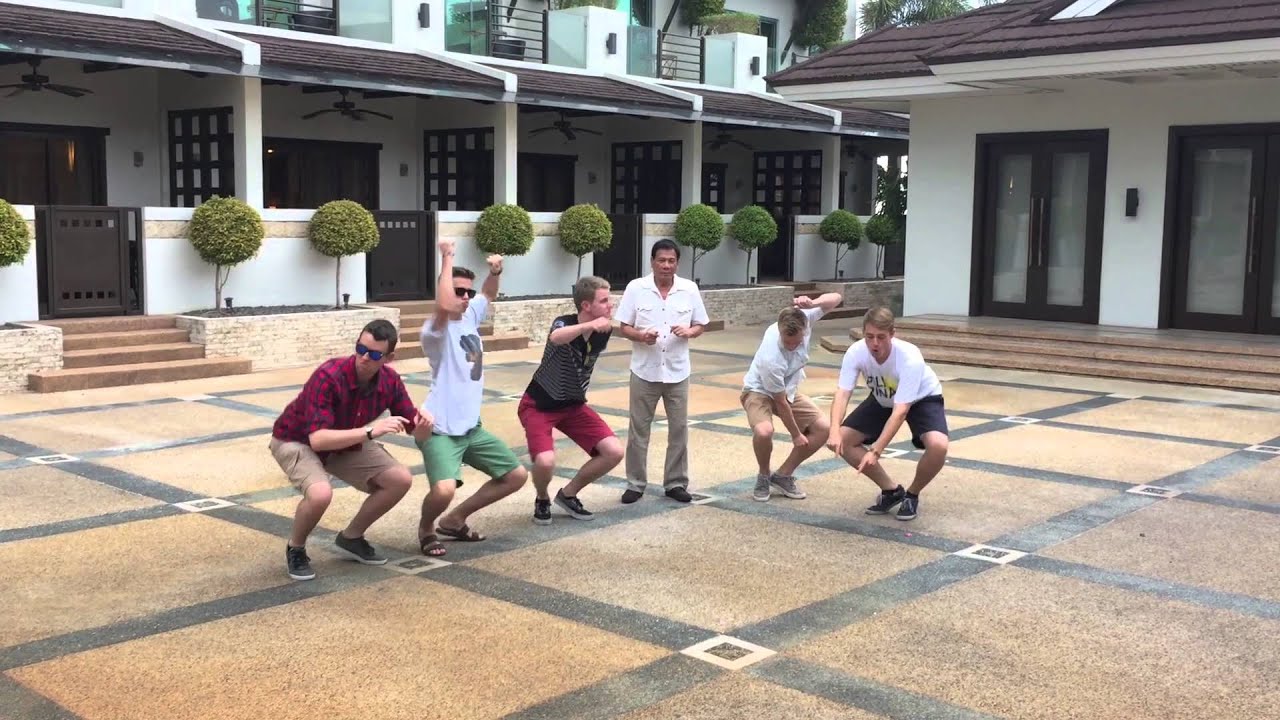
"Meeting the President (Duterte) of the Philippines - Hey Joe Show" "Ang SAYAW ni PRESIDENT DUTERTE - Hey Joe Show!"