You can buy survival candles that are meant to supply a bit of heat in an enclosed space.
https://pagebean-pagebean.netdna-ssl.com/sciplus/productImages/Regular/55797.jpg
You can burn a lot of stuff that isn’t wood. I mean, everybody poos.
Dung fires aren’t especially good for you, especially in an enclosed space, but you do what you’ve gotta do.
For some values of ancient. This living arrangement was very typical up through the Middle Ages and even into the 19th century in many places.
Also led to viruses jumping species.
With few or no skills and knowledge for doing the practical and manual tasks required for “primitive” living.
Among Native Americans? AFAICT, no, not in any systematic way. I imagine anybody constantly burning wood for fuel occasionally obtained some probably negligible amount of charcoal on parts of logs that got just the right amount of oxygen deprivation.
For colonial settler life, you might like to check out some of the videos from Townsends.
Charcoal is really expensive compared to firewood, so it wasn’t generally used for everyday heat. I’m not sure what the ratio to the amount of wood needed to be burned to the resulting charcoal, but it’s pretty high. In the proper environment (enclosed, insulated, with forced air) a charcoal fire can get much hotter than a wood fire, well over 1000 °C. So it was used mainly for industries that required that: smelting and forging metals, glassmaking, lime kilns.
Note that in metalworking, charcoal, being almost pure carbon, has the advantage over both wood and coal in not introducing unwanted impurities into the final product. That’s also why they use coke in metalworking. Coke is coal with the impurities driven off, just as charcoal is wood with impurities driven off.
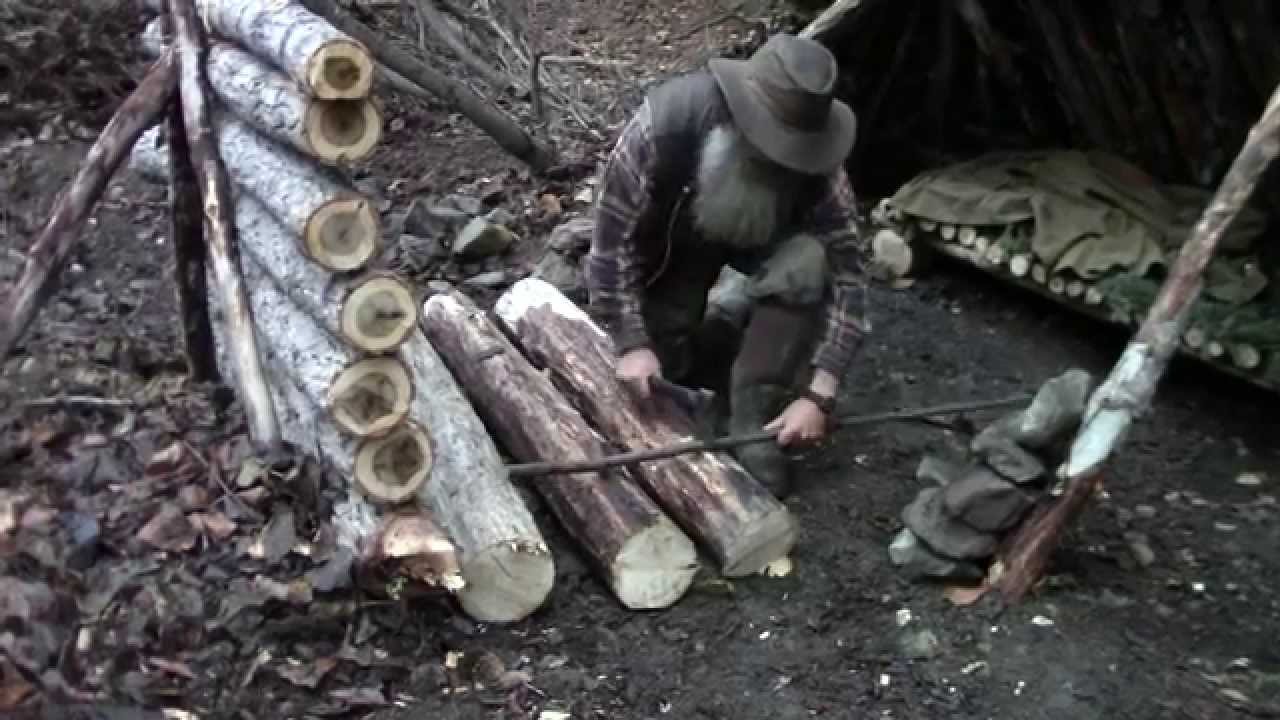
So, if you were the guy in the video above, eking out a primitive living with no modern tools, would you skip making charcoal for yourself and just burn wood?
Presumably he is not making it for industrial purposes.
(And yes, I know the guy making YouTube videos is not really “eking out a primitive living” in reality.)
I recall a discussion of this point once - European cooking, in a land overflowing with forests, tended to often roast an animal whole (or large chunks) over a large cooking fire. In places like China in areas where the human-to-forest ratio was much greater, and wood was scarce, they tended to chop meat and veggies into small bits so they cooked through much faster, with less fuel.
(I recall on 2010 seeing even in downtown Beijing there were piles of pressed charcoal or coal briquettes for sale outside of large 20-story modern high rises. Still the most effective and cheap means of cooking when electricity and liquid fuels are expensive.)
Another point is that an igloo is a very well insulated structure; yes, it’s all ice, but the thick walls are insulation against external temperatures well below freezing. Same with other North American indigenous dwellings, they would pile on branches and fir tree bits.
I also imagine that the available deadfall and small branches were numerous when living in a forested area. For bigger jobs, I remember reading of the west coast tribes making canoes by felling giant pine trees - they would heat rocks in a open fire, then press them around the trunk. The charred wood was easy to bash away. When you reached unburnt wood - repeat. Same technique to hollow out the dugout canoes from logs six feet or more in diameter. They also carved totem poles before acquiring metal tools, so presumably pointy rocks worked well. (They did, however, go on a giant carving spree as soon as they got the metal tools, hence all the huge totem poles and other carvings.)
I also recall some articles about natives carrying coals from camp to campsite. A birchbark container lined with dry moss could keep an ember hot enough for a day or more, so that just blowing on it could cause it to light kindling at the new campsite. That linked video is one of a series, and in a few he makes fire by rubbing sticks. There’s a technique to it. Some museums have Inuit fire bows - Something like a fiddle bow, with the line wrapped around a stick; saw the bow to rotate the stick back and forth while using a cupped rock to apply pressure. the base of the stick will eventually light sawdust or leaves. I think the guy in the video just presses down as he rubs to rotate a stick back and forth quickly.
Also, for assorted carpentry or firewood, using wedges (rock or wood) to split logs along the grain works pretty well. You don’t need an axe, a wedged rock works when hammered.
A earthen pot inside a small wicker basket (kangri) is used as a personal heater in Kashmir, India. Embers from a wood fire is kept inside the earthen pot. Not a lot of wood gathering is needed to keep an individual warm :
My father made it to Eagle Scout and claims once you learn the knack for fire starting it’s easy. Apparently he and a fellow Scout from his troupe used to win contests at Jamborees.
He was making it for industrial purposes, I believe. He made several attempts to produce a usable amount of iron from some iron-rich clay. Also a lot of his videos concern kilns for firing pottery, as pottery is one of the primary bits of ‘high-tech’ in the stone age - vessels, bricks, roof tiles, etc. But it seems to me that he got enough heat for pottery just out of wood by using various tricks to increase the draft of his kilns, and the charcoal was explicitly for his attempts at metallurgy. It’s been a while since I watched though. He hasn’t uploaded anything for a long time.
When I was a scout, fire making was all flint/steel. You sure your dad used other methods?
Thanks for the primitive/settler vids, guys. I REALLY needed another time suck! 
Anyone notice the guys doing the primitive activities aren’t exactly 98# weaklings?!  My GOD - but that one guy is ripped! I was wondering about the energy he used to lift that freaking boulder to drop on the lengths of wood - as opposed to the energy he would derive from the length of wood…
Just a comment on this, an anagama kiln, built into the side of a hill, with the fire at the base and the pottery upslope, can create quite high temps with a wood fire (I think this is likely a similar option to what @Gorsnak meant by various tricks). And theoretically, you could use the same device (replacing tightly packed dry wood for the pottery) to make high quality kiln dried wood and/or charcoal, although the latter would involve careful sealing ( clay and the like) after the initial firing.
Human beings existed in all parts of the planet successfully for many thousands of years before the Bronze Age. I always find it kind of annoying when those who have never lived without fossil fuels let alone metallurgy, imagine that life before modern times was horribly, horribly, uncomfortable. No, most of the time it was just fine. People had very different skills than we do.
Natives of cold climates didn’t spend months trying to get up enough firewood to survive. They used less resource-intensive means – for example, Iroquois spent winters with the whole village sleeping in one long building. Huge diversity of solutions to keeping warm.
I know Inuit used a type of oil lamp (kudlik?), But I suspect it was more for light and utility than heat. An igloo is plenty warm. Inuit survived with very little wood to use.
I have slept in snow caves and quinzhees. Not that different from inuit snow shelters. They are better insulated than any modern home and will quickly stabilize to a temperature a little above freezing. Quite comfortable, you are still going to be wearing warm clothing, but really the biggest problem with them is humidity and moisture. They are dark and extremely quiet. Some of the best sleeps I have ever had really.
Indigenous peoples of Alberta often relied on dried bison dung for fuel, huddled in bison skin shelters. For a nomadic lifestyle you would not need much in the way of tools to harvest dead wood and material from bushes and scrub.
A healthy forest will produce a lot of deadwood for a small settlement. Consider that medieval serfs were often were only allowed to harvest fallen wood for their fuel needs.
Eleanor Arnason’s terrific anthropological SF novel, A Woman of the Iron People, contains this gem:
Always remember, in a society with a pre-industrial technology, everything takes far longer than you think it will. Everything involves a lot more work. And there are almost always a lot of bugs.
I imagine that would apply to the getting the wood, too. But when it’s necessary to keep you alive, and keeping everyone alive is everyone’s one and only job, you just put in the time, I guess. (And I like the idea of “pre-industrial technology.” Just because it’s not our technology, that doesn’t mean it’s not technology.)
As the old proverb says, “Man who chops own firewood is twice warmed.” 
The Townsends videos do have several middle-aged/elderly/heavy/female people helping make the bricks and split the logs and tote the barrows and all, so being a super-athletic young guy isn’t really necessary for primitive activities if you can harness the power of teamwork. For a lone pioneer, though, yeah raw strength is probably a huge advantage.
Modern notions of ‘firewood’ are often neat little split pieces of log that you can pick up with one hand and place into a wood stove or fireplace, but if you’re feeding an open fire on the ground, or inside a hut, etc, it’s not necessary to cut the wood so small - you lay a long piece of branch over the fire and let the fire burn through it - then you have two shorter pieces that you can just feed into the fire as the ends burn away.
Still some cutting required just to get the wood out of the woods, of course, but not nearly so much of it as you would need to prepare neat and tidy modern firewood.
One other thing to note - beech trees when they are allowed to grow to maturity, tend to get to a size where they just suddenly fall apart, and beech timber being somewhat brittle, a tree that ends its life in this way often smashes itself into somewhat manageable pieces as it falls.
Is there any explanation in the videos of why he made his axe of stone rather than flint? While flint has a much sharper edge than stone, does it split if used to chop down a tree?
Or you can build a long log fire:
Stranger
Yeah, attitudes are clearly different. Spending the whole winter snowed in with all your family and neighbors, with no TV, or books, or recorded music, sounds to modern people like a great set up for a disaster movie or horror movie, not “everyday life”.