# YouTube videos about geometric construction
**URL:** https://boards.straightdope.com/t/youtube-videos-about-geometric-construction/1002811
**Category:** In My Humble Opinion
**Tags:** science-math
**Created:** [June 13, 2024, 2:23am UTC](https://boards.straightdope.com/t/youtube-videos-about-geometric-construction/1002811 "2024-06-13T02:23:09Z")
**Posts on this page:** 8
**Page:** 1
### Author:  [@Lumpy](https://boards.straightdope.com/u/Lumpy)
#### Post date: [June 13, 2024, 2:23am UTC](https://boards.straightdope.com/t/youtube-videos-about-geometric-construction/1002811/1 "2024-06-13T02:23:09Z")
I’ve read repeatedly that one cannot divide a circle into seven equal arcs with just a compass and unmarked straightedge. So why are there several YouTube videos which seem to demonstrate doing so? Inaccurate? Cheating?
---
### Author:  [@PastTense](https://boards.straightdope.com/u/PastTense)
#### Post date: [June 13, 2024, 3:04am UTC](https://boards.straightdope.com/t/youtube-videos-about-geometric-construction/1002811/2 "2024-06-13T03:04:35Z")
Here is one of those videos:
[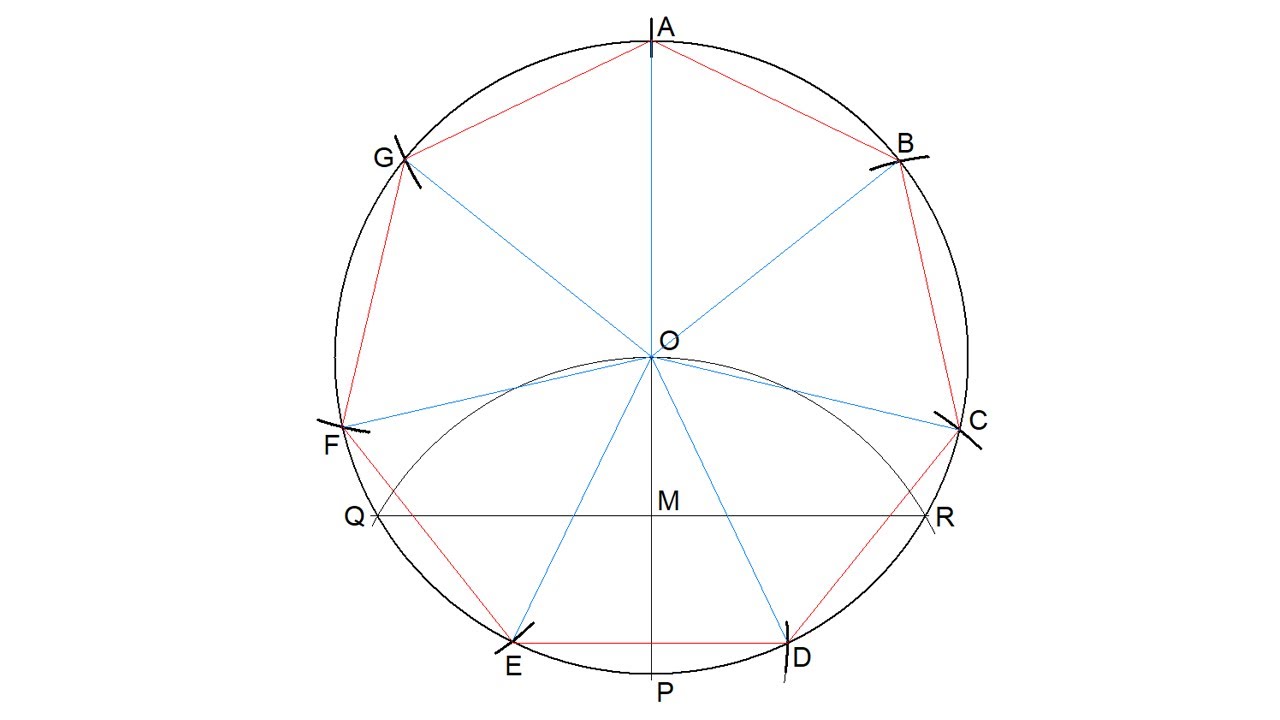 ](https://www.youtube.com/watch?v=mJ-fe4T7irE&t=17s/)
And I note this comment:
> Sorry, but this doesn’t seem right. The heptagon is not constructible with compass and straightedge. When you ‘close it’ I don’t think it actually closes. It only looks so because the length of your ‘sides’ is very very close to what it should be (they have length approx. 0.8660 and should have length approx. 0.8678). You can read more about this here:
> **[Heptagon](https://en.wikipedia.org/wiki/Heptagon)**
>
> In geometry, a heptagon or septagon is a seven-sided polygon or 7-gon.
> The heptagon is sometimes referred to as the septagon, using "sept-" (an elision of septua-, a Latin-derived numerical prefix, rather than hepta-, a Greek-derived numerical prefix; both are cognate) together with the Greek suffix "-agon" meaning angle.
> A regular heptagon, in which all sides and all angles are equal, has internal angles of 5π/7 radians (128.mw-parser-output .frac{white-space:nowrap}.mw-parser-output .frac ....
---
### Author:  [@Lumpy](https://boards.straightdope.com/u/Lumpy)
#### Post date: [June 13, 2024, 3:21am UTC](https://boards.straightdope.com/t/youtube-videos-about-geometric-construction/1002811/3 "2024-06-13T03:21:12Z")
That’s what I suspected: that’s there’s an almost-correct construction that looks right if your measurements with the compass are imprecise enough.
---
### Author:  [@DaveUnknown](https://boards.straightdope.com/u/DaveUnknown)
#### Post date: [June 13, 2024, 3:42am UTC](https://boards.straightdope.com/t/youtube-videos-about-geometric-construction/1002811/4 "2024-06-13T03:42:52Z")
deleted- nevermind
---
### Author:  [@DPRK](https://boards.straightdope.com/u/DPRK)
#### Post date: [June 13, 2024, 5:51am UTC](https://boards.straightdope.com/t/youtube-videos-about-geometric-construction/1002811/5 "2024-06-13T05:51:10Z")
The geometric construction of a regular heptagon is with a _marked_ ruler. Here is a description:
> **[Regular Heptagon -- from Wolfram MathWorld](https://mathworld.wolfram.com/RegularHeptagon.html)**
>
> The regular heptagon is the seven-sided regular polygon illustrated above, which has Schläfli symbol {7}. According to Bankoff and Garfunkel (1973), "since the earliest days of recorded mathematics, the regular heptagon has been virtually relegated...
> [@Lumpy](#):
>
> I’ve read repeatedly that one cannot divide a circle into seven equal arcs with just a compass and unmarked straightedge. So why are there several YouTube videos which seem to demonstrate doing so? Inaccurate? Cheating?
Well, if it does not have to be _exactly_ regular then yes, you can do it, as has been known for millennia.
---
### Author:  [@Chronos](https://boards.straightdope.com/u/Chronos)
#### Post date: [June 13, 2024, 1:16pm UTC](https://boards.straightdope.com/t/youtube-videos-about-geometric-construction/1002811/6 "2024-06-13T13:16:22Z")
> [@Lumpy](#):
>
> So why are there several YouTube videos which seem to demonstrate doing so?
Because they got all excited about folks saying that it was impossible, and then didn’t go to the trouble to actually understand what they were doing.
Reminds me of a fellow I heard of second hand who claimed to be able to trisect an angle. He then drew a square, bisected two of the sides, and drew lines from the far vertex to those midpoints. Which, first of all, isn’t a trisection of the right angle, and second, it’s trivially easy to trisect a right angle; the problem requires being able to do it to a general angle.
Oh, and while we’re on the topic, Gauss’s first of many great advances in mathematics was to show that it is possible to construct a regular 17-gon. And also a regular 257-gon, for that matter.
---
### Author:  [@minor7flat5](https://boards.straightdope.com/u/minor7flat5)
#### Post date: [June 13, 2024, 1:38pm UTC](https://boards.straightdope.com/t/youtube-videos-about-geometric-construction/1002811/7 "2024-06-13T13:38:52Z")
I like practical constructions like this. It’s not a proper solution to the problem, but it would work if you needed to draw a seven-sided figure on a sheet of vellum.
It reminds me of the technique we used to use to draw ellipses for isometric projection back in the stone age when we did our drafting in pencil on vellum on a drafting board.
Draw construction lines forming an isometric square on the face where the circle needs to go–since this is an isometric projection, the square is going to be an elongated diamond shape. Let’s assume you are drawing the top face: it will look like a wide diamond.
Draw two construction lines from the top point to the centers of the bottom two edges. Draw two construction lines from the bottom point to the centers of the top two edges.
Now draw the left and right sides of the “ellipse”. Place your compass point at the intersection of the right two construction lines and swing an arc from the top edge-centerline point to the bottom edge-centerline point. Repeat, placing the compass point at the intersection of the left two construction lines, swinging an arc on the left side.
Now draw the top and bottom sides of the “ellipse”. Place the compass point at the bottom intersection of the diamond and swing an arc forming the top edge of the ellipse. Then place the compass point at the top point of the diamond and swing an arc forming the bottom edge of the ellipse.
This produces an ellipse-like shape that is good enough for technical drawing, but it is definitely not mathematically accurate. It’s practical.
---
### Author:  [@Chronos](https://boards.straightdope.com/u/Chronos)
#### Post date: [June 13, 2024, 2:08pm UTC](https://boards.straightdope.com/t/youtube-videos-about-geometric-construction/1002811/8 "2024-06-13T14:08:45Z")
Eh, if it’s practicality you’re looking for, it seems to me that it’d be a lot easier to use a protractor to construct an angle of 51.429º (or rounded to whatever amount your protractor is capable of).
And for ellipses on a technical drawing, the better solution is to use a trammel, which does give a mathematically-exact ellipse, to within the tolerance of your tools.