The Straight Dope

Go Back   Straight Dope Message Board > Main > General Questions

Reply
 
Thread Tools Display Modes
  #1  
Old 01-06-2006, 08:51 AM
chinaglenn chinaglenn is offline
Guest
 
Join Date: Dec 2005
Weird shaped nations and states.

I have always had a fascination with maps and geography, even as a small child. I used to have a globe with me which I constantly look at. I also love history, which goes hand in hand with maps.

In my small apartment here in China, I have maps of the World, a large map of Vietnam, a map of China and other smaller street maps and road maps in Chinese and English.

We human beings have subdivided ourselves into nations and states (or provinces). Some nations and political divisions are natural and logical, some are crazy paychworks and others have extremely odd shapes. Some are long strips of land, while others are tiny microscopic places. A continent by continent breakdown of strange looking nations.

SOUTH AMERICA.

Chile. I start with South America (SA) because Chile to me wins top prize for an unusual looking political state. It has a 3000 mile coastline (long) and is about 100 miles wide. Deserts in both the north and the south, with most of the people living in the center of the country.
http://www.odci.gov/cia/publications...k/geos/ci.html

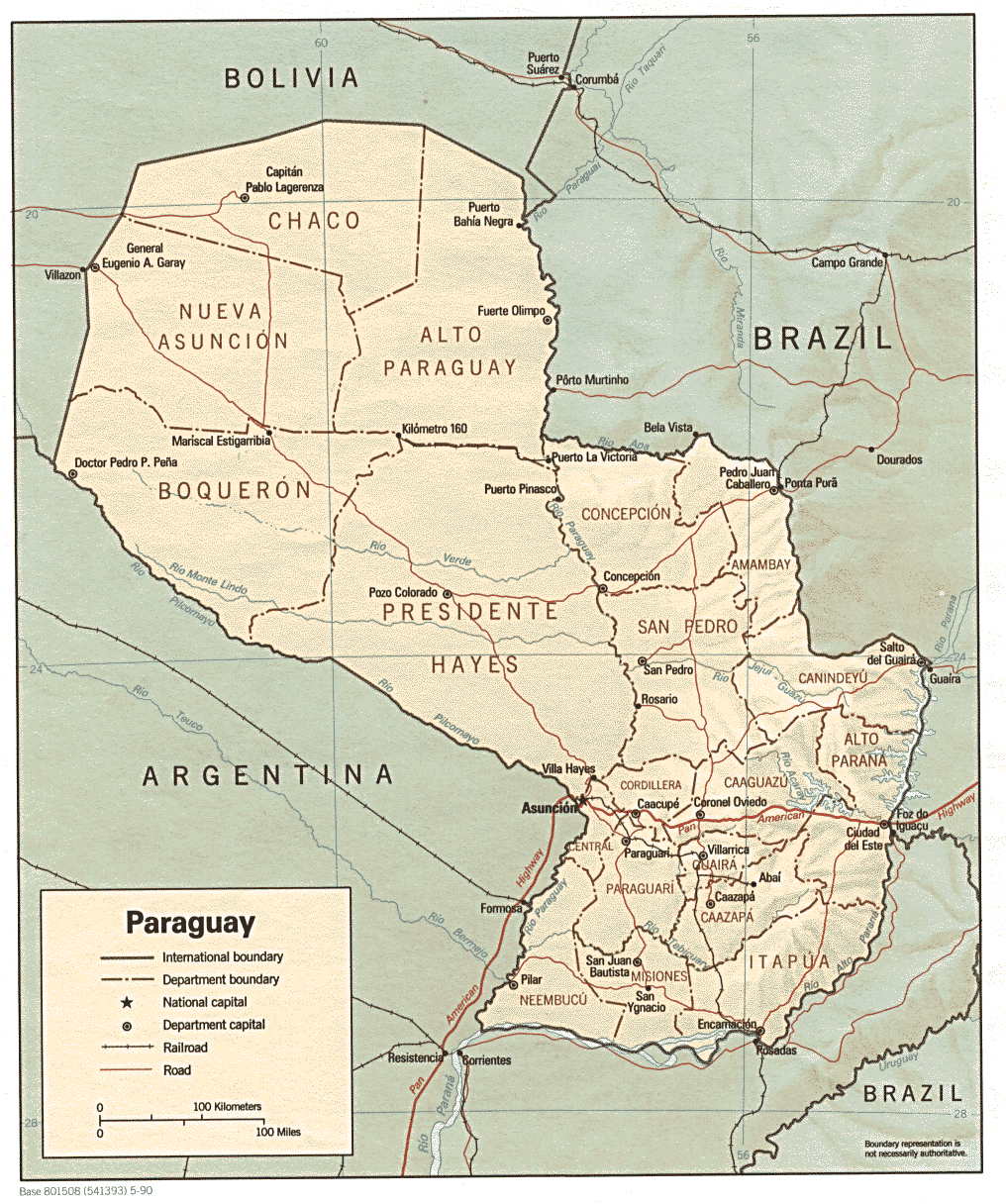
Paraguay. Not to be confused with Uruguay. Nation looks like a penis. Somewhat of a backwater place that had the same dictator for about 50 years until recently. P.J. O'Rourke, the writer, wrote a chapter in one of his books about going to Paraguay and really enjoying the food and the culture, and making fun of the tinpot General Stroessner (the 50 year dictator)
http://www.odci.gov/cia/publications...k/geos/pa.html

NORTH AMERICA

Central American nations. There are seven small nations composing of Central America, and I have wondered why these nations are so small and why these countries just do not merge together with a common currency and a common police/military. The peoples of these countries are similiar, and they all share a similiar background, culture and history.

EUROPE

Lichenstien, Luxembourg, Monoco and Andorra. Lichenstien is a tiny, tiny nation between Switzerland and Austria. Only 33,000 people live there. Another writer, Bill Bryson went to Europe and wrote a book about it and said that the people of Lichenstien were all basically rich Hapsbergs and he did not feel that welcome. Luxemborg lies between Germany, France and Belguim. Andorra is a tiny spot between France and Spain in the Pyrenees Mountains. Are all of these nations just left over from the Middle Ages, and the Papal States?
http://www.odci.gov/cia/publications...k/geos/lu.html
http://www.odci.gov/cia/publications...k/geos/ls.html
http://www.odci.gov/cia/publications...k/geos/an.html

Norway. Europe's long narrow strip country. A cold rugged coastline. Unlike Chile, Norway is very valuable due to the oil and gas deposits in the North Sea.

Croatia. Looks like an alligator jaw, with Bosnia in its mouth. Almost landlocks Bosnia out of the Adriatic. This border shows the pettiness of Mankind, and how we are more geared for our own self enrichment and distrust to hostility to our neighbors instead of trust and mutual cooperation to share the waterway. Probably the most pathetic border. Unnatural and artificially conceived.
http://www.odci.gov/cia/publications...k/geos/hr.html


AFRICA

The Gambia. A tiny nation with a river flowing through it (The Gambia River). Totally surrounded by Senegal, which is a small nation itself but is huge around The Gambia. Note that the correct name for this backwater is THE Gambia.
http://www.odci.gov/cia/publications...k/geos/ga.html

Togo. Tiny, narrow strip of a country, bordered by Benin in the east and Ghana in the west, both Ghana and Benin also small nations squeezed by other small impoverished nations west of Nigeria on the Gulf of Guinea. Their leader, a one Gnassingbe EYADEMA, was overthrown by the Togolese people for having a name larger than the country. Supposedly this was against tribal customs. To note, I met a Togolese once, and he was the darkest black man I have ever seen. He made Samuel L. Jackson look Swedish. To wit.
http://www.odci.gov/cia/publications...k/geos/to.html

Mali. Large, landlocked, strange looking place that few people care about. Basically owns a lot of worthless land in the Sahara. It shares a border with Mauritania, probably my favorite nation name. If you get a chance to see Michael Pallin's (of Monty Python) "Sahara", please watch it. It will actually make you want to go there. Bamako and Timbuktu are in Mali.
http://www.odci.gov/cia/publications...k/geos/ml.html

Equatorial Guinea. the only nation in Africa to speak Spanish as a first language. Basically a small square of land in Africa and a small island off the coast. The capital is on the island. Has oil. Probably will never see it.
http://www.cia.gov/cia/publications/...k/geos/ek.html

Namibia. Actually a very straight forward looking square block nation except for its Northeast where there is a small strip of land that stretches east to Zambia. There is a town called Katima Mulilo at the end of it near Zambia. What is that strip of land? Why was it drawn this way?
http://www.odci.gov/cia/publications...k/geos/wa.html

(There are other weird looking ones in Africa, if this thread grows legs, I'll add more.)

ASIA.

Afghanistan. Fairly rounded out sized borders except for a small strip of land in the Northeast that stretches out to touch China. It is called the Wakhan Corridor. Why was this nation drawn like this?
http://www.odci.gov/cia/publications...k/geos/af.html

Burma. Myanmar. The southern leg of the nation that borders the Andaman Sea. Almost cuts Thailand in two. Has this territoy been a contention of these two nations in recent times?
http://www.odci.gov/cia/publications...k/geos/wa.html

Brunei. A tiny, wealthy oil state on a large island occupied by three nations (Brunei, Indonesia and Malaysia) Indonesia (especially) and Malaysia are much larger poor nations surrounded by this oil rich state that floated to far away from the Middle East.
http://www.odci.gov/cia/publications...k/geos/bx.html

Malaysia. Is that peninsular Malaysia or island Malaysia. Why is it like that?
http://www.odci.gov/cia/publications...k/geos/my.html

UNITED STATES

West Virginia is probably the oddest looking state in the USA. My question is that spike in the northern part that splits between Ohio and Pennslyvania. Why did the Virginians draw that? is there valuable land there?

The Missouri Bootheel. Why is there a Missouri Bootheel? It consists of two counties in Southeast Missouri. How come this land belongs to Missouri and not Arkansas? Why did the boundry dip south at the Paragould river?

Oklahoma Panhandle. Why was this drawn up like this?

Idaho Panhandle. Same question.

Michigan Upper Peninsula. Why is this part of the state of Michigan when it is clearly part of Wisconsin? Of course, this could blow up into a conversation of why Wisconsin is not part of another state or blah, blah, blah, but I think the UP belongs to the wrong state.

Anything to add, please do. I love geography!
Reply With Quote
Advertisements  
  #2  
Old 01-06-2006, 09:03 AM
Bosda Di'Chi of Tricor Bosda Di'Chi of Tricor is offline
Charter Member
 
Join Date: Dec 1999
Location: Dogpatch/Middle TN.
Posts: 27,577
Quote:
Originally Posted by chinaglenn

Anything to add, please do. I love geography!
OK, I'll add this: every single one of your links does not work.

Better luck next time, kid.
__________________
There's an Initiation Ceremony.
It involves a Squid and a Goat.
You're gonna be good friends with that Goat.
The Squid will not exactly be a stranger, either. ~~Me, on the SDMB Initiation
Reply With Quote
  #3  
Old 01-06-2006, 09:12 AM
ecobuckeye ecobuckeye is offline
Guest
 
Join Date: Jan 2006
I found this tidbit regarding one of WV's panhandles:
Quote:
When West Virginia was admitted into the Union in 1863, the West Virginia Panhandle (Jefferson, Berkeley, and Morgan counties) was added to the new State in a bid to maintain control of the B&O Railroad, even though most of the citizens of those counties supported the Southern cause. (source - STUDY OF CIVIL WAR SITES IN THE SHENANDOAH VALLEY OF VIRGINIA / PURSUANT TO PUBLIC LAW 101-628 / U.S. DEPARTMENT OF THE INTERIOR / NATIONAL PARK SERVICE / SEPTEMBER 1992
(FA - http://www.cr.nps.gov/hps/abpp/shenandoah/svs2-2.html)

Those three counties make up the far eastern part of the eastern panhandle, the part that looks like it should be VA because of the river.
Reply With Quote
  #4  
Old 01-06-2006, 09:19 AM
Acsenray Acsenray is offline
Charter Member
 
Join Date: Apr 2002
Location: U.S.A.
Posts: 23,721
It seems to me that for general purposes neither a general answer to all these questions nor a specific answer to all these questions will be particularly interesting.

One general answer is that the development of human society and the physical connections that are made has almost nothing to do with how those things might look on a map. In this sense, maps can be very misleading. Things that bring people together in real life, such as rivers, are made to look like major points of separation on a map.

People and cultures don't spread in regularized, concentric circles. First of all, there are geographic barriers, such as mountains. Second, there are other environmental restrictions -- a society whose characteristics are formed by the environment of a coastline is more likely to spread along the coastline further than it is to move inland. Third, there are the barriers caused by the presence of other people and all the resulting factors (wars, politics, etc.).

Another general answer is that there are historical political and administrative reasons for all these things that you consider anomalies. Each specific case will be different in the details, but in the big picture, there won't be much difference between why West Virginia has a panhandle and why Oklahoma has one or why Liechtenstein and San Marino have survived as sovereign entities.

In places like the Middle East, Africa, and North and South America, the lines were drawn completely arbitrarily, based not on the needs and the realities of the people living there, but for the purposes of people in far away capitals drawing the lines. It's almost futile to ask specifically why Togo was drawn the way it is when, in reality, none of the borders in Africa (except maybe for Egypt and Ethiopia) has any basis in on-the-ground realities. It was all political shenanigans between the French and the British.

There was at one point a Central American union encompassing all those states except Belize (which was a British territory) and Panama (which was part of Columbia). You might want to look into its history to find out why it didn't survive.
Reply With Quote
  #5  
Old 01-06-2006, 09:28 AM
enipla enipla is online now
Member
 
Join Date: Jul 2001
Location: Colorado Rockies.
Posts: 7,647
Oklahomas Panhandle

The Neutral Strip

Sounds like it was a strip of land between Kansas and Texas that nobody claimed, Oklahoma ended up with it for whatever reason.

Sorry about your links, that was a lot of work.
Reply With Quote
  #6  
Old 01-06-2006, 09:29 AM
wolfstu wolfstu is offline
Charter Member
 
Join Date: Jan 2001
Location: Earth
Posts: 1,618
Quote:
Originally Posted by chinaglenn
NORTH AMERICA

Central American nations. There are seven small nations composing of Central America, and I have wondered why these nations are so small and why these countries just do not merge together with a common currency and a common police/military. The peoples of these countries are similiar, and they all share a similiar background, culture and history.

A friend of a friend is the former Minister of Finance for Costa Rica, who has told me that in fact there is work being done to create some kind of economic union of several of these states, but not a currency union... yet. I don't have many details for you, because I haven't seen this guy in a while.
Reply With Quote
  #7  
Old 01-06-2006, 09:36 AM
CalMeacham CalMeacham is offline
Guest
 
Join Date: May 2000
I've long thought that a book on why the boundaries of states are where they are would be interesting. Then UI found that someone had already produced such a book. I don't recall the title or author, and I haven't bought it yet. some small press.

Generally the reasons for boundaries are because some defining feature sets it -- rivers, mountain ranges, etc. The reason Chile is long and skinny is that the Andes form one side.

Some boundaries mark regions long held by one group, who tenaciously hang onto it even if the other side "logically" ought to have the other. Staten Island, by all rights, oughtta be part of New Jersey "logically", but historically it's part of New York City, and will stay that way.

what I find amusing are weird little features that seem to defy expectation.

1.) The boundaries of the big Western states look as if they're drawn with long straight lines, but generally they're not. Colorado has more than four sides.

2.) The boundary between Delaware and N.J. looks like the Delaware River -- but it isn't. If you look closely at the map you se a really tiny bit of Delaware on the New Jersey "mainland" (and far from Delaware, too). I still haven't learned why.

3.) Howcon Minnesota has a little "tip" that extends up into Canada?

4.) Why does Massachsetts have a little "tip" that extends down into Connecticut.

5.) In a rational universe, the boundary between New York on one side and Connecticut, Massachusetts, and Vermont on the other side would be the big, wide Hudson River, just like big local rivers define boundaries between other former colonies (NJ and PA, NJ and Delaware -- for the most part, Vertmont and NH, etc.) Howcom New York managed to grab both sides?

6.) there's a tiny bit of Kentucky -- the westernmost end -- that's literaly cut off from the rest of the state by a bit of Missouri that penetrates int Tennessee. It's the result of the Mississippi (which forms the boundary between the states -- unlike the case of New York) changing its course and nipping off that bit of Kentucky. Why do this, instead of keeping the original boundary, despite the motion of the river? I don't know of any other cases where a river change forced a boundary change that everyone accepted. Has this happened anywhere else?
__________________
"You know nothing, Sergeant Schultz"
Reply With Quote
  #8  
Old 01-06-2006, 09:48 AM
Colibri Colibri is online now
SD Curator of Critters
Moderator
 
Join Date: Oct 2000
Location: Panama
Posts: 21,425
Quote:
Originally Posted by acsenray
There was at one point a Central American union encompassing all those states except Belize (which was a British territory) and Panama (which was part of Columbia). You might want to look into its history to find out why it didn't survive.
Central America is mountainous and travel and communication has historically been very difficult within it. This has helped contribute to its political fragmentation. After independence in the early 1820s, the Central American provinces were initially annexed by Mexico. After the downfall of Emperor Iturbide in 1823, the Central American states formed their own separate union. Political conflicts between Conservative and Liberal factions eventually degenerated into civil war and dissolution of the union in 1840. There have been sporadic attempts to revive it since, but they have never gotten very far.

Britain,as part of its colonial competition with Spain, became involved in the Caribbean coastal areas very early on. These areas were usually under only tenuous Spanish control from the more densly populated highlands and Pacific coastal plain. They were settled by British pirates, loggers, and escaped slaves. At one time Britain or associated protectorates occupied most of the Caribbean from present Belize (British Honduras) to the Miskito Coast of Nicaragua. Britain eventually abandoned most of these by treaty in return for clear control over Belize.

Panama declared independence from Spain separately from Colombia in 1821, but joined it a short time later. It attempted to break away several times during the 1800s, finally succeeding in 1903 due to US help.
Reply With Quote
  #9  
Old 01-06-2006, 09:50 AM
zev_steinhardt zev_steinhardt is offline
Charter Member
 
Join Date: Jan 2000
Location: Brooklyn, NY
Posts: 6,768
Quote:
Originally Posted by chinaglenn
Michigan Upper Peninsula. Why is this part of the state of Michigan when it is clearly part of Wisconsin?
You could also ask, of course, why the bottom of the Delmarva Peninusula is part of Virginia when it clearly should be part of Maryland. (Of course, if it were, it would be called the Delmar Peninusula).

Within Europe, you can also mention San Marino, which is contained entirely within Italy. (So is the Holy See, which is entirely contained within Rome).

Zev Steinhardt
Reply With Quote
  #10  
Old 01-06-2006, 09:52 AM
zev_steinhardt zev_steinhardt is offline
Charter Member
 
Join Date: Jan 2000
Location: Brooklyn, NY
Posts: 6,768
As an aside, if you're really interested in oddly-shaped geographical regions, look up some of the congressional districts here in the U.S.

Zev Steinhardt
Reply With Quote
  #11  
Old 01-06-2006, 09:55 AM
Bricker Bricker is offline
And Full Contact Origami
SDSAB
 
Join Date: Dec 1999
Location: Northern Virginia
Posts: 37,348
Quote:
Originally Posted by CalMeacham
6.) there's a tiny bit of Kentucky -- the westernmost end -- that's literaly cut off from the rest of the state by a bit of Missouri that penetrates int Tennessee. It's the result of the Mississippi (which forms the boundary between the states -- unlike the case of New York) changing its course and nipping off that bit of Kentucky. Why do this, instead of keeping the original boundary, despite the motion of the river? I don't know of any other cases where a river change forced a boundary change that everyone accepted. Has this happened anywhere else?
Kaskaskia.
Reply With Quote
  #12  
Old 01-06-2006, 09:58 AM
zev_steinhardt zev_steinhardt is offline
Charter Member
 
Join Date: Jan 2000
Location: Brooklyn, NY
Posts: 6,768
Quote:
Originally Posted by CalMeacham
3.) Howcon Minnesota has a little "tip" that extends up into Canada?
Info on the Northwest Angle

Zev Steinhardt
Reply With Quote
  #13  
Old 01-06-2006, 10:14 AM
Crandolph Crandolph is offline
Guest
 
Join Date: Jul 2004
Most of your long, thin countries listed have a ridge of impassable (now and/or when the lines were drawn) mountains which serve as a natural barrier and seperate peoples, languages, cultures and government.

The nations of Central America have strong cultural identities (often a few disntict cultural regions within one let alone between them) and in many cases rivalries. Trust me, it takes hours to get from one valley to another over so-so or worse roads; this maintains local differences. I don't see them reforming one nation anytime soon.

Equitorial Guinea is well on its way to being a substantial oil producer and I fully expect to see that within a decade.
Reply With Quote
  #14  
Old 01-06-2006, 10:23 AM
RealityChuck RealityChuck is offline
Charter Member
 
Join Date: Apr 1999
Location: Schenectady, NY, USA
Posts: 32,942
Quote:
Originally Posted by chinaglenn
Paraguay. Not to be confused with Uruguay. Nation looks like a penis. Somewhat of a backwater place that had the same dictator for about 50 years until recently. P.J. O'Rourke, the writer, wrote a chapter in one of his books about going to Paraguay and really enjoying the food and the culture, and making fun of the tinpot General Stroessner (the 50 year dictator)
I've been reading up a lot on Paraguay and, like any other odd border, it's a combination of factors. First of all, it looks much more like a peanut than a penis*. The country is divided by the Paraguay River, and up until the mid-1930s, only the eastern part (neatly deliminated by rivers) was Paraguay. The western part was officially Bolivia, but was settled by Paraguayans simply because there was no good way to get to Bolivia (it's the Chaco area, described having all the bad qualities of a desert combined with a swamp). In the 1920s, Bolivia decided they wanted the land (worthless, but there were rumors of oil); Paraguay claimed it because they were the ones settling it. The fought the brutal Chaco War over it, decimating Paraguay's male population (for a second time). Paraguay was granted the land in the end; the border is a mountain range.

And Stoessner was only one of several colorful tinpot dictators of the country, and probably the least colorful. I'd recommend the book At the Tomb of the Inflatable Pig as a great read about the absurdity that is Paraguayan history.

*Note Villa Hayes, the only non-US city to be named after a US president. Rutherford B. Hayes decided for Paraguay in a border dispute and they named a city (and an entire province) for him, considerably more recognition than Hayes got in the US.

Quote:
Originally Posted by Cal Meacham
5.) In a rational universe, the boundary between New York on one side and Connecticut, Massachusetts, and Vermont on the other side would be the big, wide Hudson River, just like big local rivers define boundaries between other former colonies (NJ and PA, NJ and Delaware -- for the most part, Vertmont and NH, etc.) Howcom New York managed to grab both sides?
Because the eastern bank was settled by New York (or, rather, by New Amsterdam) and kept their ties to the city, not to Boston or Hartford. Also, those on the east bank of the Hudson were cut off from CT and MA by the Berkshires, so it made more sense to be part of NY.

As for Vermont, NY claimed that territory up until it became a state. So did NH. Vermont's border with New York is mostly Lake Champlain, with a straight shot after the lake ends.
Reply With Quote
  #15  
Old 01-06-2006, 10:23 AM
Renato Marmaduque Renato Marmaduque is offline
BANNED
 
Join Date: Jan 2006
Posts: 26
Quote:
Chile. I start with South America (SA) because Chile to me wins top prize for an unusual looking political state. It has a 3000 mile coastline (long) and is about 100 miles wide. Deserts in both the north and the south, with most of the people living in the center of the country.
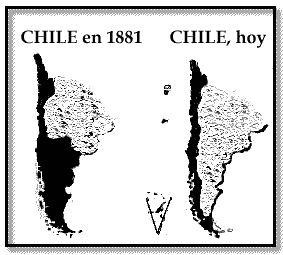
Originally, Chile wasn't as thin as it is now. It actually included the whole Patagonia. During the War of the Pacific against Bolivia and Peru, the Chilean government feared that Argentina would ally itself with Bolivia and Peru and attack Chile. So, in 1881, President Domingo Santa María decided to give all the territory east of the Andes to Argentina, since he considered the Patagonia to be basically worthless.

Here's a map of Chile before 1881 and Chile after 1881
Reply With Quote
  #16  
Old 01-06-2006, 10:28 AM
the PC apeman the PC apeman is offline
Guest
 
Join Date: Dec 2005
Quote:
Originally Posted by chinaglenn
West Virginia is probably the oddest looking state in the USA.
Just part of our quirky charm. The most convenient way to get from central WV to either panhandle is via another state. Many folk in both panhandles feel a bit shortchanged and separated (and separatist) from what goes on in the bulk of the state.

I've always wondered about the barely noticeable bump out in the NE corner of New Mexico.
Reply With Quote
  #17  
Old 01-06-2006, 10:31 AM
ecobuckeye ecobuckeye is offline
Guest
 
Join Date: Jan 2006
Quote:
Originally Posted by zev_steinhardt
Now, that's interesting.
Reply With Quote
  #18  
Old 01-06-2006, 10:41 AM
Slithy Tove Slithy Tove is offline
Guest
 
Join Date: Jan 2000
Quote:
Originally Posted by chinaglenn
Michigan Upper Peninsula. Why is this part of the state of Michigan when it is clearly part of Wisconsin? Of course, this could blow up into a conversation of why Wisconsin is not part of another state or blah, blah, blah, but I think the UP belongs to the wrong state.

Anything to add, please do. I love geography!
Congress had intended on giving Michigan the north shore of the Maumee river (present day Toledo, Ohio) while in the process of granting it statehood, but Ohio wanted the entire area, and even called out the state militia in April 1835 to ensure this. Although Michigan already had the tip of the UP, it was given the rest of it as a consolation prize. Wisconsin had fewer people than Michigan, much less than Ohio, and was thirteen years away from its own statehood, so nobody cared about their part of the bargain.
Reply With Quote
  #19  
Old 01-06-2006, 10:43 AM
zev_steinhardt zev_steinhardt is offline
Charter Member
 
Join Date: Jan 2000
Location: Brooklyn, NY
Posts: 6,768
Quote:
Originally Posted by CalMeacham
2.) The boundary between Delaware and N.J. looks like the Delaware River -- but it isn't. If you look closely at the map you se a really tiny bit of Delaware on the New Jersey "mainland" (and far from Delaware, too). I still haven't learned why.
I have a guess on this one. Looking at the map, I see that the DE-NJ runs along the NJ shore. The idea was that the river is clearly DE, not NJ. The area near Fort Mott, NJ may be a landfill that was built later on, and, since it was built over Delaware's river, it is part of Delaware.

A similar situation occurs in New York City. The border between Kings County (Brooklyn) and New York County (Manhattan) runs along the Brooklyn shore. However, there are several piers that jut out from the shore. Those piers are, technically, in New York County, not Kings County, since the boundary between the counties is the edge of the river.

Zev Steinhardt
Reply With Quote
  #20  
Old 01-06-2006, 10:45 AM
ElvisL1ves ElvisL1ves is offline
Charter Member
 
Join Date: Jul 2000
Location: New England
Posts: 26,702
Monrovia, Liberia was also named for a US president. I'll second the vote for At the Tomb of the Inflatable Pig - it was hilarious.

The OP asked about West Virginia's northern panhandle, not the eastern one. My understanding is that the southeast corner of it is simply where Mason and Dixon ran out of money and stopped surveying their line. A later surveyor was instructed to start with the end of the Mason-Dixon line and head due north to create Pennsylvania's western border. The closeness to the Ohio River is due to the fact that nobody knew exactly where it was at the time.

As for the Idaho panhandle, the version I've heard is that another team of surveyors was assigined to mark the Continental Divide, which was to be the Montana-Idaho border. They mistakenly followed the wrong ridge crest, well to the west, and when they discovered that simply struck out due north to try to get back where they were supposed to go.

More on panhandles.

Michigan got the Upper Peninsula as compensation of sorts for losing a border dispute with Ohio that cost them the port of Toledo (The Toledo War was a farcical episode, fortunately nobody got killed). There's still a road in the Toledo area called Old State Line Road.

The Missouri Bootheel was created to appease a wealthy, connected landowner who wanted to live in Missouri rather than Arkansas.

The Caprivi Strip in Namibia was created by a Germany-UK treaty to give it a connection with the Zambezi River.
Reply With Quote
  #21  
Old 01-06-2006, 10:52 AM
ElvisL1ves ElvisL1ves is offline
Charter Member
 
Join Date: Jul 2000
Location: New England
Posts: 26,702
Oh, yeah, the "jog" in the Massachusetts-Connecticut border is, according to legend, to keep Mass. from sliding into the Atlantic Ocean. The real story is just too dull.
Reply With Quote
  #22  
Old 01-06-2006, 11:10 AM
Colibri Colibri is online now
SD Curator of Critters
Moderator
 
Join Date: Oct 2000
Location: Panama
Posts: 21,425
Quote:
Originally Posted by zev_steinhardt
A similar situation occurs in New York City. The border between Kings County (Brooklyn) and New York County (Manhattan) runs along the Brooklyn shore. However, there are several piers that jut out from the shore. Those piers are, technically, in New York County, not Kings County, since the boundary between the counties is the edge of the river.
Also, a small chunk of the Borough of Manhattan (Marble Hill) is actually on the mainland, attached to the Bronx, where a side channel of the Harlem River was filled in around a former island.
Reply With Quote
  #23  
Old 01-06-2006, 11:11 AM
ShibbOleth ShibbOleth is offline
Guest
 
Join Date: Jul 2001
Quote:
Originally Posted by chinaglenn


ASIA.

Burma. Myanmar. The southern leg of the nation that borders the Andaman Sea. Almost cuts Thailand in two. Has this territoy been a contention of these two nations in recent times?
http://www.odci.gov/cia/publications...k/geos/wa.html
Burma and Thailand have fought each other for centuries if not longer. Bangkok is the capitol of Thailand mainly because Ayutthya and Sukothai were sacked so often. They still don't get along too well and IIRC still have border skirmishes in the northern mountain areas of Thailand where a lot of ethnic tribes (the Karen and related tribes) dwell and the opium trade thrives.

Did you mention Maryland or did I miss it?
Reply With Quote
  #24  
Old 01-06-2006, 11:13 AM
Bippy the Beardless Bippy the Beardless is offline
Guest
 
Join Date: Mar 2002
USA is dissjoint within the same contiguous land mass. ie you can travel from Alaska to the rest of mainland USA br land, but not without going through another country. I can't think offhand of any other country with such a break in its shape.
Reply With Quote
  #25  
Old 01-06-2006, 11:13 AM
GorillaMan GorillaMan is offline
Guest
 
Join Date: Oct 2003
I live here - there's a peculair jigsaw-notch piece of the west of the county, which takes in the town of Newmarket. I've never found out why this border occurred.
Reply With Quote
  #26  
Old 01-06-2006, 11:15 AM
GorillaMan GorillaMan is offline
Guest
 
Join Date: Oct 2003
Quote:
Originally Posted by Bippy the Beardless
USA is dissjoint within the same contiguous land mass. ie you can travel from Alaska to the rest of mainland USA br land, but not without going through another country. I can't think offhand of any other country with such a break in its shape.
Russia: http://en.wikipedia.org/wiki/Kaliningrad
Reply With Quote
  #27  
Old 01-06-2006, 11:23 AM
Captain Amazing Captain Amazing is online now
Charter Member
 
Join Date: Oct 1999
Posts: 22,036
Quote:
Originally Posted by zev_steinhardt
You could also ask, of course, why the bottom of the Delmarva Peninusula is part of Virginia when it clearly should be part of Maryland. (Of course, if it were, it would be called the Delmar Peninusula).
Because that area was settled by Virginia before Maryland became a colony.
Reply With Quote
  #28  
Old 01-06-2006, 11:23 AM
Giles Giles is offline
Charter Member
 
Join Date: Apr 2004
Location: Newcastle NSW
Posts: 11,554
Quote:
Originally Posted by Bippy the Beardless
USA is dissjoint within the same contiguous land mass. ie you can travel from Alaska to the rest of mainland USA br land, but not without going through another country. I can't think offhand of any other country with such a break in its shape.
The US has two other disjoint parts, where you can only travel to the rest of the US by land by travelling through Canada: Point Roberts in Washington State, and the Northwest Angle of Minnesota (already mentioned).
Reply With Quote
  #29  
Old 01-06-2006, 11:28 AM
sciurophobic sciurophobic is offline
Guest
 
Join Date: Aug 2005
Similar to the Northwest Angle is Point Roberts, WA. It's part of the U.S. because it's below the 49th parallel, but it's reachable by land only through Canada.
Reply With Quote
  #30  
Old 01-06-2006, 11:32 AM
GorillaMan GorillaMan is offline
Guest
 
Join Date: Oct 2003
Brunei is also non-conguous within one land mass: http://www.brudirect.com/BruneiInfo/..._location3.htm
Reply With Quote
  #31  
Old 01-06-2006, 11:33 AM
GorillaMan GorillaMan is offline
Guest
 
Join Date: Oct 2003
*non-contiguous
Reply With Quote
  #32  
Old 01-06-2006, 11:35 AM
RealityChuck RealityChuck is offline
Charter Member
 
Join Date: Apr 1999
Location: Schenectady, NY, USA
Posts: 32,942
Quote:
Originally Posted by Bippy the Beardless
USA is dissjoint within the same contiguous land mass. ie you can travel from Alaska to the rest of mainland USA br land, but not without going through another country. I can't think offhand of any other country with such a break in its shape.
There are many, categorized as enclaves.

Fishers Island, NY looks like it should be part of Connecticut. You cannot reach it by car without going through CT, and it's considrably closer to New London than anywhere in NY. It was granted to NY in the late 1800s, and there's a small movement right now to join CT.
__________________
"One never knows, do one?"
Provider of quality fantasy and science fiction since 1982.
Reply With Quote
  #33  
Old 01-06-2006, 11:36 AM
Meurglys Meurglys is offline
Charter Member
 
Join Date: Jul 2003
Location: Edinburgh
Posts: 1,603
Also Angola and it's slightly detached Cabinda province...
Reply With Quote
  #34  
Old 01-06-2006, 11:47 AM
GorillaMan GorillaMan is offline
Guest
 
Join Date: Oct 2003
Quote:
Originally Posted by RealityChuck
There are many, categorized as enclaves.

Fishers Island, NY looks like it should be part of Connecticut. You cannot reach it by car without going through CT, and it's considrably closer to New London than anywhere in NY. It was granted to NY in the late 1800s, and there's a small movement right now to join CT.
Your own link excludes the American examples from being considered true enclaves!
Reply With Quote
  #35  
Old 01-06-2006, 11:53 AM
HubZilla HubZilla is offline
Guest
 
Join Date: Jun 1999
Quote:
Originally Posted by Giles
The US has two other disjoint parts, where you can only travel to the rest of the US by land by travelling through Canada: Point Roberts in Washington State, and the Northwest Angle of Minnesota (already mentioned).
Oh, I can think of one more
Reply With Quote
  #36  
Old 01-06-2006, 11:53 AM
Bippy the Beardless Bippy the Beardless is offline
Guest
 
Join Date: Mar 2002
Thanks exclaves is my new word for the day.
Quote:
Originally Posted by wiki
* Angola: Cabinda, located between Democratic Republic of Congo (former Zaire) and the Republic of Congo
* Azerbaijan: Nakhichevan
* Brunei: Temburong is a unconnected to the larger western part of the country; thus, it is an exclave of Brunei
* Croatia: Dubrovnik
* East Timor: Oecussi-Ambeno
* Northern Cyprus: Kokkina.
* Oman: Musandam
* Russia: Kaliningrad
* Spain: The cities of Ceuta and Melilla, on the north African Moroccan coast
* United States: Alaska (Hawaii is not counted because it is made up of islands)
Reply With Quote
  #37  
Old 01-06-2006, 11:55 AM
elmwood elmwood is online now
Charter Member
 
Join Date: Nov 2000
Location: Upstate New York
Posts: 9,053
The Izu Islands and Ogasawara Islands, stretching out over a distance of 1,850 kilometers south of Tokyo in the Pacific Ocean, are actually considered part of Tokyo metropolis, and governed by Tokyo Metropolitan Government
Reply With Quote
  #38  
Old 01-06-2006, 12:01 PM
Giles Giles is offline
Charter Member
 
Join Date: Apr 2004
Location: Newcastle NSW
Posts: 11,554
Quote:
Originally Posted by HubZilla
Oh, I can think of one more
If you're thinking of Hawaii, can you explain how you can travel from Hawaii to the lower 48 by land through Canada? And if Hawaii, why not other parts of the US which are islands? (e.g., the Channel Islands of California)
Reply With Quote
  #39  
Old 01-06-2006, 12:08 PM
ElvisL1ves ElvisL1ves is offline
Charter Member
 
Join Date: Jul 2000
Location: New England
Posts: 26,702
One not mentioned so far: Afghanistan's Wakhan Corridor, across the northern end of Pakistan to connect with China, was created by the British in the 19th century as a buffer against Russian adventurism into India.
Reply With Quote
  #40  
Old 01-06-2006, 12:47 PM
St. Urho St. Urho is offline
Guest
 
Join Date: Nov 2001
Quote:
Originally Posted by chinaglenn
Michigan Upper Peninsula. Why is this part of the state of Michigan when it is clearly part of Wisconsin? Of course, this could blow up into a conversation of why Wisconsin is not part of another state or blah, blah, blah, but I think the UP belongs to the wrong state.
Here's a recent thread on the subject.

St. Urho
Yooper, eh
Reply With Quote
  #41  
Old 01-06-2006, 12:58 PM
CalMeacham CalMeacham is offline
Guest
 
Join Date: May 2000
Quote:
I have a guess on this one. Looking at the map, I see that the DE-NJ runs along the NJ shore. The idea was that the river is clearly DE, not NJ. The area near Fort Mott, NJ may be a landfill that was built later on, and, since it was built over Delaware's river, it is part of Delaware.

zev, you do seem to be correct:

http://www.njhm.com/delaware.htm


What makes things confusing is that many maps show the boundary going down the center of the river/bay, but it follows the mean high water mark since 1934. Interesting but odd stuff. The landfill is at Finn's Point.
__________________
"You know nothing, Sergeant Schultz"
Reply With Quote
  #42  
Old 01-06-2006, 01:14 PM
Crandolph Crandolph is offline
Guest
 
Join Date: Jul 2004
Quote:
Originally Posted by Bippy the Beardless
USA is dissjoint within the same contiguous land mass. ie you can travel from Alaska to the rest of mainland USA br land, but not without going through another country. I can't think offhand of any other country with such a break in its shape.

My first attempt at posting this ended up in the ether...

Russia has Kalningrad and Malaysia two non-contiguous chunks of Borneo.
Reply With Quote
  #43  
Old 01-06-2006, 01:14 PM
Gangster Octopus Gangster Octopus is offline
Guest
 
Join Date: Dec 2002
Bosnia and Herzogovina has a small strip of alnd - 23 km - that cuts Croatia in two at the city of Neum.
Reply With Quote
  #44  
Old 01-06-2006, 01:18 PM
Raguleader Raguleader is offline
Guest
 
Join Date: Mar 2003
Texas's current borders are largely a result of our joining the US. If you ever find a map of the Republic of Texas, it's amusingly large and reach-y, including parts of Oklahoma, Kansas, Colorado, Wyoming(!), and New Mexico, not to mention areas south of the Nueces River and west of the Sabine River down to the Rio Grande (these two rivers were the borders of the province of Texas in Mexico). IIRC, when the US annexed Texas, they set the boundaries more or less where they are today.

The Mexican-American War started when US and Mexican forces got into a fight in area that we both claimed (south of the Nueces and north of the Rio Grande). There was some dispute as to exactly where the fighting started (some Northerners and Whigs, such as Abe Lincoln, suggested that the US troops might have been south of the Rio Grande looking for a fight). Long story short, the US won, setting the southern border of Texas at the Rio Grande, and annexing the claimed parts of the Republic of Texas that would later become parts of other states, presumably as part of the deal for assuming Texas's debts.

I understand there was a minor border conflict with Oklahoman settlers at some point, and recently the New Mexico government found that a narrow strip of land south of New Mexico in Texas was apparantly supposed to be part of New Mexico but became part of Texas due to a clerical or survey error of some sort. Not sure if anything will come of that.
Reply With Quote
  #45  
Old 01-06-2006, 02:19 PM
smiling bandit smiling bandit is online now
Guest
 
Join Date: Nov 2001
Many borders which follow rivers get weird over time. If the river changes course, the original border stands. This can lead to a very strange situation.
Reply With Quote
  #46  
Old 01-06-2006, 02:27 PM
GorillaMan GorillaMan is offline
Guest
 
Join Date: Oct 2003
Quote:
Originally Posted by smiling bandit
If the river changes course, the original border stands.
I suspect this depends on the jurisdiction, and whether under the law of the territory in question the border remains as the river path, or as the line on the map.
Reply With Quote
  #47  
Old 01-06-2006, 03:43 PM
Bookkeeper Bookkeeper is offline
Charter Member
 
Join Date: Oct 2001
Location: Ottawa, Canuckistan
Posts: 2,155
Quote:
Originally Posted by Bippy the Beardless
Thanks exclaves is my new word for the day.
If you really want to go to town on exclaves and enclaves, the Dutch-Belgian border is a jigsaw of them, with areas of one country surrounded by territory of the other, which is in turn surrounded by the first country. There are areas where the nationality of buildings is defined by which street the front door is located on (and where residents have changed nationality by blocking one door and designating a new "front door" - usually for tax advantages).
Reply With Quote
  #48  
Old 01-06-2006, 03:59 PM
Terminus Est Terminus Est is online now
Charter Member
 
Join Date: Apr 2001
Location: Surrounded by reality
Posts: 4,906
Quote:
Originally Posted by Bookkeeper
If you really want to go to town on exclaves and enclaves, the Dutch-Belgian border is a jigsaw of them, with areas of one country surrounded by territory of the other, which is in turn surrounded by the first country. There are areas where the nationality of buildings is defined by which street the front door is located on (and where residents have changed nationality by blocking one door and designating a new "front door" - usually for tax advantages).
This is the town of Baarle-Hertog/Baarle-Nassau, a truly fascinating place. Some links (including photos):

http://ontology.buffalo.edu/smith//baarle.htm
http://www.borderlandtv.com/photos_2.html
http://rz-home.de/%7Emhaertel/baarle2002/index.html
Reply With Quote
  #49  
Old 01-06-2006, 04:37 PM
yabob yabob is online now
Charter Member
 
Join Date: Mar 2000
Posts: 6,992
Quote:
...
6.) there's a tiny bit of Kentucky -- the westernmost end -- that's literaly cut off from the rest of the state by a bit of Missouri that penetrates int Tennessee. It's the result of the Mississippi (which forms the boundary between the states -- unlike the case of New York) changing its course and nipping off that bit of Kentucky. Why do this, instead of keeping the original boundary, despite the motion of the river? I don't know of any other cases where a river change forced a boundary change that everyone accepted. Has this happened anywhere else?
Quibble - the "Kentucky Bend" is not due to a change in the course of the river, but because of a survey error. There's a common misconception that it was caused by the New Madrid quake, but, in fact, the border was set a few years before the quake. See my response in this thread:

http://boards.straightdope.com/sdmb/...d.php?t=127228

Some percentage of map anomalies are the result of surveyor's errors. This is probably the reason that Colorado is not QUITE rectangular, but I haven't been able to confirm it (look at the southern part of Montrose county - you may have to find a good resolution map to see it).
Reply With Quote
  #50  
Old 01-06-2006, 04:47 PM
yabob yabob is online now
Charter Member
 
Join Date: Mar 2000
Posts: 6,992
Quote:
As for the Idaho panhandle, the version I've heard is that another team of surveyors was assigined to mark the Continental Divide, which was to be the Montana-Idaho border. They mistakenly followed the wrong ridge crest, well to the west, and when they discovered that simply struck out due north to try to get back where they were supposed to go.
In fact, if you look at a modern map, you will find a place called "Lost Trail Pass" where US 93 crosses the border from Idaho, and where the Continental Divide diverges from the border. Most of the border follows the wrong mountains. At the point where the border shoots straight north to Canada, you will note that they ran smack dab into the Clark Fork river flowing in the "wrong" direction.
Reply With Quote
Reply

Bookmarks

Thread Tools
Display Modes

Posting Rules
You may not post new threads
You may not post replies
You may not post attachments
You may not edit your posts

BB code is On
Smilies are On
[IMG] code is Off
HTML code is Off
Forum Jump


All times are GMT -5. The time now is 12:23 PM.


Powered by vBulletin® Version 3.7.3
Copyright ©2000 - 2013, Jelsoft Enterprises Ltd.

Send questions for Cecil Adams to: cecil@chicagoreader.com

Send comments about this website to: webmaster@straightdope.com

Terms of Use / Privacy Policy

Advertise on the Straight Dope!
(Your direct line to thousands of the smartest, hippest people on the planet, plus a few total dipsticks.)

Publishers - interested in subscribing to the Straight Dope?
Write to: sdsubscriptions@chicagoreader.com.

Copyright © 2013 Sun-Times Media, LLC.