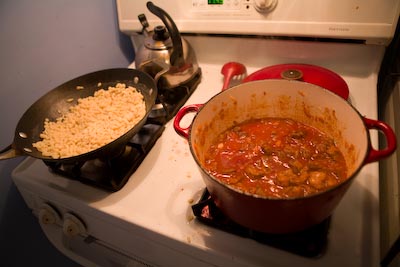
I’ve tried making stew several different times, using different recipies, and it always comes out the same: thick flavorless goo. I always use diced stew meat from a local butcher shop, along with celery, carrots, onions and potatoes. I’ve tried using different portions of ingredients, more or less water, and different herbs, all to no avail. It always seems to come out the same, namely a big crock pot full of thick, flavorless yuck.
Frankly, a can of Dinty Moore stew is better than anything I’ve ever made at home, which is pretty sad. Dinty Moore and Alpo have a lot in common.
So who has a kick-ass stew recipie they would be willing to share?
For one thing, use chicken stock or vegetable stock instead of water. Put some soy sauce into it too, as I’m Chinese and we put soy sauce into everything
Start with a bone in chuck roast. Look it over well, as these cuts are fatty. Now, you want some fat, but the chuck will have more than enough, so get the leanest roast you can find. It will have the fattier side down, anyway.
Season some all purpose flour with salt and pepper. Coat the whole roast with this. Brown it in some vegetable oil. I use peanut oil. Peel and dice a yellow or white onion while the roast is browning, and then after you’ve browned the roast on all sides, take the roast out and put the onions in. Let the onions wilt a bit while you wash and cut up some celery, and peel and cut up some carrots. About two ribs of celery and two carrots should be plenty for a 3 to 5 pound roast. After the onions have turned transparent, set them aside on the roast, and cook the carrots and celery for a bit. Save the peels and end bits from these vegetables. When they’re done, put everything in a roasting pan, along with some peeled, chunked potatoes. Make a cup of beef stock from Better than Bullion flavor base, according to directions, pour it in. Pour in a cup of red wine. Roast at 350 until the beef registers done on a meat thermometer, and the veggies are done.
But wait! I just told you how to make a pot roast, you say. So I did. When you take the roast out, cut it up completely, and stick the bones and trimmings into a pot of simmering water. Let this simmer while you eat. After a couple of hours, strain the bones and peels out of the water. NOW, add the liquid from the roast. You’ll probably need to add some flour, too. Add more veggies if you want. Add any meat scraps. Let simmer for another couple of hours, and refrigerate. Tomorrow evening, see if you need to remove any fat from the stew. Add one single serving can of V8, and let it warm up.
The key to making good soup or stew is to boil up some bones. Most “soup bones” are way overpriced, so I just start out with a chuck roast and get a roast AND a stew out of it. I’ve heard that heart makes very good stew, but that it can be tough. I’ve never tried heart, though.
Mom added Kitchen Bouquet to beef stew, for color as well as flavor. Another way to add beef flavor (some people like Dinty Moore) is to add some beef boullion cubes.
I buy stew meat (I think it’s chuck), dredge in flour (and salt and pepper), brown it, add water and beef cubes and simmer until the meat is almost tender. Then I add the veggies, herbs, and spices. Usually just potatoes, carrots, onions, garlic, and a bay leaf.
Lynn’s bones method is tops, but if you don’t have time (or bones), try the boullion cubes. You can get low-sodium cubes if that’s an issue.
Sounds like you’re trying to thicken it after everything has cooked. That will definitely give you a tasteless broth. You’re basically aiming for a large pot of gravy with chunks of stuff and need to follow the rules for making gravy, which is to make a roux and build from there. Lynn’s method is great, but you can also cut that roast up into manageable chunks, salt/pepper them, dredge in flour and brown well in some fat in a dutch oven. Remove the meat and set aside. Saute your onions/garlic for a few minutes in the pot, add some celery and herbs of your choice, put the meat back in and add the stock you’re using. Broth is second choice, water is no choice. Bring it to a boil, then reduce the heat to a slow simmer and let it simmer uncovered for several hours. The meat will braise and fall apart, and the liquid will reduce. Bring back to a boil and add a shitload of cut up potatoes. As they cook, they will help thicken the stew further. Add salt to taste.
I’ve been making this recipe for … oh, 25 years? Or more. Very simple, very easy, very tasty, hearty, substantial.
adapted from the Fannie Farmer Cookbook
Old Fashioned Beef Stew
1/3 cup flour
1 tsp salt or garlic salt
1/4 tsp black pepper
2 pounds chuck, cut into bite-size chunks
4 Tbsp shortening or oil
1 Tbsp lemon juice
1 Tbsp Worcestershire sauce
1 large onion, thinly sliced
2 bay leaves
1/4 tsp allspice
12 small carrots (washed & trimmed) or 24 baby carrots
12 small white onions (trimmed) or 3 medium onions (quartered)
8 small red potatoes or equivalent white potatoes
Mix flour, salt, and pepper in a clean plastic or paper bag. Melt shortening over high heat in a Dutch oven or heavy-bottomed pot with a cover. Add beef to bag with flour mixture a few at a time, shake to coat, and add to pot to brown on all sides, then remove to a warm plate. DO NOT crowd the pan – the meat needs space to brown properly rather than steam. Repeat with the rest of the beef until all is browned. Add the the onion to the pot and saute until tender and starting to brown. (Sometimes I add a little minced garlic and some minced celery at this stage.) Return all the beef to the pot and immediately add 4 cups of BOILING water. (It will sputter - stand back.) Stir in remaining ingredients except vegetables. Turn heat to low, cover, and simmer for 1 1/2 to 2 hours, or until tender. (Do NOT bring to a boil as this toughens any meat.) Add the vegetables and cook another 20 - 30 minutes until they can be pierced easily with a fork. Do not cook past this point or vegetables will be mushy.
NOTE: I often sub 1 cup of red wine for 1 of the cups of water.
2 lb bony beef
2 onions
4 cloves of garlic
3 potatoes
8 carrots
2-3 stalks celery (optional)
2 cans stewed tomatoes
1 can water chestnuts
About 8 radishes
1 pound peas
Bay leaves, rosemary, celery seed, mustard powder, basil, parsley, cumin, paprika, pepper, salt to taste
Chop up the meat, and put it in a big pan to brown over medium-high heat. Once the meat’s produced a bit of juice, add the onions, half the garlic, and cumin, and brown those too.
Once the onions are translucent and the beef’s browned all over, add two of the potatoes, chopped fine, and just enough water or stock to cover it all, plus the bay leaves (count them as you add them; I use about 4). Once it comes to a boil, turn it down to low, and let it simmer for an hour or two.
Then, fish out the bones and the bay leaves (count them again to be sure you got them all), and add the last potato (chopped in big chunks), the carrots, the tomatoes, the rest of the garlic, and the rest of the seasonings. A couple of stalks of celery would probably be good, too, but I usually don’t buy celery, since I can never use it up. Let that simmer for another couple of hours.
About five minutes before you’re ready to eat, add the peas, water chestnuts, and radishes. Once it comes to a boil again, it’s ready to serve. If it’s too thin, you can add a little instant mashed potatoes, but it should be at least pretty close.
This feeds me for about a week; your servings may vary.
My normal MO is to coat the diced meat in a thin coating of flour w/ salt & pepper. I put this in a wok with just enough water to keep the meat from burning as it browns. When its done I put the meat in a crock pot with a couple of cups of water pre-mixed with beef bullion. I add cut up carrots, celery and yellow or red onion. Mix with a couple cloves of mashed garlic and a few bay leaves, a bit of pepper and some lea and perrins sauce. Maybe some dried basil. Once its simmering I add a few cups of diced potatoes. Cook until done.
Problem is, it doesnt take long, and ‘done’ is a thick flavorless goop. Yuck.
I grew up on Dinty Moore, and have a repulsive love for it (it really does remind me of canned dog food, but is A+ comfort food). Would like to find a simple recipie that produces an end product similar.
Stews are simple once you get the hang of them. Here’s the basic rundown of hints:
Brown your meat. This is not desirable for every type of stew (veal stews, for instance, you often don’t brown to keep light and delicate), but for most, like beef, pork, or chicken, browning adds a nice layer of flavor to your meat. How to brown meat properly is not necessarily trivial, so I’ll run it down for you. Dredging the meat in a thin coating of flour helps the process along, but I don’t dredge in most of my stews.
–a) Coat the bottom of your cooking vessel with oil. You don’t want it swimming in oil, but you do want the entire surface to be coated.
–b) Heat the oil over a medium-high flame (or whatever the equivalent electric burner setting would be). Some people like to heat the pan first, then add the oil. I find no difference either way. You want to heat up the oil to the point where food audibly and steadily sizzles on contact, but you want to be careful not to burn the meat (this is important if you’re dredging your meat in flour, which is easily susceptible to burning.)
–c) DO NOT CROWD THE PAN. This is the most important point, hence the caps. Too much meat in the pan, and the meat juices are released and pool in the bottom, preventing the meat from browning properly. You basically want something like a half an inch to an inch of space between your pieces of meat to ensure proper browning.
–d) Leave the meat the hell alone. Tossing and stirring it around prevents browning. Let it sit for about two/three minutes or so, and then check the underside of one of the pieces. If it looks like it’s properly browned (should be about a peanut butter-to-chocolate brown. This is a good representation of what you’re looking for.) you can turn the meat to brown the other sides. Otherwise, wait. Continue in this fashion until all sides are browned or you lose patience.
–e) Remove meat from pan, place aside in a container (bowl/pot/another pan/whatever). Continue with the rest of the meat you need to brown.
After you finish the browning step, you can continue with adding your onions, veggies, etc., and scraping all the flavorful browned bits off the bottom of the pan.
Be careful of using too much liquid. This is one of the bigger problems people have with their stews. Too much liquid and you’re making a soup, not a stew, and you don’t have the concentration of flavor stew has. You actually don’t need a lot of liquid for many stews, as the meat and the veggies (depending on how many you have) will release a lot of their own during the cooking process. See the pot of beef on the right there? I added maybe a half cup water to that stew, just to prevent it from burning. All the rest of the liquid is from the meat and onions. (Full illustrated recipe here.) If you like your stews on the soupier side, the suggestions for using a flavorful liquid like beef stock or beer or wine are spot on.
This isn’t appropriate for all stews, but keeping the meat bone-in will add to the flavor and texture (because of the gelatin) of your final stew. This is especially evident in chicken stews. Unless I’m trying to be low-calorie and “healthy,” I keep chicken bone-in and skin-on for stew, as the difference in flavor is remarkable. If you don’t like bones and skin, just take the whole pieces of meat out, remove what you don’t like, and reincorporate it into the stew.
Adjust for salt, especially at the end. Lots of bland stews are simply undersalted. Don’t underestimate the power of salt to lift and tie your flavors together.
Cheat. If, despite all this, it ain’t working for you (it should, but in case you screwed up a part), a stock cube or two can go a long way to rescuing a bland dish (usually one that has too much liquid in it.) I find stock cubes/bullion to be a bit “sharp” and “institutional” in flavor, but they do the trick. Another option, if you’ve overshot on the liquid front, is to reduce the liquid by cooking it with the cover off until it’s concentrated to your liking. Most stewing cuts of meat are pretty forgiving of overcooking (and, technically, many are cooked well past the point of “well done”), but, if you’re really worried, you can always remove the meat and place it aside.
I’m sure that run-down contains omissions and arguable points, but those are my general rules. Let me know if you have any questions.
You don’t need any water. If you’re putting water in, I suspect your meat is not browning, but rather what I call “graying.” Fat+meat is all you need. If it’s burning, you’re cooking it at too high a heat. Dial it back.
Personally, I would fry up the mirepoix in the wok you just cooked the meat in, making sure to scrape every last bit of browning off the bottom of the pan, then put it into the crockpot. If you want to avoid all that, at the very least, put a little bit of your bullion liquid into the wok, scrape up all the browned bits (which I suspect you may not have much of, given your adding water to the wok while browning), and put that liquid into the crockpot. I also think you may be using too much liquid for a thick, hearty stew.
What do you mean, it doesn’t “take long”? What cuts of meat are you using, how long is it taking you, and how would you describe the texture of the meat when you’re done? On the stovetop, with a stewing cut such as chuck or shortribs, it usually takes me anywhere from 2.5 to 4 hours before the meat is at the “fork tender” stage.
I add a bunch of chopped fresh cilantro (stems and all) at this step and let it dissolve into the broth as everything reduces. I promise it won’t add that soapy taste that some people hate about fresh cilantro; it adds a deep savory flavor that compliments everything else.
First, my meat is nicely coated in flour before browning. This is what thickens the stew. Second, I use a lot of liquid but it cooks down. In fact, by the time it’s done, there’s barely any liquid, only a nice, thick, rich gravy, so to speak.
To the OP … so many things wrong with your method. As others have said, using water to brown the meat is absolutely the wrong thing to do. You have to brown in fat and add liquid later. Next, you’re using a wok?? Wrong pot altogether. A wok is made to concentrate heat at the center/bottom. You want even heat over a large surface area, because you are braising. The wok, and your comment “it doesn’t take long” is a big part of the problem. Slow cooking is what’s required here. Braising. After the browning and adding of boiling liquid (or bringing to a boil) you immediately turn down the heat to simmer.
Try my recipe. Trust me. Follow the directions exactly. Use a dutch oven, not a wok. It may not be the beef stew of your dreams – it’s like chili, everyone makes it differently – but it will be instructive and tasty. Compare all the ways the recipe varies from what you usually do and you will learn.
2 hours or so, start to finish, crock pot on high. I put the meat in first, after I have browned it, then add the veggies except for the potatoes. My experience has been putting the potatoes in at the same time as everything else causes the stew to take a long time to cook. Maybe im imagining things. The meat usually isn’t falling-apart tender, still firm.
My biggest issue is the damn consistency of the final stew. Doesn’t seem to matter how much liquid or how little flour I use, the end result is EXTREMELY thick – like peanut butter or mayonaise. That’s just too thick. I got pissed at it once and added some water w/ bullion at the end of the cooking and even a cup and a half of liquid didn’t change the consistency much. It’s like this liquid-sucking stuff that is hell-bent on being the consistency of wet cement.
I confess I don’t know the cut of meat; I get a ‘stew mix’ from a local butcher shop. He sells ~2 lb packs of cubed beef packaged for cooking in stew. That may be part of my problem.
I’m pretty fearless when it comes to various herbs and veggies to throw in any dish, although I have no experience cooking with wine or beer and have no idea what works with what. My main issue is getting something that is thicker than a soup but doesnt look like it came out of a tub of spackle. I’ve never had good luck with new flavors, mainly because each time I make it I worry about the thickness and sorta forget about playing around with the flavors. This thread has given me lots of ideas for new flavors.
I will add that this thick goo has maybe, at the high end, two tablespoons of flour. I generally use a regular tea-type spoon from the silverware drawer, get a scoop of flour (not a heaping mound), sprinkle it over the meat with the salt and pepper, then stir it to coat it before putting it on the heat. I’ve always just browned all the meat at once; apparently that’s one of the many things I’m doing wrong. I still can’t figure out why the end result is so thick.
Your instinct about the potatoes is somewhat correct. Putting them in early has the problem, though, of having the potatoes way overdone by the time the stew is finished, no so much a problem of taking a long time to cook (although I cook see that being an issue, too.) Potatoes get mealy and “chalky” in consistency with overdoneness, so that’s why you only want to put them in the last hour of cooking (although with a crockpot, the window may be longer.)
This doesn’t really make sense to me. If it’s pasty, you have too much starch in the stew. It may be flour, it may be somewhat influence by the potatoes, but it’s just too much starch. How much flour are you using? There’s no way the flour involved in just dredging the meat should be enough to make your stew pasty or concrete-like, with the amount of liquid you’re using. Heck, it shouldn’t be enough even with the natural juices from the meat and vegetables. My goulash–which uses no flour and is not supposed to have flour, at least in the Hungarian style–is somewhat viscous but not pasty with very, very little added liquid (like I said, about a half cup.) I don’t understand how you’re getting such thick consistencies without adding too much flour (or other starch).
Second, the meat should not still be firm. If it’s got a decent amount of chew left to it, it’s underdone. Leave it in for longer. Here’s the deal with stewing/braising/slow cooking cuts of meat. Stewing cuts are generally from well-exercised parts of the animal. Because they get a bit of a workout, they get tough. However, the well-exercised parts also have a lot of collagen. This collagen, at the temperature range of about 150-175-ish or so, turns into gelatin. Gelatin is soft, feels moist, ands body to the stew. Collagen is tough and chewy. You want to cook your stew long enough so that collagen changes over into gelatin. If you’re tasting your stew along the way (and any good cook should do this to know what’s going on), you’ll notice that the meat starts out kinda flabby and soft, then turns out what seems to be tough and dry. It “tightens up” before the collagen converts to gelatin and it becomes the soft, stew meat you and I are used to. If the meat feels tough, give it a bit more time. It’s not going to help if you use cuts of meat that are not high in collagen (like loin or whatnot), but for stewing cuts, you have to wait for the magic to happen.
I don’t trust or buy anything called “stew” meat. Who the heck knows what it is. If you’re buying beef you the following: are safe cuts: chuck, short ribs, shank, brisket. If you’re buying pork: Boston butt/shoulder, picnic ham (another shoulder cut). There are other cuts that will work (like the ham, for instance), but those are the easiest to work with, the cheapest, and the most flavorful.
I personally wouldn’t worry about the additional flavors. You should be able to get a decent stew with nothing more than salt, pepper, meat, and a little bit of liquid, and perhaps some starch to thicken. You should be able to adjust for a stew that’s too thick by adding more flavorful liquid (like broth or stock) to it. Why this isn’t happening to you is a mystery to me.
It sounds like you are using corn starch. Your method is all wrong, but two tablespoons of flour is about right for a Dutch oven size stew. Cooking stew in a wok makes no sense.
My method: brown meat in several batches so it is not too crowded. Do this in the same large pot you will cook the stew in, and makes sure you have enough oil. Add more oil to the pan after you take out the meat and then add your flour. It should make a thin paste that you cook until it is slightly brown. Then add your stock, water, wine or whatever and scrape up all the brown stuff on the bottom. Get it to a slow boil then add your meat back along with a couple of bay leaves and simmer covered for an hour or so. Then add your potatoes, onions, carrots and cook until they are done. Near the end add thyme, marjoram, and/or oregano. A little Worcestershire or soy sauce is good, but go easy