(I did searches in IMHO and GD for “Natural” (titles) and “frack” (all posts) and was surprised to find that this wasn’t discussed… at least, not with those search terms being used, that is. I’m sure someone will be here soon with links to prove otherwise. )
One of the more unheralded big stories of the past few years is the natural gas boom in the United States, principally North Dakota and Pennsylvania, a boom so large it has collapsed the price of natural gas (NG) from a high of $13/mmBTU in July, 2008 to $1.99 just last week (Scroll halfway down until you see chart “Weekly natural gas rig count and spot Henry Hub”). “Henry Hub” is the spot price for a NG contract.
This boom is caused by the rise of two production technologies: “horizontal drilling” which is exactly as it sounds – drilling horizontal (side-to-side) in the earth rather than vertical (up-down); and “hydraulic fracturing”, aka “fracking”, the controversial process in which water and other chemicals are pumped into shale deposits, fracturing them so that there will be more gas and oil to extract from the well.
(I would prefer that this thread not get derailed into a debate about fracking, if that’s possible…)
Recently, President Obama called the US the “Saudi Arabia of natural gas”, and I have been reading in the business press about the likelihood of chemical and plastics production, which are currently based overseas to take advantage of lower labor costs, are planning on moving back to the US to take advantage of the massive savings caused by $2/mmBTU gas and lack of transportation. Estimates of up to 600,000 new jobs by the end of the decade have been thrown about, and I can personally attest it is a pain in the ass to secure a warehouse in Western Pennsylvania because of the Marcellus (Wallace) shale.
So, at the very least we know two things:
There’s a cheap, new source of energy, born of technological change, that has come about, and
Right now it’s largely based in the US, as the US has the largest shale deposits in the world.
Here are some questions:
Does this bode ill (as it seems to me) for the non-hydrocarbon-based alternative energy systems being put into play, especially wind and solar?
a. Hell, does it bode ill for shale/tar-sands based oil production?
Do you know of anyone, or is your area, involved in this portion of the energy industry?
Assuming an era where natural gas is as cheap and plentiful as oil was, for as long as it was (and still is, really), what do you think some long-term effects would be of this?
Do you think America can hold its lead? Do you even believe the numbers?
What are some other long-term implications of a long-term (40+ years) drop in the price of natural gas?
For those of you who argued that technological change would assist in solving the energy "problem", do you feel vindicated?
Well, wind and solar are free, right? So, they should be able to compete with this nascent technology as it ramps up, if all the hoopla is correct about how they are both really competitive. If they aren’t, in fact, competitive then it still doesn’t mean that it bodes ill for them, since there are always subsidies to make them competitive even if they can’t really compete on a level playing field.
Personally I think that wind and solar have always been niche energy production technologies, and unless there are huge distortions in the market (a.k.a. governments forcing the use of them), they will mostly remain niche energy producers in the future. Where they make sense (such as places where there is constant wind or lots and lots of sun) I think they will do well and will increase production…where they don’t make sense they won’t, and other technologies will out compete them even with government intervention.
Depends I suppose. I wasn’t under the impression that there was that much natural gas, i.e. enough to replace oil based fuels for stuff like personal transport. I thought we were talking about energy production…ELECTRICAL energy production I guess. I know you can use natural gas as a vehicle fuel source, of course (several different ways to do this), but I didn’t think there was enough of the stuff to make it viable. I have to admit I don’t know though, and I suppose that if there is enough of the stuff to power electrical production AND personal transport, and if it’s cheap and abundant enough to do it then there could be a shift to natural gas based vehicle production on a large scale, as well as a shift in the infrastructure to support it.
In my area? Not personally, no, though New Mexico has some reserves that are being exploited already IIRC. I do have some friends in North Dakota who are involved in the industry though.
Well, I suppose the effect would be a paradigm shift in technology away from oil based fuels an into natural gas based systems. It would mean a lot of new wealth injected into the US and other countries with large natural gas reserves, plus perhaps additional revenue from US companies consulting in those other countries to help exploit the resource. Ecologically it would mean additional green house gases and additional global warming, which would have a large negative effect world wide. Whether that negative effect would be offset by the positive economic effects I couldn’t say, but it will probably be a net loss (just my WAG based on my understanding of the current debate wrt AGW climate shift).
It would mean all the Peak Oil gloom and doomers will be put off for a couple more decades though, which might be worth any amount of nasty climate effects right there.
I don’t believe that the amount of reserves are comparable, but I don’t know…I’m not even all that knowledgeable about natural gas or the amount of potential extractable resource that is actually available, nor even the current state of using it as a full blown alternative to oil based fuels for personal transport. I also don’t know how much reserves exist in other countries…my WAG is that whatever the US has there are probably huge amounts of reserves that are currently untapped elsewhere in the world, so I doubt we’d hold a lead for long, if at all.
I suppose that if the reserves are vast that the long term effects could be a new golden age of cheap energy to drive further development and expansion world wide (right now countries like China are exploding with new person transport, so there are vast new markets opening up), but on the down side we’ll continue pumping GhG into the atmosphere with gods know what consequences. Could be grim 50 or 100 years down the pike, but also could be a huge new expansion of technology and certainly wealth, so it might balance, depending on what new technologies would emerge.
It hasn’t happened yet, so wouldn’t want to count eggs or anything. That said, I always knew that technology and economics would put up answers to perceived resource shortages and that the world wouldn’t end a la the Peak Oil folks predictions of gloom and doom. There is simply too much money at stake to simply throw up our collective hands and go back to 19th century technology or have the world fall apart for want of a fuel source. I don’t know if the alternative will be natural gas or something else (if I did I’d be investing everything I have so that I could cash in and live on a beach earning 10% while scantily clad love muffins peel me grapes and fan me with those big palm frond thingies :p), but I was and am pretty sure that something will.
natural gas is cleaner than gasoline, so it would still be a step up. Plus because it is domestic you not longer have to buy fuel from foreign countries. Plus natural gas will be cheaper than gasoline and (I’m assuming) coal so people will save on energy costs. So it isn’t a perfect solution, but it is better than our current situation. With gas at $4 a gallon coming especially.
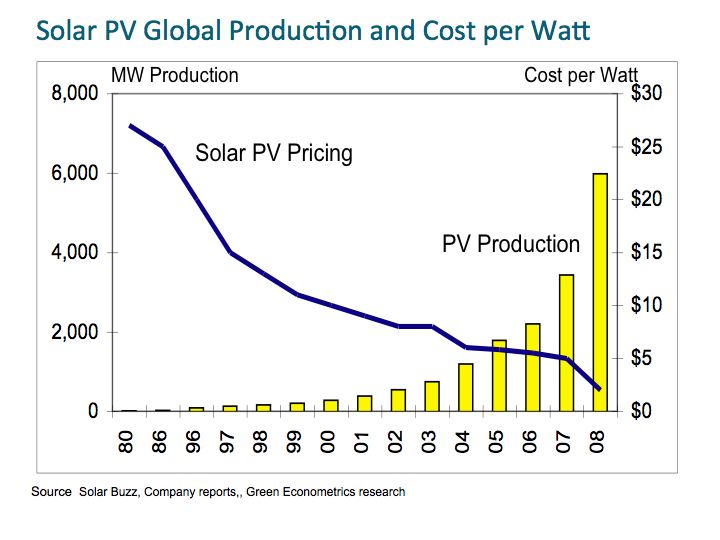
Long term, I don’t think it’ll matter much because the price deflation in renewables is so steep. Solar alone saw prices go down about 75% in the last few years. Prices have declines about 97% in the last 30 years.
Solar is now less than $1/watt from wholesale distributors, sun electronics sometimes sells them for that price or less. I’m assuming the cost will be down to a dime a watt or so by the 2020s. I wouldn’t be surprised.
I don’t think fossil fuels will be able to compete with renewables like solar within the next 20 years (or less).
Granted, you can’t run a car on solar though. However you can use the energy from solar to create liquid fuel from carbon dioxide.
There are reports fracking has been causing localized earthquakes. And what does fracking do to the local water tables, not to mention groundwater supplies for agriculture and human consumption? You might keep warm rather inexpensively, so you can afford bottled water to drink and bathe in because the local supply will kill you. Not a fair trade in my book.
Funny how the discussion centers around an immediacy of alleged energy independence and jobs, but nary a thought for energy conservation, environmental protection and human health.
We have had cheap natural gas in California for a long time. Most homes have natural gas piped in for powering of major appliances, and our #1 method of generating electricity is with natural gas power plants. I’m not sure how relevant this is, but it seemed worth mentioning.
The main effect that I see happening is the push towards using natural gas in cars. Nat gas in $1.85 for the equivalent of a gallon of gas… In Oklahoma City, the quick stops are putting in natural gas pumps at a steady rate. Most are by the interstate or busy areas but eventually they will be about everywhere. Most of the Cheasapeak Energy vehicles already run on natural gas.
The reason they are producing so much gas is they keep drilling for $100 oil and get the gas as a by product. They have been shutting big gas wells off in west texas because it’s not worth selling the gas at such a low price. The amount of gas isn’t being exaggerated to the extent that one might think… It’s truly there.
Since it’s all the same gas, when enough vehicles are running on natural gas the price will go up and the price to cook your meals, run your hot water heater, and heat your home will go right with it.
And the Oil/Gas boom gave me my job… so that part is true too
The only way fracking can contaminate ground water is if the well bore has a bad cement job and even then they know and send a tool down hole to fix it. The actual frac occurs at the bottom of the well which is 15,000 to 25,000 ft below the ground. the water table is no where close to being this deep. So it’s misleading to say the oil companies are putting chemicals straight into the drinking water.
A friend was in Turkmenistan for a month working in the oil field and they patch their pipelines with wooden chop sticks… He said the pipeline looks like a porcupine. They have major spills every other day, the US does not.
except for the whole BP deal
Does this bode ill (as it seems to me) for the non-hydrocarbon-based alternative energy systems being put into play, especially wind and solar?
Well, it doesn’t help, that’s for certain.
1a. Hell, does it bode ill for shale/tar-sands based oil production?
Upon reflection, this is a stupid question. Much of the excess natural gas is a byproduct of normal oil production.
Do you know of anyone, or is your area, involved in this portion of the energy industry?
No.
Assuming an era where natural gas is as cheap and plentiful as oil was, for as long as it was (and still is, really), what do you think some long-term effects would be of this?
I can see LNG cars becoming dominant, or electric cars powered by a grid mostly fueled by natural gas.
A fair number of regulations and NIMBY laws are coming down the pipe and I hope the industry is prepared for them.
Do you think America can hold its lead? Do you even believe the numbers?
I doubt the majority of this type of production will stay in the US - as a general rule, I don’t see why 6% of the landmass has 80%+ of the shale deposits… there has to be more out there. If there is, the great 600k+ job migration may not happen.
If there are any geologists reading this, some enlightenment would be nice…
What are some other long-term implications of a long-term (40+ years) drop in the price of natural gas?
Duh, this is the same as question 3. Stupid me. That’s what I get for hurrying.
For those of you who argued that technological change would assist in solving the energy “problem”, do you feel vindicated?
Kind of. It sucks that the technological change is so successful that the price has collapsed, but, imho, it’s a powerful demonstration of what can be done when you put your mind(s) to it.
The sad thing is, as we blow billions of $$ on idiotic technologies like solar and wind, we could become essentially energy independent. That means:
-no more involvement in the ME
-no more kowtowing to the corrupt kingdom/mafiosi of Saudi Arabia
-lowered emissions (natural gas burns clean)
a huge drop in our balance of payments deficit
Of course, we won’t exploit this opportunity-we’ll continue on the present path!
1. Does this bode ill (as it seems to me) for the non-hydrocarbon-based alternative energy systems being put into play, especially wind and solar?
This could slow down wind installations (since they’ve already reached a temporary shelf–a lot of the low-hanging fruit has been picked; now, areas where they can put new turbines will require massive transmission lines to be built or massive zoning battles to be fought). I think solar is actually out of our hands–the price drops in solar are being driven by Chinese manufacturing/Chinese future demand, now, not by US demand. Those prices should continue to drop whether we install more panels or not. The Chinese know they need domestic energy production badly.
While this bodes well for cleaner air (fewer pollutants/particulates), it bodes poorly for fighting CO2 emissions/climate change. I would guess that it will only accelerate global CO2 emissions (whereas high oil prices were starting to make people look seriously at non-hydrocarbon energy sources; but this will likely be too cheap and “clean” in all other senses to pass up). 3. Assuming an era where natural gas is as cheap and plentiful as oil was, for as long as it was (and still is, really), what do you think some long-term effects would be of this?
no refineries needed for it; what does this mean for the already-complicated refinery industry? What about Delta Airlines, who just bought their own refinery? Is it possible to fly a jet with NG, or is the energy density not there to make the math work? Or would the redesign/refit of the engines be too costly to make it worthwhile? Does all that mean that air travel will become more expensive yet, at least in comparison to NG-augmented ground travel?
lots of local production/power generation? Fewer transport issues?
no NIMBY aspect for power generation (unlike coal or nuclear, or even wind). NG power plants are all over the place already, and most people aren’t even aware of them.
Do we see a boom in home off-grid/grid-tied NG power generators? There’s a robust NG distribution network in much of the urbanized US already. NG generators seem an ideal emergency outage power replacement (at least in the Northeast, where outages are usu. storm-related; for earthquake/tornado damage, they wouldn’t be of much use, since NG lines often get destroyed, too). I remember back at Y2K, a number of survivalists advocated for moving to property with gas wells, and getting a gas generator in order to be fully self-sufficient. With gas more widely available nationally, I wonder if that sort of thing will have more traction. (Although I’m unfamiliar with the length of extraction time for fracking–I don’t think it lends itself to that sort of slow, trickle usage of a single home’s demands. Maybe you’ll see small cluster communities of 5-20 homes that all draw from a single well and have their own mini NG gas/elec. distribution system.)
And I agree we may see a boom in CNG cars (which seemed to be having a mini-boom about 10 years ago in municipal vehicles, then tapered off).
**4. Do you think America can hold its lead? Do you even believe the numbers? **
The numbers are probably pretty accurate. The problem is the NIMBY aspect of fracking. A lot of the shale gas is located in areas of major population or areas with important natural (flora/fauna/drinking water) resources. You will have (and are having) major NIMBY/zoning battles over drilling in these areas. So a lot of the reserves will be off-limits.
I find the transport issue interesting. NG pipeline transport is already a big deal throughout Europe and Asia; I expect it will become a bigger deal. Due to geogrpahy, the US has fewer adjacent trade partners, so I imagine the vast majority of the NG will be consumed domestically. (Plus, we have the appetite for it.)
In general, though, since NG doesn’t travel as easily by sea as oil does (always huge battles here over highly explosive liquefied gas terminals…), I think it won’t be as easily exportable as oil has been. All of this means that we may see more local (i.e., within a nation, but also hyperlocal, within miles of NG well) power production globally. More decentralization. That seems like a good thing, in my mind (leaving out the enviro. costs of more hydrocarbon burning and of fracking).
Your whole premise is preposterous. NG exploitation is already booming. It will continue to boom. It’s too good for people to ignore. If we sunk a trillion dollars into renewables, it wouldn’t impact NG’s development by even 1 cent.
Just in reply to your energy density point. Here’s a chart of the enrgy densities of various fuels. The x-axis shows the energy density by weight, with natural gas being slightly higher than diesel and gasoline. However the y-axis shows the energy density by volume and here natural gas loses out majorly. Even LNG is only just over half the values for diesel and gasoline. So I don’t think you’d can run planes with it without major redesigns.
Industrial production of synthetic petrol from natural gas is a solved problem. Mobil built a plant in New Zealand in the 1980sthat did this. Petrol production at Motonui stopped in 1997 because of low oil prices but the technology and know-how is certainly around. It’s just a matter of whether it makes business sense.
The way natural gas replaces gasoline is not with compressed natural gas. Its with electric cars (at least if you want to make a dent in gasoline use in the forseeable future). Even solar and wind cannot replace gasoline except to the extent they can generate electricity and use the electricity for plug in vehicles.
Right now solar and electric are nowhere near grid parity and even natural gas is more expensive coal or nuclear but without the pollution from coal and the radioactive waste from nuclear.
If we don’t embrace natural gas, we are fucking retards. Its a frikking lifeline that will keep us going while the geniuses figure out how to make solar and wind economical.
[QUOTE=ralph124c]
The sad thing is, as we blow billions of $$ on idiotic technologies like solar and wind, we could become essentially energy independent. That means:
[/QUOTE]
Good grief…why do you assert they are ‘idiot technologies’?? Both are viable as niche energy sources, and R&D is very rarely a waste. I think most of the low hanging fruit for wind has been captured in the US (when you factor in the NIMBY thinking), but exploiting it has hardly been ‘idiotic’. Solar has great potential where it makes sense and R&D and even development and deployment is, again, hardly ‘idiotic’. The future of energy in the US is going to be a mix of different technologies, with wind and solar always playing their part in their niche…as does geothermal and hydroelectric.
Besides, it’s not like we have been spending vast amounts on wind and solar while completely ignoring natural gas (as well as many other alternatives, excluding, sadly, nuclear since that seems to be a political third rail). We have spent plenty on developing the very technologies under discussion in this thread to enable us to tap into this vast natural gas resource. It didn’t just happen by magic, ehe?
Complete hyperbolic horseshit and completely contrary to the fact that we ARE exploiting this resource and increasing our exploitation of it. You aren’t going to see a total paradigm shift away from oil in a year or even a decade because oil is still very cheap and plentiful, and the benefits of natural gas as a personal vehicle fuel source haven’t been shown to be economically superior to a degree that would warrant the huge amount of capital it would take to shift us away from oil. THINK about what it would take before spouting this stuff. Look at it from a realistic cost to benefit analysis. As the price of oil climbs it will eventually reach a level where it WILL be realistic to start seriously looking at large scale alternatives. Maybe natural gas fuel cells will be the eventual winner. Maybe it will be all electric vehicles. Maybe it will be one of the various hybrid technologies. Maybe we’ll simply convert natural gas or other materials into hydrocarbon ‘gasoline’ and just stick with what we have now, simply substituting something else for the oil. Who knows? What I DO know is that SOMETHING is going to eventually supplant oil. You are making the same basic mistake that the Peak Oil folks constantly make.
It seems to me that the way to go is to rely more on electric power generated with a mix of natural gas, wind, and solar. Investments should be made in improving the electrical grid and better battery technology. We have so many options for generating electric power. In the future we may have safer fission and possibly even fusion reactors, but whatever the source all of them can feed the grid. Your car doesn’t care how the electricity was generated.
The Bakken in North Dakota is not a natural gas play; it is primarily oil with a big portion of the small amount of gas produced being flared. It is more accurate to say that the active natural gas unconventional plays are in Texas (Barnett, Eagle Ford, Granite Wash, Haynesville), Louisiana (Haynesville), Arkansas (Fayetteville), Oklahoma (Woodford), Pennsylvania (Marcellus, Utica), Ohio (Marcellus, Utica) and West Virginia (Marcellus). Of course these aren’t the only active plays, and some other areas like New York with the Marcellus and Utica may becomne more active in the future. There is also a huge amount of natural gas produced in conventional plays in places like Texas, Louisiana, the Rockies, Oklahoma, New Mexico, Wyoming, the Gulf of Mexico, and Alaska. Also, none of the really dry gas plays are really active except for the remaining amount of leasehold retention issues going on. The more “liquids-rich” (oil and NGLs) plays or areas of the plays are the most active. For example, the Haynesville has slowed down while the Eagle Ford has kept on ramping up; this is because their are liquids-rich areas of the Eagle Ford while the Haynesville is mostly dry gas.
Of note, the Henry Hub price is for gas sold in Louisiana. It is common to quote as the most common natural gas futures contract traded on NYMEX is based on Henry Hub. In this way, it is like West Texas Intermediate (“WTI”) for oil.
Hydraulic fracturing increases the permeability of the formation. Horizontal drilling increases the surface area of the wellbore that is in the formation. These same wells can be marginally productive in vertical wellbores without a frac.
The U.S. does not have the majority of gas shale reserves. North America probably has less than a third. Also, don’t get confused with your categories. You’re going back and forth between oil shales and gas shales. Also, you are leaving out other big unconventional gas plays like coalbed methane. You might want to consider opening up the top to unconventional oil and gas of all types.
The real reason the U.S. is in the catbird seat is the combination of our natural resources and our entreprenurial spirit. Places like Argentina have big reserves, but you don’t do a good job of developing them when you do things like over-tax or nationalize the resources. Also, don’t neglect the fact that we can simply more easily use natural gas as a fuel since we already have the pipeline infrastructure. Places like China just can’t develop or use their reserves as well as we can.
From a production standpoint, the U.S. is also the Saudi Arabia of coal and the Saudi Arabia of oil. We’re probably also the Saudi Arabia of wind and other alternative fuels. I mean this from a production of the fuel standpoint only. What makes Saudi Arabia so influential in the oil market is that they are the biggest exporter and they hold the largest excess production capacity. The U.S. will probably be producing more oil than Saudi Arabia again within a decade though. The U.S. will never be the Saudi Arabia of natural gas from an export side because it is not politically feasible for the U.S. to be a huge exporter regardless of our production capacity. Also, your statements here are somewhat conflicting. The resurgence of the chemical industry in the U.S. is somewhat in conflict with the U.S. becoming a major exporter of the fuel. Take a look at who is bank rolling the anti-LNG liquefaction lobby.
Remember that we don’t have the largest shale reserves in the world. China has more reserves than us. We’re just the best at producing the reserves.
To some extent. However, those fuels are not really ready to be major contributors yet. It’s good to get our power from multiple sources though (including coal). We don’t need to choose one specific fuel source. I guess people have the innate desire to be part of a team or choosing a side that they don’t really understand that we can keep moving forward with everything. We should be moving forward on clean coal, unconventional and conventional oil and gas, wind, solar, hydroelectric, biofuels, nuclear, geothermal, etc.
Same technology and in a lot of cases the same formations produce both unconventional oil and gas.
Yes, in almost every respect: from financing the earliest producers like George Mitchell, to producing in almost every formation, to working on the most active completion crews for Halliburton, I either have done or know someone in every stage of the industry.
The energy revolution currently going on in the U.S. will produce staggering results for the U.S. economy. Unconventional natural gas is only one part of the story.
The U.S. is not in competition with other countries in natural gas production with other countries. The U.S. is on an island. Natural gas can not easily be transported to the U.S. or out of the U.S. LNG importing is essentially no longer necessary. LNG exporting will be politically difficult to do in a big way.
Natural gas has actually been pretty cheap for a long time. Even the rise in prices that occurred for much of this decade did not seem like it would last very long; we all thought LNG importing would be a game changer. It seems like gas will remain pretty cheap for a long time.
No, but I also don’t feel vindicated when I win an argument with my three-year old.
If wind and solar are free than so is natural gas and oil, right? I mean the stuff is just sitting there free for the taking. All you have to do is spend a bunch of money and brain power to produce it and put it in a useable form, but other than that it’s all free.
The vast majority of California’s natural gas comes from out of state: places like New Mexico, Colorado, and Canada. California has had cheap natural gas for a long time because natural gas has been cheap in most of the U.S. for a long time. It was always a little more expensive in the North East, but it was still cheap there too.
IMO yes, it is depressing and delaying development of solar and wind projects in some areas, but then those solar and wind projects were not especially attractive anyhow. The principal, #1 impact cheap gas has had is to accelerate greatly the retirement of scores of coal-fired power plants (along with a set of “big 4” environmental regulations), as well as putting outrageous pressure to cancel pending coal-fired projects. The last year in my industry has been stunning and unprecedented, and every couple of weeks a client of mine tells me about a new coal plant which is about to be announced as closing because, primarily, of a combination of cheap gas and environmental regulations. I could write for pages on what’s going on, but I think the above summarizes it.
I have heard it may improve production due to cheaper gas used in the process.
Yes, me.
Continued retirement and non-replacement of coal-fired power plants, a major shift in reliance on gas which may be harmful in terms of energy diversity, a sandbagging effect on renewable energy (the Sierra Club basically shot themselves in the foot here), and a sandbagging of nuclear projects.
The numbers depend greatly on whether local environmental legislation ends up restricting or banning fracking.
A possible increase in the drive for CNG vehicles.
 )
)