Hard to believe. I recall the fifth anniversary. Someone called for a memorial at MIT, but only three people showed up, including me.
It was a predicted and avoidable disaster, and has been chronicled in enough places, including Adam Higgibotham’s book Challenger: A True Story of Heroism and Disaster on the Edge of Space that came out two years ago.
I had a now retired colleague who filled out all the paperwork needed to apply for the position of “First Teacher in Space” and a place on the shuttle. I remember him telling me how envious he was until the vehicle blew up on live television. He couldn’t describe the feeling as, totally stunned by the event, it slowly dawned on him that they all had to be dead and, if he had “won”, he’d be dead, too.
Yes! My beloved high school history teacher applied, and asked me to write a reference for him, if I recall correctly. I wonder if I would have felt some guilt, if he had been picked!
When I teach Crew Resource Management to pilots I often discuss Challenger and the phrase that came out of the investigation: “Normalization of deviance.”
NASA had rules about launching in low temperatures because the O-ring problem was known. On a couple of earlier occasions when the temp was slightly below the limit they decided to launch anyway on the thinking that it was close enough. When nothing bad seemed to happen (which turned out not to be true) it emboldened them to continue launching at low temperatures. Hence, they made it normal to break their own rule.
It’s as important a lesson today as forty years ago, and still an easy trap to fall into.
I was in college, and remember passing a dorm room with the door open. I saw the launch, but NOT the explosion as I passed by. I thought “hmm - interesting they don’t always show launches” –
It wasn’t until later when I saw the whole thing.
I was at work when it happened. I overheard a coworker saying he had just heard it on his radio.
10 years to the day later was was Super Bowl XXX. In the F16 flyover, Richard Scobee, son on Shuttle Commander Dick Scobee, flew the missing man formation.
I’m still mad at NASA, I haven’t got sadder, I’ve gotten madder.
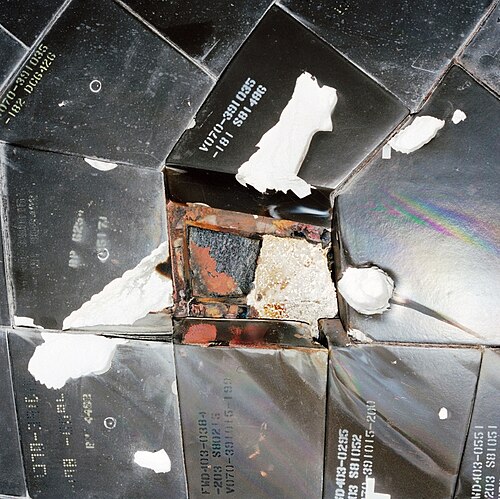
Like the Columbia. Did you know another shuttle almost burned up before Columbia? Tiles were lost and burn through had started. NASA would like you to forget. But I won’t.
BTW: I’m going to quibble with the word “explosion”.
Challenger disintegrated aerodynamically. The O-ring failure caused a series of structural failures that essentially changed the shape of the combined orbiter, external tank and solid rocket boosters. At the speed they were going that shape instantly failed, similar to how a piece of paper would crumple if you held it out the window at highway speed.
The fuel in the external tank ignited, but that was an after-effect. Challenger itself basically tumbled in the airflow, with sufficient G-forces to tear it apart while ejecting many pieces intact. One of those pieces was the crew cabin and the astronauts were probably alive until it hit the water. Possibly conscious, but I hope not.
I can’t quibble with the term “explosion” as during the launch, the NASA commentator said that the Flight Dynamics Officer stated that the vehicle had exploded.
It was entirely preventable, just don’t launch in freezing ass weather. Florida has many days with warmer weather to choose from. The political pressure to launch must have been enormous as voices of warning were overridden.
Not to keep drifting off topic, but I highly recommend William Langewiesche’s article Columbia’s Last Flight for that. Few things more gripping than a talented technical writer chronicling a disaster & the followup investigation. Really makes you angry when you realize how many missed opportunities could’ve prevented it.
It’s good to be aware that the vehicle failed due to aerodynamic disintegration, but the fuel and oxidizer did deflagrate, and deflagrations are commonly referred to as explosions, even if there’s no proper detonation.
I still think it’s a distinction worth mentioning.
The failure was with the solid rocket booster, not the orbiter itself. So saying “Challenger exploded” is simply wrong. Challenger was subjected to aerodynamic forces that destroyed it, which was the root cause. Fuel and oxidizer igniting happened afterward as a result.
I was in 5th grade and we did not watch it live as we didn’t have access to CNN. But there was a keen interest in this launch because of Christa McAuliffe, so someone was keeping track of what was happening, and at some point the principle hopped on the PA system to announce the tragedy to the whole school. I think some of the teachers might have been keeping track of the launch by radio, so announcing it to the whole school was probably for the best instead of letting rumors run wild.
I totally agree w your point technically. But this:
totally depends on defining “Challenger” as the shuttle vehicle itself only, not the entire mission stack. Which flies in the face of how NASA’s civilian-facing PR has generally treated terminology about launch. Call it “lies taught to laymen” and it becomes a lot more palatable.
During liftoff to the moon, the whole stack was called “Apollo 11”. etc.
The orbiter itself aerodynamically disintegrated. As you said, it’s important to understand this if you’re focused specifically on what happened to the orbiter itself, because it didn’t explode.
But it’s correct to say that parts of the Challenger stack exploded, referring to both the intentional destruction of the SRB’s, plus the deflagration of the liquid fuel/oxidizer, which is what most viewers saw in the media, and how flight control announced the event.