It’s a circle because the implication is that the system is self-contained. A causes B which causes C which causes A.
A cycle can have external causes. You may have a repeated pattern but the pattern isn’t creating itself.
It’s a circle because the implication is that the system is self-contained. A causes B which causes C which causes A.
A cycle can have external causes. You may have a repeated pattern but the pattern isn’t creating itself.
Clearly, it’s “cyrcle”.
We have a winner. Well done - you have stopped this vicious cyrcle of a thread.

LOL, no, I don’t have a cite. IMHO saying “addicting” is right on par with saying “irregardless,” you can point to the dictionary and I can think you sound like a moron.
Oh c’mon, the whole *point *of being pedantic is that you have to have cites. I can tell you succinctly why irregardless is “wrong” (because “regardless” is already negative, “ir” is also negative," and most mainstream dialects of U.S. English use two negatives in sequence as a positive instead of an intensifier, so it’s almost certainly a result of confusion with words like “irrefutable”).
“I just don’t like it” doesn’t cut the mustard unless you want to turn in your nerd card.
We could argue about whether addicting is a transient verb, a participle adjective, or both and we could cite til the break of dawn but wouldn’t it be exceedingly boring?
A person could say, “Joe is addicting me to Halo.” A person could also say “Joe is getting me addicted to Halo” or “Joe and I played Halo, it’s addictive.” All correct. I reserve the right to think the first example makes the speaker sound like a douche bag.
In French, it is always said as cercle vicieux = vicious circle.
eta: A quick Google search shows that the incorrect English version, vicious cycle, seems to have infected the French language. But in pre-internet days I never saw “vicious cycle” in French.
I draw your attention to your use of the word “boring.” Please note that it is employed in exactly the same way as the usage of “addicting” to which you object. Please explain why you believe that the verb “bore” can be used in this fashion but “addict” cannot.
I’m a fan of Vicious Cycles.
I draw your attention to my previous post wherein I acknowledged the myriad ways in which addicting can in fact be used correctly.
“Boring” and “annoying” are both excellent examples of the principles behind the proper use of addicting, they also describe this hijack quite nicely.
Some people like “vicious cycle” and some “vicious circle,” people who fall into either camp are correct. However, as this thread illustrates, folks from one camp tend to think folks from the other camp sound weird/wrong/ridiculous.
Pretty soon they’ll be calling us circle jerks.
It is NOT “circle”! :mad:
How about “A tough row to hoe”? I often see it rendered “A tough road to hoe,” including in a headline just a few days ago in the Bangkok Post. “Road” makes no sense whatsoever. You don’t hoe a road, you hoe a row, as in farming!
Holy crap, more people use ‘vicious circle’ than ‘vicious cycle’? My mind has been blown. I don’t think I’ve ever heard someone say ‘vicious circle’ as a matter of fact…
Out of curiousity, do you cycle people use the expression “we’re going around in a circle” or “we’re going around in a cycle”?
Apples and Oranges. Relevant only if one were to say “Going around in a vicious cycle/circle,” which no one does.
It is a “tough row,” certainly. You’re right about that one, wrong about this one.
However, it’s not just a matter of whether the expression makes sense, or can be thought of it in a way that makes sense. Using an expression fluently in English means not just constructing the words together in an intelligible way, but also knowing and understanding the established references for that combination of words.
Think of “anchors aweigh” versus “anchors away.” Either of these can make a kind of sense, but their meanings are approximately opposite. To weigh anchor is to bring it up, prepare for departure; “anchors aweigh” is the condition of having accomplished this, to be ready to go. That is the established expression. “Anchors away,” on the other hand, suggests throwing out the anchor, to catch hold and stay someplace.
Now, “vicious circle” and “cycle” are functionally about the same, but there’s still a history and connotations behind the “circle.”
You misspelled “right about both.”
When I think of a vicious circle, I’m thinking of a metaphorical circle - something where you’re moving but not making any progress because you keep going back over the same points. That’s why people speak about breaking out of a vicious circle.
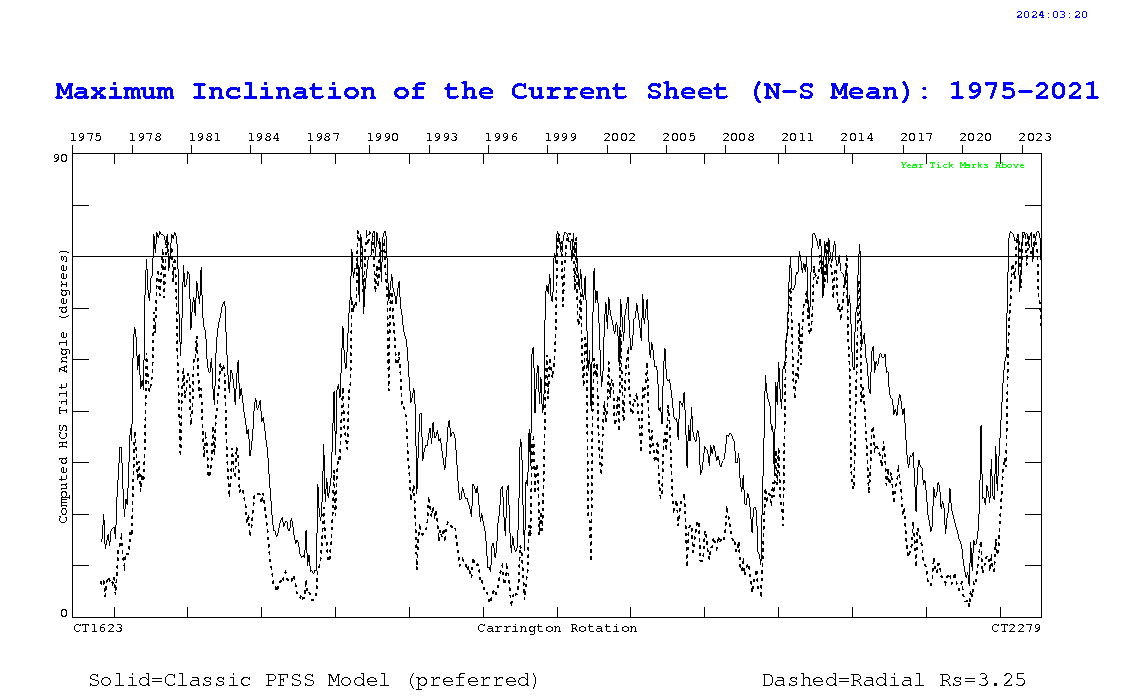
But a cycle’s not like that. A cycle may be going up and down but it’s also moving along a line. You’re going somewhere with a cycle. (Some examples of what I picture when I think of a cycle.)
Actually, you used “boring” in *exactly *the same way you complained about other people using “addicting”: you used “boring” to mean “cause you to be bored,” and they use “addicting” to mean “cause you to be addicted.” You simply have an apparently irrational and completely unsubstatiated objection to this usage. Those are fine to have, as long as you don’t have any illusions about the legitimacy of your position.
For example, I really hate the word “panties.” But I’m not going to run around claiming that people who refer to the things that cover their crotch using that word are “wrong.”
Uh, no. Vicious cycle is quite demonstrably a confused version of the original expression, “vicious circle.” Which isn’t to say that “vicious cycle” hasn’t come to be equally accepted, but it certainly didn’t start out that way.
Except we have proof that it was originally “vicious circle,” including variants in other languages. In fact, I don’t think anyone’s brought in a single non-English version that’s “cycle” instead of “circle.”
FWIW, in German it’s “Teufelskreis” which translates to “devil’s circle”, but then, cycle is “Kreislauf”, so it’s not too far off.