Is there a specific reason why Adam and Eve used fig leaves (as opposed to any other leaf/object/etc.) for their garments when they realized they were naked? Is it just because fig leaves are large? Or because fruit-bearing fig trees would have been plentiful in an imagined paradisiacal garden like Eden? Or did fig trees/fruits/leaves have some subtextual meaning to the Israelites of the time Genesis was composed that modern readers (or obtuse readers, like me) aren’t aware of?
Because* they were (supposedly) plentiful in the (theoretically) lush environment of Eden. And because they are only sort of adequate to the purpose, thereby representing that their first attempt at a solution for their sinful condition, as symbolized by nudity and shame, was an inadequate physical solution to their underlying spiritual problems.
A “fig leaf” has come to have frequent use in English rhetoric as a metaphor for an inadequate cover-up or defense of large crimes and offenses.
*Disclaimer: I am interpreting other sources in the first paragraph, this is not something that I believe to be true. The factual element is that this is something like what the religious sources say.
Figs are one of the Seven Species, the seven plants most important to the ancient Israelites. These staple crops were wheat, barley, grapes, figs, pomegranates, olives and dates. Of these, the fig tree produced the second-largest leaves, and date palm fronds are not what you’d call wearable. It makes sense that fig leaves would be the ones used for clothing.
Also, although the fruit that they ate was never named in Genesis, for much of history it was believed to have been a fig, since after it was eaten they covered themselves in fig leaves to hide their nakedness.
I know that doesn’t really answer the OP’s question, it’s rather the opposite, but presumably if it was a fig, that would explain why they used fig leaves; it was probably the closest thing they had on hand once the ate the fruit. Rabbi Nehemiah Hayyun (1650-1730 CE) was one proponent of that theory. And Michelangelo portrayed a fig as the forbidden fruit in his famous Sistine Chapel painting.
Figs are an ancient symbol of fertility and abundance, which makes them a natural choice for a narrative like this with its intended message of humans transcending divine prohibitions.
I wonder if the fruit eaten in the original telling was a fig.
In this cylinder seal from the British Museum (known as the ‘Temptation Seal’), two figures (accompanied by a snake) are sitting facing a date palm.
https://www.britishmuseum.org/collection/object/W_1846-0523-347
The image dates from ~ 2200 BCE, and is sometimes interpreted as depicting Adam and Eve (although at least one of the figures is apparently a god).
So maybe in an early version of the legend the fruit was a date.
Not really a useful answer, but have you seen women’s lingerie recently?
Quite a few of the high end expensive stuff are completely inadequate to the purpose…
… but, instead, serve a very different purpose.
Although I have not seen Agent Provocateur issuing “fig leaf” styled underwear. If I had a girlfriend I might buy it for her, depending on her personality…
I hope this isn’t too much of a hijack, but assuming the forbidden fruit was originally a fig (or maybe a date), how/when did it become an apple in popular culture?
I believe the leading theory is that it’s a mistranslation of sorts. Words change over time, and old Latin texts used to call the fruit a “pomum”, which is just a generic Latin word for “fruit”. This Latin word evolved into the French word “pomme” which originally was a generic word meaning “fruit”, but over time the meaning changed to the more specific reference of “apple”. Since the Bible isn’t specific about the type of fruit, medieval French artists started portraying the fruit as an apple, and it stuck.
IIRC, someone opined that “malum” suggested an irresistible play on words.
The word “apple” in English was also originally a generic word for “fruit”, whose meaning shifted to the more specific one we’re familiar with today.
I think there’s a parallel between fig leaf (a leaf of the default fruit tree) and apple, the fruit of the default fruit tree when you move from the middle east to northern Europe.
What @Alessan says has always been my assumption about why it was a fig leaf. Fig leaves are by far the most appropriate of the options. But i wonder if there are any stories from nearby cultures with different coverings.
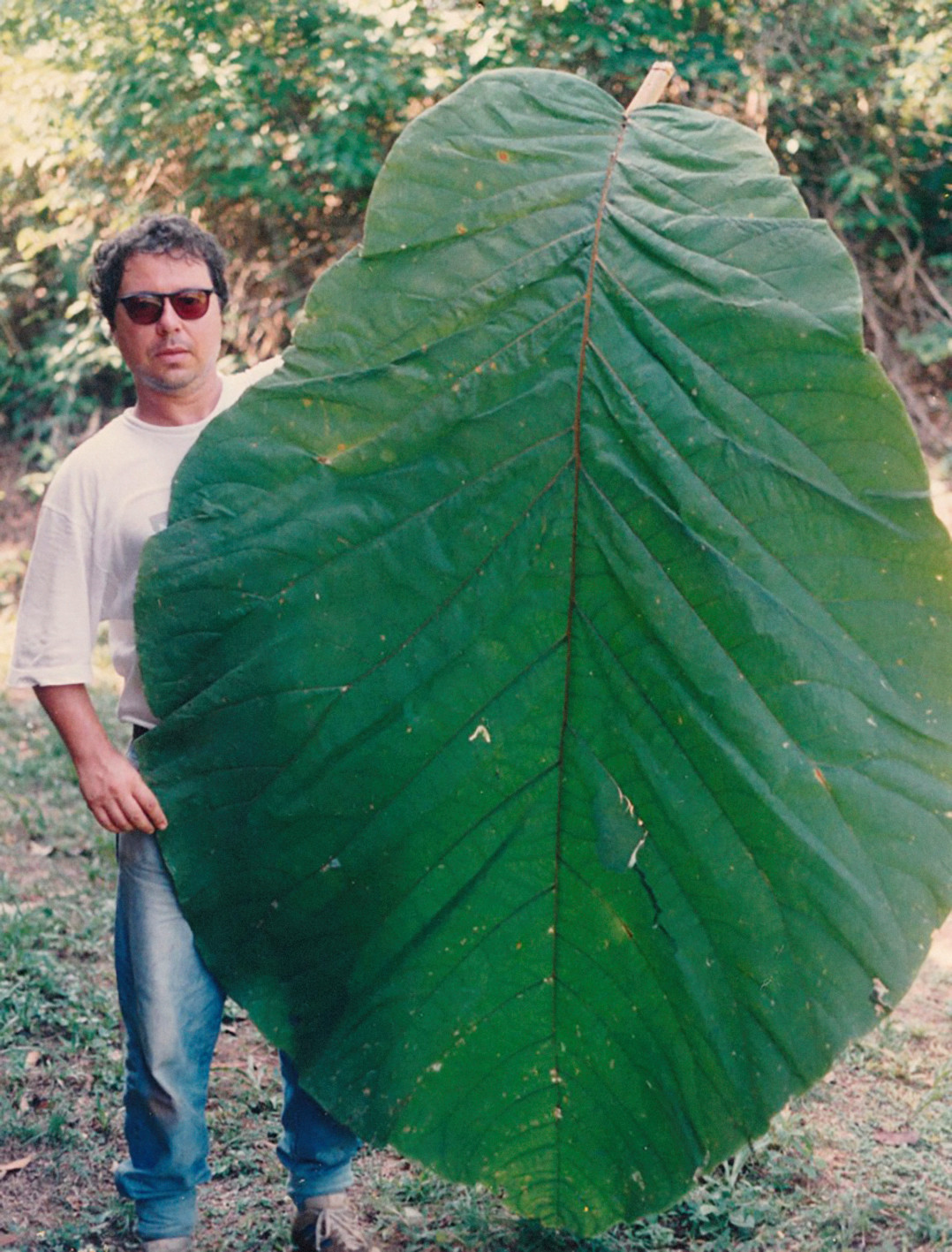
From a practical standpoint, fig leaves, while varying in size and shape, are nowhere near adequate to cover Forbidden Body Parts.
This is the one you want (Coccoloba gigantifolia):
I thought I read that God killed an animal and used the skin to cover them.
Fig leaves look a bit like hands….so they were using leafy hands to cover their nakedness. Plus, fig trees were abundant in the world in which that particular story was dreamed up.
Why does everyone always ask what kind of fruit the Forbidden Fruit was? It was a tree-of-knowledge fruit. I mean, I’ve eaten figs (and pomegranates and apples), and they were tasty, but none of them imparted any moral insight on me. Clearly the Forbidden Fruit was something else, that doesn’t grow outside of Eden.
Well, duh, that’s cause we’re postlapsarian.
At first, the couple used fig leaves to cover themselves. Apparently, sewing them into a garment, not merely hiding their naughty bits with individual leaves.
God intervened and provided animal-skin garments after they were busted.
Don’t you already have all of the effects of eating tree-of-knowledge fruit?