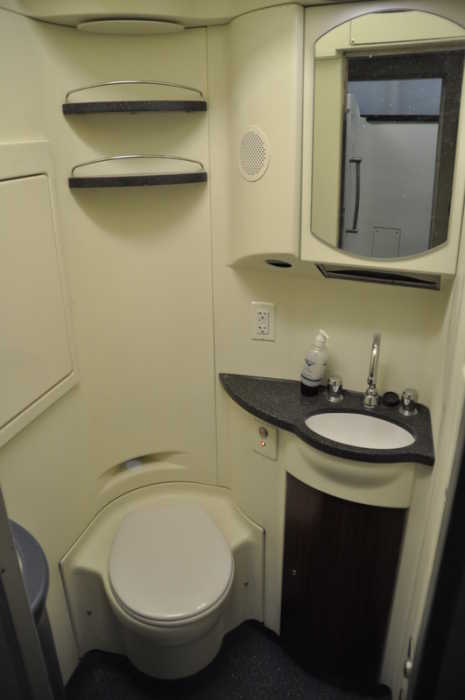
More than you probably want to know about the Superliners. Article sez Amtrak will be replacing them by 2032, but I wouldn’t hold my breath.
(Easiest way to determine which version you’re in — assuming you have a roomette — is the SL-II has a very small closet while the SL-I with the spray-all-over-creation-and-half-of-the-formless-void faucets has a clothes hook and a strap to keep things from flopping about.)
As for the schedule, it has some wiggle room built in. Last time I took the Empire Builder was in 2012, and according to my log while we were 36 minutes late leaving Minot we were on time leaving Shelby. From there on we were on time or a little ahead of schedule, arriving Seattle 39 minutes early.
I didn’t actually realize there were two different versions of the Superliner sleepers. It would be kind of nice to have a sink in my room, just so I don’t have to walk over to the bathroom to brush my teeth.
Looking at some diagrams of the car layout, it looks like I’m assigned to a Roomette on the lower level. I could see advantages and disadvantages to that. Less swaying, I imagine, and a shorter walk to the showers and toilets, but perhaps not quite as good of a view. And it looks like I’ll be right next to the stairs. I hope I’m not going to be hearing people going to and from the toilets all night. I’ll have to remember to bring earplugs.
Regarding the schedule, at least one YouTube video I watched said that there is some padding built into the “smoke break” stops, and if they’re running behind they make up time by spending less time at those stops.
i don’t know about superliner roomettes, but viewliners have two - the newer ones don’t have toilets in the cabin. I’ve seen different layouts in the shared bathrooms in the superliner - one is adequate, the other is only comfortable if you’re a child.
The upper roomettes are better for access to other cars, since the crossover is upstairs, but yes there’s more swaying. I’ve done both and it makes little difference to me.
Anyone ever noticed the sensation when you’ve been on a boat or in the ocean, where it still feels like you’re bobbing up and down? I noticed yesterday in Chicago, LOL.
And our first bit of unfortunate news:
Heard the staff talking just now and they have not yet been told that we are NOT going through, but I’m not holding my breath. I suspect we’ll be looking at a long, uncomfortable bus ride from Whitefish to Spokane.
Doing a little more research there are two, although I think I misinterpreted @OttoDaFe’s post earlier. When he mentioned the sinks I took that to mean there were sinks in the Roomettes, but I believe the difference is:
Superliner I: No closet in the Roomettes, and apparently the “spray everywhere” faucets in the shared bathrooms.
Superliner II: Closets in the Roomettes.
In the first place, there is a wc upstairs as well. The people in the 10 roomettes upstairs will mostly not be coming down for their needs, only for te shower. If you are in the last room, there is still not much noise from activity out there when your door is closed. Yes, there is less of a view, but you can go hang out in the lounge car if you want to see stuff. I personally prefer the dowstairs room because it is often a relief to just get up and stand for a while, and there is lots of space for that just a few steps from your roomette.
Looks like we will not need to detrain after all, phew!!
We did make up a little time en route, st Shelby just now they cut the “smoke break” quite short, for example. I had stepped off to try to get a snapshot if my husband from outside but couldn’t see inside enough to do so And they hollered “all aboard” almost as soon as i stepped off. Hoping our dinner reservation has us timed right for Glacier National Park, and that they haven’t run out of everything i want.
Sounds like you dodged a bullet. My retirement-celebration trip on the Coast Starlatelight ran afoul of the Delta fire, so instead of kipping the night away in a roomette I (along with everyone else) got treated to a six-hour nighttime bus ride from Klamath Falls to Sacramento (fortunately I5 had been reopened or it would have been eight or nine hours). In Sacramento we were supposed to be loaded onto the northbound train which had been stopped there, but for some reason it wasn’t available so those of us with destinations along the East Bay got to fight with commuters for space on the Capitol Corridor. Suffice it to say that I arrived in San Francisco somewhat the worse for wear.
(Not blaming Amtrak, or at least the personnel in SAC. I think it would have gone a lot more smoothly had the northbound CS been available as intended.)
(Sorry ‘bout the wall o’ text.)
Exactly. Whether SL-I or -II, no roomette has an in-cabin sink. Probably could have made that more clear.
I’ve seen several reports that Amtrak has begun refurbishing the entire Superliner fleet, but while a couple have implied that the restrooms will be redone others say not. Meaning that the “super-soaker” faucets may remain. As I said about the replacements, I’m not holding my breath.
Contrary to the impression I may give, I’m not really obsessed with railroad potties. That said, perhaps a comparison of SL-I and SL-II may be of use.
According to the Wikipedia article above, the original Superliners were designed to liquefy solid waste and dump everything on the tracks when the train reached a certain speed. Perhaps the machilery accounts for the cabinet bulkiness; at any rate, the actual toilet is a bit narrower than your average coach airline seat. Reducing the cabinet size and angling the commode makes the whole affair much more usable. You can also see the difference in the faucets.
I rode the train dozens of times as a youngster in the (19)60s: the toilets I recall flushed using a pedal on the floor (awesome idea, quite frankly, it is hard to understand why more domestic toilets are not like that) and through its opened throat you could see the ties racing by – there was a sign next to the toilet warning you not to flush while the train was standing in the station.
I’ve never ridden Amtrak, but I did ride CN, CP, and later Via here in Canada. The older rolling stock, which likely came out of American factories, much like Amtrak’s; had signs in the restroom telling everybody not to flush in the station. And yes, when you flushed when the train was in motion, you did indeed see the ties racing by.
A Toronto folksinger once wrote a song about travelling between Toronto and Montreal on a train. It was a humorous song, and I cannot remember it, but I do remember two lines:
Oh, well I remember the consternation, When I flushed the john while standing in the station.
On subsequent trips in more modern equipment, where that’s not a concern, I still don’t flush in the station. I can wait until the train is rolling again.
Being pedantic, but Amtrak didn’t exist until around 1970 or 71. So @eschereal’s story about trains in the 1960s would have been on one of the pre-Amtrak commercial railroads.
OK, but that would have been the New York Central, or the Pennsylvania Railroad, or similar. And when Amtrak came along, it would have used those railroad’s rolling stock, with different livery. Like Via did. No need to order brand new cars if all you have to do is change the livery on perfectly-serviceable cars.
Those days of “don’t flush in the station” that I experienced were on CN and CP, whose equipment was sold to Via in about 1977, and remained in service for some years after. I certainly rode on CN and CP before Via, and Via used the same stock after 1977, until it could order and take delivery of new equipment. I believe that Amtrak did the same thing–bought the NYC’s and PRR’s (etc.) equipment, and just repainted it, until new orders could be delivered.
Regardless, my point is that CN’s, CP’s, NYC’s, and PRR’s rolling stock tended to come out of the same factories in the USA. Budd in Pennsylvania certainly supplied CN and CP with long-distance passenger cars, as I’m sure it did for American railroads. So, in the 1960s and 1970s, the train cars may have been repainted to Amtrak/Via, but they were the same old stock as long as they worked and until they needed replacing.
Exactly so; it was formed in 1970, and started officially operating trains on May 1st, 1971. They did, indeed, originally operate using passenger cars and locomotives which they had inherited from the freight railroads which had been operating them, and which was referred to as the “Heritage Fleet.” They started buying new passenger cars in the mid '70s, with the Superliners, and then the Viewliners starting in the 1990s.
Eschereal, it came down to economy of scale. Is it better to have one passenger railroad, or ten?
In the 1960s and 1970s, passenger rail was declining in both the US and Canada. Oh, there were some busy, well-used spots–the Northeast Corridor in the US, and the Windsor-Quebec Corridor in Canada, were, and continue to be, well-used. But it’s the other routes which aren’t: how many people will use the Empire Builder between Chicago and Seattle for two days, when a flight takes four hours? Or the Canadian, between Toronto and Vancouver, when a flight is five hours, while a train takes three days?
Best to consolidate all passenger rail under one umbrella, and that’s why we have Amtrak and Via. They can take advantage of economies of scale, which individual railroads could not do, and use their power to negotiate reasonable running rights on other railroad’s tracks. Plus, it eliminated the need to change railroads at certain stations to get where you wanted to go. And sometimes even stations: cf. Montreal Central (CN), and Montreal Windsor (CP).
But all the towns and people seem
To fade into a bad dream
And the steel rail still ain’t heard the news
The conductor sings his songs again
The passengers will please refrain
This train got the disappearing railroad blues
And, at least in the U.S., by that time, the freight railroads were trying to get out of the passenger train business – it was withering, due to competition from cars and airliners, and the Postal Service had just pulled their mail business from the passenger trains. Santa Fe and Penn Central had already filed with the government to discontinue many, if not all, of their passenger routes, and if Amtrak had not been formed, intercity passenger trains would have largely gone extinct.
Kenobi, the same happened here in Canada. Neither CN nor CP wanted to continue passenger service; it was a money-loser. But passenger service had to be maintained, so Via was the answer.
Interestingly, in the late 1960s, the Government of Ontario (note those letters) formed GO Transit, which used CN rolling stock (mostly) to create a suburban rail commuter service, rather like Chicago’s Metra. Running far beyond Toronto’s borders, it made commuting to Toronto much easier for folks in places like Stouffville, Meadowvale, and Pickering. Today, GO uses custom-made equipment, but I still remember riding a GO train in about 1968 that had a GO sticker covering up the CN on the side of the car. Kinda cheesy, but it got the job done.
The Empire Builder has had a fair complement when I have taken it, so people must be using it. I have an old-style drivers license, so I am not allowed to fly (tried to get the enhanced version but found they needed one more thing than I had). It is so much nicer to take a journey of a thousand miles that does not begin with a metal detector and a strip search(credit Bob Thaves).
@DesertDog, yes, “passengers will please refrain.” From flushing in the station, of course.
The stories I could tell. Not mine; my Dad worked on CN passenger service in the dining cars in the 1950s, and he insisted, unless there was no other reasonable way, that we always take the train, and I remember many things from those trips, as well as the stories my Dad told me about trains in those days.
“Playing card games with the old man in the club car/Penny a point, ain’t no-one keepin’ score.” Dad never did learn how to play gin rummy, but he sure learned how to play craps, which was a popular game in the men’s room, apparently. He also could pour a cup of coffee from three feet up, without spilling a drop. And then there was the night he ran out of cigarettes in Chicago, where his train was doing a turnaround. And the time he got us back from Calgary with my new baby sister, who needed bottles and changing and so on, with full cooperation from the train crew.
Lots of stories. Freights have numbers; passenger trains have names, and those names are special. “The City of New Orleans” is just one.