This article appeared today in my geophysics news feed. I was initially struck by the photo, which looks unreal enough to suspect Photoshop. Until you see the credit is the US Navy, who’d have little reason to fake this particular shot.
The larger info in the article is pretty amazing in that they’re using satellite-based gravimetric data to detect changes in tension along fault lines.
[aside]
And no, Discourse, my topic is not similar to every topic ever written that includes the word "interesting" in its title. In fact, it's not similar to any of them. But thanks for trying.
I’ll be convinced when they can predict an earthquake in advance, evacuate a large city, and save thousands of lives. Of course, completely evacuating a city and waiting for an earthquake that may or may not happen may be a minor issue.
Very interesting findings. (I assume the implied Factual Question here is in the neighborhood of “is there enough here that quake forecasting will become plausible,” or some such.)
[Moderating]
Definitely cool, but it’s a “hey look at this”, not a question. And “hey look at this”, even if cool, even if arcane and pointful, goes in MPSIMS.
Even a prediction of minutes would be helpful, as it would allow people to move to a safe place, stop their vehicles, etc.
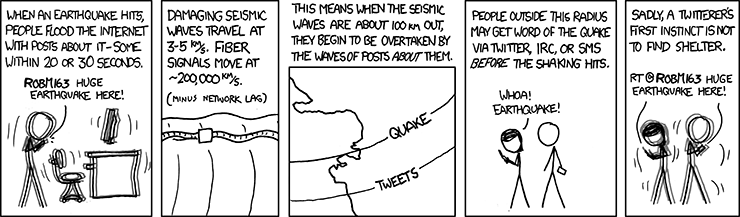
I don’t know if it’s gone anywhere, but there’s been some talk of using a wide network of seismometers, and blasting a notification to cell phones when a large one has occurred. Earthquakes only move at a few miles per second, so if you’re, say, 20 miles away, you might have enough time for some reasonable action (like ducking under a desk, moving away from windows, etc.).
The notion of evacuating a city is nonsense, even with magically precise 100% accurate foreknowledge of the timing.
The notion of telling the populace to take extra precautions is not. Sorta like with hurricanes here, at the start of every season we tell the populace to stock up & make a plan, etc. Similar could be done for the more “seasonal” long-ranged earthquake prediction that something is getting stretched near the breaking point nearby, and a quake within months is highly likely. That will deliver value, not disruption.
The other thing, which @Dr.Strangelove also says, is that earthquake & tsunami detection can provide useful warning time for anyone not immediately at the hypocenter of the earthquake. Now that we have most of the populace carrying online warning devices wherever they go, if we can detect it & characterize it automatically, we can also launch automated warnings quickly enough to be actionable. If the small percentage of people in the most precarious of positions, e.g. high up on a ladder, performing brain surgery, had 30 seconds notice to stop what they were doing, many of them would be less harmed. Folks knowing to either stay inside a building or out in the middle of the street, but not just outside the door or near the walls, etc.
The pic in that article was tsunami damage, not earthquake damage. The earthquake caused the tsunami of course but my point is that level of damage is not what a city looks like after a simple earthquake.
I’d been in the shower and didn’t even notice it (it was only about magnitude 3 at my place), but my phone did show an alert. I wonder if it did arrive a few seconds before the shake.