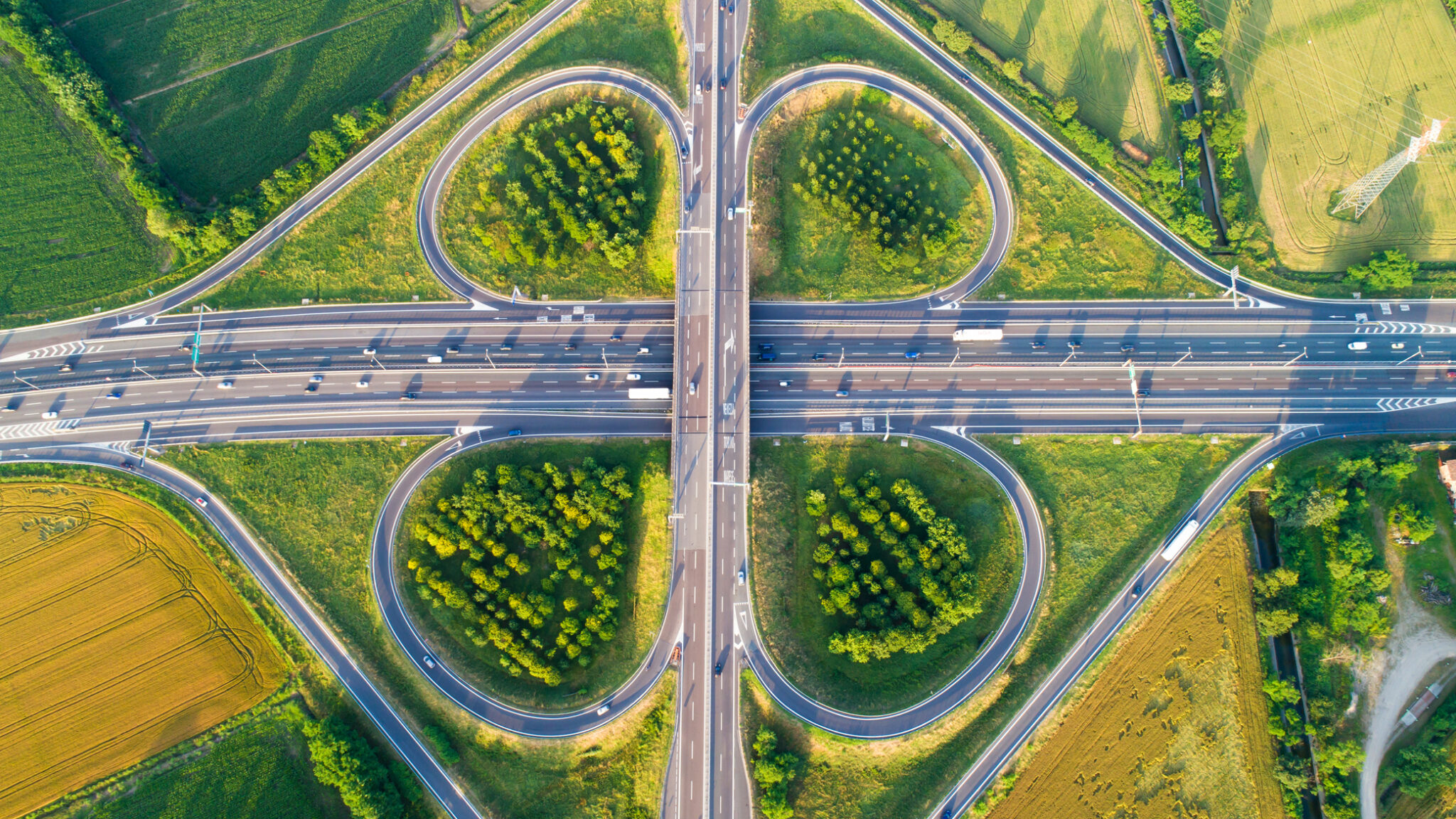
Beig that, during wartime, the US Armed Forces would transport some serious hardware across our nation on the Interstate Highway system, I’d think “the enemy” would target infrastructure to hinder such movements.
Nonsense. We have tens of thousands of cloverleafs. The enemy has a couple thousand deliverable ICBM warheads, and probably needs to assign two per target to get reliable kills.
There are a few non-obvious chokepoints in the US railroad system that would be good nuke targets. And maybe a few spots along interstates.
Once the nukes aimed at the enemy’s homeland start flying, the war will be over in another hour or so. What the enemy might use their roads for next week is immaterial.
This won’t be like WWII where war materiel flows for years from factory to front.
When a fire destroyed an overpass on the 405 in L.A., service was resumed within a week. If there were a war, materiel would in the interim have priority on all alternate routes.
As LSL says, using a nuke on a mere cloverleaf would be a waste. Aim for a major node on the electric grid instead.
And cities, don’t forget cities. A nuke on Chicago or Kansas City would disrupt many transport facilities, along with a bunch of cloverleafs. And people. Many, many people.
Exactly, why target a highway cloverleaf when you can destroy the transportation infrastructure much more easily by destroying the cities. And during the Cold War there were far, far, far more warheads than cities.
But on the other hand, it’s not entirely as absurd as it sounds, since there were so many warheads to assign, things got kind of crazy coming up with targets for them to service. To quote Churchill “If you go on with this nuclear arms race, all you are going to do is make the rubble bounce.” SIOP (Single Integrated Operational Plan), the US plan for where all the warheads were going to be delivered if WWIII happened had 16,000 targets in the National Target Base (NTB) in 1985. Allegedly multiple warheads were being assigned to individual cement factories in the Soviet Union, so I suppose it went past how high do you want the rubble to bounce to how much do you want to overkill the ability to ever replace the rubble once it stopped bouncing.
If intercontinental nuclear missiles are flying, we are way beyond concerns about moving transport convoys across the Interstate Highway System. The real purpose of the Interstate system wasn’t to facilitate moving hardware but to disperse populations away from city centers. Of course, this was during the age of bomber-delivered weapons; by the mid-Sixties, with the US and the USSR building massive fleets of ICBMs and SLBMs with vast overkill and capability several hundred kiloton to megaton yields, being out in the suburbs provided little additional protection, but at that point Interstates were an innate part of the distribution infrastructure and American society.
Beyond that, you’d have to hit a highway interchange dead-center to probably do any significant damage. They’re made from reinforced concrete, after all. There’s not much to suffer blast effects in most of them, unless you hit really close, even with a nuke.
Railroad marshalling yards and port facilities would be the prime targets as far as transportation infrastructure is concerned. Airports would probably be a distant third.
A nuke might not do so much, depending on where it hit. They’re massively destructive, but they’re not typically that big these days- you’d need multiple for a city like Kansas City.
The entire doctrine of nuclear war is so vastly removed from conventional warfare to make comparisons strained at best. That was why we ended up with MAD - mutually assured destruction. There really isn’t a useful middle ground when both sides have the capability to annihilate the other in the space of a couple of hours. There isn’t time to negotiate, or dictate terms. Nor is there any sense in which weakening the infrastructure of an opponent makes them any less a threat and less capable of annihilating you.
If you are on the aggressor side, there is no useful upside to launching an attack. Your country will glow in the dark for decades to come as the rats pick over the rubble. There is no attack profile, from a single weapon delivered, to an all out attack on every known missile facility of your opponent, that does not leave your country a nuclear wasteland a few hours later.
Sadly as, we see in Ukraine, conventional warfare is still fought with trenches and artillery. Bridges and rail are common targets. But nobody is breaking out the nuclear option. That takes us into a world that has no sensible rules or outcomes.
In 1981, CBS ran a documentary (“The Nuclear Battlefield”) about military doctrine on how to fight a nuclear war. It included a visit to Hattenbach, a small town in West Germany close to the East German border which, according to documents that had become public, was listed as one of the targets for the first use of tactical nuclear weapons in case of a Soviet invasion into West Germany. The reason why this town was chosen was apparently because it was the location of a major Autobahn interchange. I realise, of course, that targeting such an interchange (on your own territory!) to slow down the enemy’s invasion is not the same thing as targeting interchanges in the enemy’s homeland. But I think it shows that the OP’s thinking is not entirely absurd.
France has a doctrine on “pre-strategic” weapon use and a weapon system, the ASMP, built around this idea that involves using it as a sort of nuclear warning shot where the idea is its use would be a demonstration of France’s resolve and a warning that the next step would be the use of its strategic arsenal.
As to any practicality of this actually working, I consider it unlikely to the point of being bunk, and more an excuse to have spent billions of Francs designing and building them (and billions of now Euros maintaining them), much like the logic behind the ‘need’ to maintain a nuclear triad (ICBMs, SLBMs, and air dropped weapons) in the United States, but there it is.
The only real bulk transportation infrastructure in Kansas City (Missouri and Kansas) are railyards, and they’re largely used for moving automobiles and refined fuel. There is also Wheeler Airport (MKC, the former Richards-Gebauer Air Reserve Station), a large warehouse district, and a network of Interstate loops connected to I-35 and I-70. All of this would be destroyed (within the primary blast zone), and essentially all industrial and civic infrastructure incinerated (inside of the thermal radiation zone) by a single 300 kT weapon (W87 carried in the Mk21A RV by the LGM-30G ‘Minuteman III’, which is a typical size for a modern ICBM-delivered warhead) airburst over the West Bottoms. The secondary blast radius would reach all the way out to Gladstone, MO, Overland Park, KS and Independence, MO. The major airport, Kansas City International Airport (MCI) would be out of the destruction zone, but it doesn’t really handle much heavy cargo.
Of course, an attack like that would probably leave 200k-300k people dead due to blast, thermal, and firestorm effects almost immediately, and another 1.0-1.5 million dead from illness due to radioactive fallout within days and more downwind within a few weeks, not to mention widespread famine and disease. Moving fighting vehicles and conventional weapons around within CONUS is probably going to be the last thing on anyone’s mind. If there is still enough civil and federal authority left constituted to provide aid, I assume they’ll be trying to distribute food, medicine, and provide shelter to the massive number of refugees still surviving. Cloverleafs and other roadways (which, within the thermal radiation zone are going to catch fire and burn or smolder for weeks, producing thick and toxic smoke) are going to be impassible even if the underlying structure is intact, and what aid can be delivered will be overland, airdropped, or by river. (Kansas City is at the confluence of the Missouri and Kansas Rivers, which are both navigable waterways, although how much river barging remains and will be possible without regular dredging is also in question.)
Play around with blast effects on your own favorite city:
Nobody gives a shit about cloverleafs when planning strategic integrated nuclear attack schemes.
If you’re aiming to disable a major highway interchange, cloverleafs are not the ones to target. They’ve mostly been relegated to low-capacity exits to surface streets and aging interchanges that are just waiting for funding to replace. Many former cloverleaves have been decanted into hybrid designs. This is because they’re actually very poor at maintaining good traffic flow due to their short merge lanes and weaving. The 4-level stack interchanges and other spaghetti bowls are the ones to go after.
I live less than half a mile from a cloverleaf - one of only three in the UK. Yes - three.
It is a vast overkill for two dual carriageways (not motorways) crossing in the suburbs and local legend has it that it’s there because the road engineers just fancied building one.
The only way to try to interpret the OP’s question is to imagine a situation in which only one or very few nukes are launched in a precision attack. North Korea has a limited supply - estimates vary greatly - and would certainly not want to exhaust its capacity in a first strike. Nor can its missiles strike anywhere at will in American territory. Where, therefore, should those first few bombs land to do the maximum damage?
Reframed this way, the question is interesting and no doubt one that is studied in war games. The answer lies in interpreting the phrase “maximum damage” correctly in the minds of aggressor. Maximum number of deaths, of military materiel, of communication providers, of transportation routes, or of societal shock (the Super Bowl or a Taylor Swift concert)?
A cloverleaf would be far down the list in any of these scenarios, in any case, but they narrow the thinking behind a launch to a workable exercise.
No, I was just citing it as a ‘typical’ modern ICBM warhead (and was in the NUKEMAP database). Russia and China both have megaton-class thermonuclear weapons; the Dong Feng-5 carries a (purportedly) 5 MT nuclear weapon, which if targeted on Kansas City city center would have a destructive range out all the way to Lee’s Summit, MO, Olathe, KS, and Liberty, MO. The point is that you don’t have to target specific transportation structures like a cloverleaf interchange with nuclear weapons; their destructive capacity will take out large installations and everything around them, or the entire metropolitan area of a second-tier city like Kansas City. And transportation and logistics are pretty much an incidental issue after global thermonuclear exchange; entire nations will be wiped off the map as completely non-functional, with major fractions of their population dead and dying long before any kind of emergency response can be organized.