I’ve gotta ask: stringline?
I assume from context it means derailing on the inside of the curve that the train is navigating, but is there something more to it than that?
I’ve gotta ask: stringline?
I assume from context it means derailing on the inside of the curve that the train is navigating, but is there something more to it than that?
Well they’ve stopped setting the river on fire so they have that going for them.
Timely thread. I have to cross a busy rail line coming off a port and get caught by trains at least 2-3x a week. Usually it’s just a few minutes, very rarely up to 20-30 if there is intensive train-building going on.
Today though I came up on a long line of cars backed up far enough I couldn’t even see the crossing. No idea how long they were sitting. But hey, no problem - I stopped and waited. After just a minute the gate lifted, cars started moving. But the line was long and there is a red light right past the tracks. So I was stopped again a couple of vehicles short of the track. And then the gates came down again, something I never see. Well, okay - that sucks, but whatever. But the big car carrier sitting in front was apparently done - he started up and just barreled right through the gate, smashing one side  .
.
I was afraid I might be stuck there for an hour after this suicidal asshole obstructed the tracks. Thankfully who ever was operating the gate immediately opened them and that gate was still floppily attached and came up. Nonetheless, people are stupid. And impatient.
Yes, you have the physics correct. The positions of the loaded and empty cars within the train has a lot to do with it, specifically long empty cars with loaded cars behind them. The loaded cars will tend to make the lighter, longer cars want to stay straight through a curve when the slack is stretched, aka draft.
Sticking a locomotive back there in the train will bunch the slack, aka buff, ahead of that locomotive. The cars being the in train locomotive will still be stretched, but the forces are more evenly distributed hence the name distributed power.
I meant to say behind the in train locomotive.
The can use many combinations of this as well. I’m on the east coast, but I know out west they run with two DP consists. So there will be the head end power, more in the middle and more on the end. So 3x2x1 for example. We generally run 2x1 or 2x2 on my territory.
All this enables longer trains, with all locomotives controlled by the one head-end crew. 15,000 foot long trains are normal now, and the public knows it.
It happened at World Famous Horseshoe Curve ™ twice two years ago. It was caught by VR.* The cars laid there for a while before the clean up crew got on them.
*Not very exciting. At 1:30 the train comes to a stop and then the camera pans left to where three spine flats decided to take a short cut.
It doesn’t sound like there are any track greasers on that horseshoe curve. Is that part of the problem? And I was amazed how fast the train stopped. And how do they get the cars back on the track?
I wonder what the hell he was thinking, especially given he was on the clock.
I doubt greasers would make the difference. With several trains an hour in both directions, if it did, I’m sure they would install some. IIRC there were greasers during the steam era when long-wheelbase locomotives were in use.
Between going uphill and being slow, yeah it doesn’t take time to stop. The “trains take a mile to stop” meme is when they’re barreling along at 60+mph.
Aside: I used to go to school in Philadelphia, and spent most holidays in Johnstown, so the natural way to travel was by train. I was very excited when I first realized I’d be going around the Horseshoe Curve.
You’re right , the greasers are mainly there to reduce wear on the rail, and also about the mile to stop meme. That’s more for old passenger trains and by old I mean like the '40’s and earlier.
Todays passenger trains have blended disc brakes. They stop like a Corvette.
Passenger, yes, but freight cars still have good ol’ tread brake shoes as God and George Stephenson intended.
I don’t know why I’m surprised because it just makes sense but I didn’t know trains had disk brakes. Also learned why the exit steam was piped through the smokestack in steam trains. It’s to create a draw on the firebox to help increase the burn rate and thus more power.
Yes. If you pay attention to a moving locomotive you’ll notice the smoke and/or steam rising out the smoke stack shows evidence of each “chuff.” The cylinder exhaust is directed through a blastpipe with a narrowing diameter so the velocity of the steam increases, increasing also the draft.
If a locomotive is stationary or just drifting, steam is directly admitted to a ring of nozzles around the blastpipe to keep the draft going and the fire from dying down. This is called a blower even though there are no moving parts as you’d expect in a mechanical blower.
It was serendipity in action. One of the early designers, Trevithick I think, started venting the cylinder exhaust to muffle the sound. The rest is history.
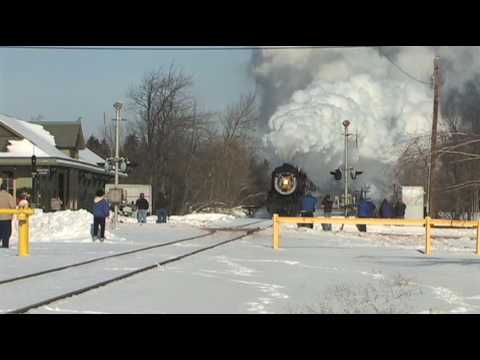
I read that George Stephenson came up with the Steam Blast.
Not satisfied, he sought to improve his locomotive’s power and introduced the “steam blast,” by which exhaust steam was redirected up the chimney, pulling air after it and increasing the draft. The new design made the locomotive truly practical.
I believe the “steam blast” was an improvement on Trevithick’s original idea – the narrowing of the nozzle part. Honestly though, I’d spent ten minutes researching for what I posted (hence both links) and that was enough for me.,
It’s using the venturi principal which was discovered in the previous century. Still good engineering considering the background of the first people building trains and how slow information traveled. I just find that kind of stuff interesting. It helps explain the progression of development.
woman almost hit by train when she runs across the tracks
I’m wondering if she was actually trying to commit suicide.
Man hit by train (dead, of course).
I assume the train was going faster then he thought - they sometimes come thundering through. The trains always blow their whistles coming to that crossing (and a lot and long), and the gate was apparently functioning, so 100% on the guy.
My assumption is that he knew the trains there tend to be long and thought “I can beat it and save a couple of minutes”. Bad bet, even if he had made it across.