Since this thread’s back: not all that far from me, a couple of weeks ago, a man was hit by a train while walking on the tracks. (Also dead, of course.)
According to neighbors he often walked on the tracks. Despite the fact that his hearing was so bad he couldn’t hear the engineer frantically blowing the whistle.
I’ve read now and again of people falling asleep on the tracks and getting run over. I could scarcely think of a place less conducive for that – it’s all cold hard steel, sharp pointy rocks, or splintery creosoted wood, everything coated with a greasy film of diesel soot.
In a discussion somebody pointed out they could be drunks too inebriated to navigate a road well, but they know where the tracks lead.
Autopsy results haven’t been released yet in the case I posted. I don’t know whether the deceased was a drinker; but I do wonder whether that might have been a factor. – a friend I mentioned the case to said that he might have expected to be able to feel the vibrations of the train coming through the ties; but, if so, it didn’t work.
How could anyone know they were asleep before being struck? It seems far more likely that a person laying on the tracks simply fell while wandering and smacked themselves unconscious (or as you suggest, drunks who passed out on the spot).
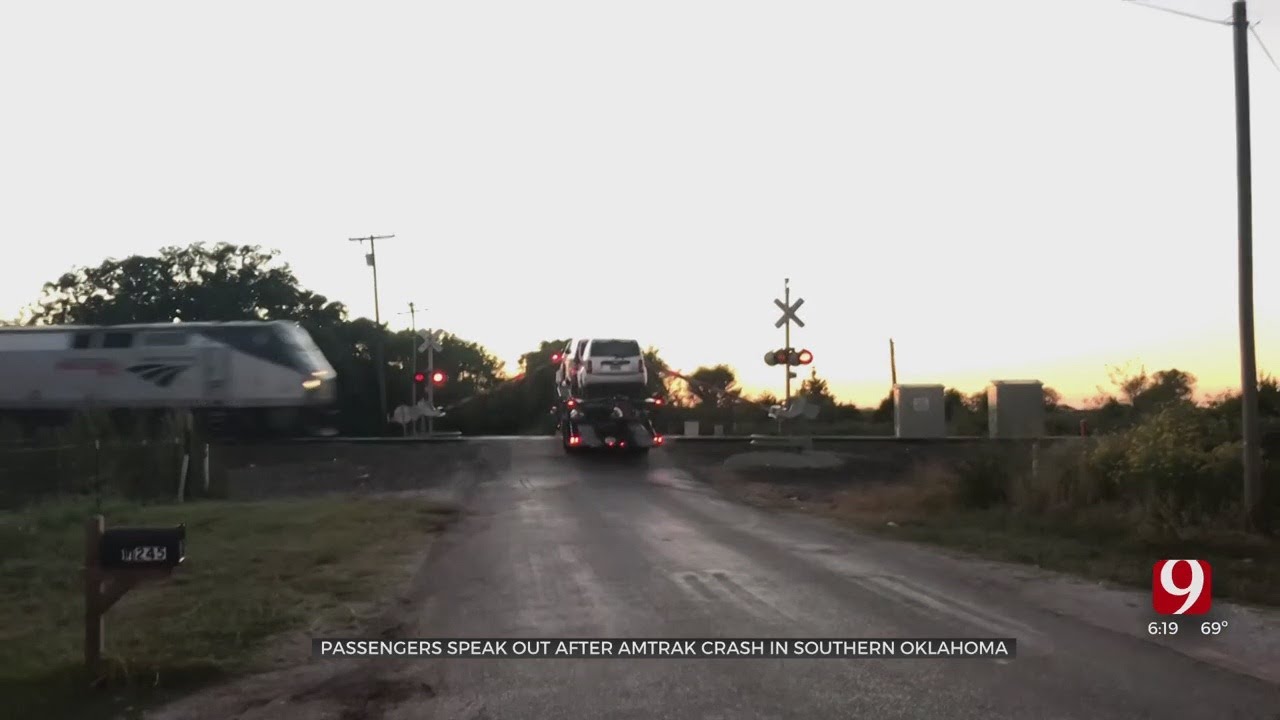
If you look at that video, you can see that the track itself is elevated, compared to the surrounding land, and that the roadway slopes up, relatively steeply, to reach the railroad crossing; presumably, there’s a similar slope downwards on the other side of the crossing.
Most cars and other shorter-wheelbase vehicles wouldn’t have an issue with navigating the up-and-down of the crossing. But, a semi trailer, with a very long wheelbase, would be in danger of “bottoming out” as it crosses the tracks, as both its front wheels (i.e., the wheels of the truck) and its back wheels (i.e., the wheels of the trailer) would be substantially lower than the middle of the trailer.
Looking at the picture, that’s one hell of a hump - perhaps an inexperienced (at least with that road) driver went too slow and got the trailer high-centered? You would think the tractor would have enough power to pull it over, but would the hitch put up with the strain?
Agree with you both - in this case the trailer may have bottomed out. However, I think the term “…got stuck on the tracks…” is used all the time whenever someone drives their vehicle onto the train tracks and manages to get struck. As if to say “It was not my fault!”, which, to this thread, usually means people made dumb decisions to get hit by a train.
It seems like “got stuck on the tracks” is used for several different situations:
Vehicle was literally hung up on the tracks (as per your example video in post 125, and @DesertDog 's example from earlier) – probably only happens with trailers or very long wheelbase vehicles, and at a relatively small number of crossings with a “hump” layout,
Vehicle stalls while crossing the tracks, and the driver is unable to restart it in time – this would seem like it shouldn’t happen that often, but I’ve seen it described this way in many news stories about train-car collisions, so I wonder if it’s used as an excuse for something else having happened.
Traffic has backed up near the rail crossing (such as at a stop sign or stoplight), and a driver, following along in the slow traffic, has stopped on the tracks. When the train approaches, said driver has no way to get off the tracks (due to being hemmed in by traffic). This one is definitely a case of “driver error,” as one shouldn’t begin to cross a railroad crossing unless one can see that there is enough safe room for you on the far side.
There are also incidents where someone tries to turn onto the tracks where there is no pavement. This happens a lot where the tracks tun down a street for a while then quit, like in La Grange, Ky.
Even if a vehicle has enough clearance to not get hung up on the rails, it usually lacks the power and/or traction to get back over them without a tow truck. VR puts up the help they get like this guy in Ashland, Va. or this guy in Fairport, NY.
They’ve not shown any collisions either because they are rare in an urban setting or from self-censoring.
Is this a common configuration in some places? I have never before seen tracks that go down the middle of a road lengthwise like this, rather than when it has to cross a road passing over the road crosswise over all driving lanes before the dedicated track picks back up.
I wouldn’t say street running is exactly common, but there are a few places about the US that still use the practice in stretches. Not as often as in years past, as it’s a slow bottleneck for the railroads.
Some off the top of my head;
South Bend Indiana, through Jack London Square in Oakland California, West Brownsville and Gettysburg Pa.