Having been indicted, could Donald Trump be issued a summons instead of being arrested? I am only seeking a factual answer to this one question. It would be a matter of New York law and I am too busy right now to look it up.
It’s technically an arrest, but Alvin Bragg has offered the courtesy of a surrender to arrest. Trump’s attorney has said Trump will accept the offer of a surrender and will appear voluntarily on Tuesday, the 4th of April.
Whether it’s a summons or warrant determines the mechanism of arrest not if there will be an arrest. He was indicted for a felony. He will be arrested and processed. Because it’s a low level felony he will be released on a summons. That would be the case with anyone. It would be highly unusual in NY for anyone with that level of felony to get a warrant and bail unless they had a long criminal history and a history of failing to appear.
A warrant just means there would have to be a determination of bail or being remanded without bail. With a summons there will be a release on their own recognizance. New York has bail reform and a presumption of a summons for low degree charges. It doesn’t change the requirement for processing such as photographs and fingerprints.
The biggest difference with the Trump processing will be the speed. A normal person arrested in NYC would be waiting around for a long time to be processed before being released on a summons. Trump will be walked through the process quickly.
And that he will have a Secret Service agent with him rather than going through the process alone.
That’s interesting. I know in other states the court can, in certain circumstances, issue a summons in lieu of an arrest The defendant is served with notice, i.e., a summons, to appear in court and no arrest is necessary. If they fail to appear then an arrest warrant is then likely. However, I do not claim to know anything about the New York Rules of Criminal Procedure.
I think the issue is the definition of “arrest” - some articles/websites I have seen distinguish between custodial and non-custodial arrests . In NY, of course, someone can be arrested and held in custody until they are brought before a judge. But there is also the Desk Appearance ticket, which is not exactly a summons. A DAT is technically an arrest. It involves being in custody for a long enough period of time for the person to be brought to the police station and fingerprinted , photographed etc. and then being released with instructions to return to court on a certain date. A “summons” is issued on the scene without fingerprinting or being brought back to the precinct.
There is no way Trump will be held in custody overnight while waiting to see a judge. He will most likely be issued a DAT but whether it’s a DAT or a judge, the processing will set speed records - not to give him special treatment but just to end the circus as quickly as possible.
Am I the only one thinking, “They need to consider the historical precedent being set.”? This is the first time a president has ever been indicted, it will be establishing traditions that will last for years to come.
I really don’t want to see a broadcast from the future, “And now, here comes the indicted former President, tweeting out to his followers, “Nothingburger witch hunt!!!”, as is traditional…”
He should be formally arrested by the newest cop on the force, or something, with a town crier type person intoning a list of charges in the background. Maybe have a staffer standing behind Trump whispering in his ear, “You too are subject to the law”. Give it a sense of occasion.
It really doesn’t matter - he’s going to be released whether he is handcuffed or not. Not because he’s the ex-president but because NY law doesn’t allow money bail for most crimes so at most , he gets released with conditions.
Can we still get the Perp Walk, though? Please?
I’m certainly no expert, but I think that you’re right. At least, the NY Criminal Procedure Law has a whole section on summons’ (in lieu of arrests). The defendant is directed to appear at arraignment and then is, afterwards, sent to be fingerprinted. But doesn’t appear to be “arrested” at any point.
The standard procedure for white collar defendants seems to be that they “surrender” at the DA’s office at a mutually agreeable time; are “arrested,” fingerprinted, and then brought to be arraigned; and then released. I’m not sure why the summons process isn’t used more often in that context.
I’m not familiar with NY’s public records laws. Are we gonna get a mug shot? I know they’ll take one, but will it be released?
With a bell ringer behind him crying “Shame. Shame. Shame.”
New York has a recent state law that bans the release of mugshots in most circumstances, so I don’t think we’ll get it unless it leaks.
I suspect that an AI version is the best we’ll get:
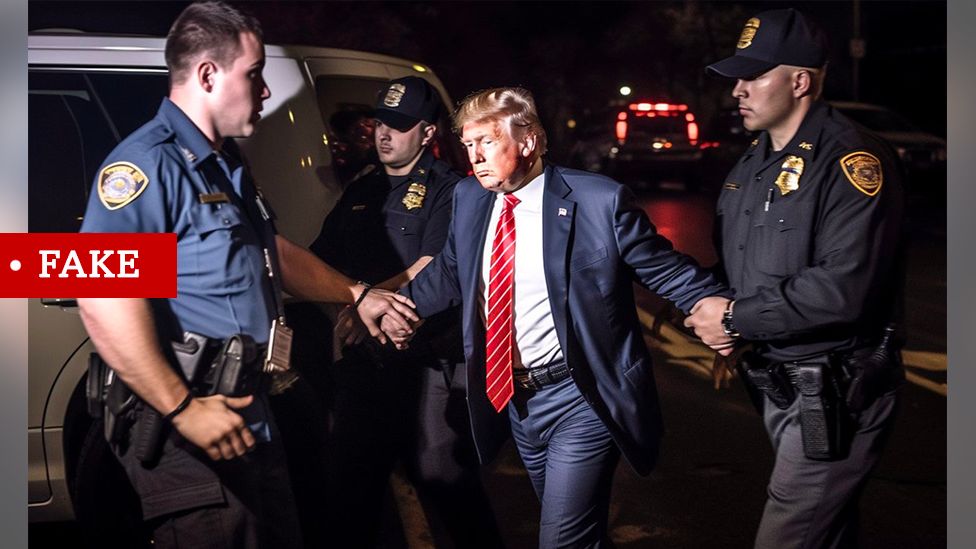
Yes that’s what I was trying to say. An arrest is what happens when you are taken into custody for a felony whether it’s being released with a summons after processing or issued a warrant with bail or other conditions attached.
At that level of a crime it is not possible to be remanded in New York, ex-president or not. If he refuses to appear then a judge can turn it into a warrant. It is standard practice to put low level felonies on a summons. In fact it’s New York law.
If he refuses to appear we then run into unprecedented territory. Putting aside the discussion as to if the Florida Governor can refuse to extradite, a Class E felony is not usually extraditable. In rare cases when it is extraditable its usually stipulated to be neighboring states only or a short list of states. Trying to extradite from Florida or somewhere else far away the argument can be made that the case is being handled more harshly than any other defendant.
First, he’s an ex-president, not the president.
And it’s not the first.
Ulysses Grant was arrested, while the sitting President, hauled to the DC police station, and only released after paying a $20 bond. For speeding, in his horse-drawn carriage.
He had been stopped previously for speeding, but given a warning. And it didn’t seem to take – he was stopped again for speeding after that. Seems US Grant had a lead foot (lead rein?).
The arresting policeman was a black man, one of only a few on the DC police force, who had previously been a soldier serving under Grant in the Union army.