How large is the “capsule” in which the 4 astronauts are calling home for 10 days? Enough to move around?
It was described as the space of “the interior volume of 2 minivans.” So, not large at all.
It’s the biggest space vehicle since the Space Shuttle in terms of habitable space, but still rather cramped for four astronauts – it’s about 16.5 ft in diameter and about 11 ft high in a blunt cone shape. Would be fairly roomy for one person, pretty cramped for four, but still – a bit of room to move around.
A mitigating factor is that in zero gravity every bit of space is equally useful. You can’t lie on the roof of a minivan or wiggle around into every nook. In a spacecraft you can. The entire interior skin works like a large floor. The two rows of seats will break the space up into a set of individual spaces each useful to a human. Cozy, but better than one might think.
I’m watching the livestream and just minutes ago the commentator mentioned the two minivans comparison then added, “about 300 cubic feet, twice as much as Apollo.”
Another question…notwithstanding whatever the astronauts are doing, is it quiet. In a car there’s wind related noise that increases with speed. Is there such a thing in space?
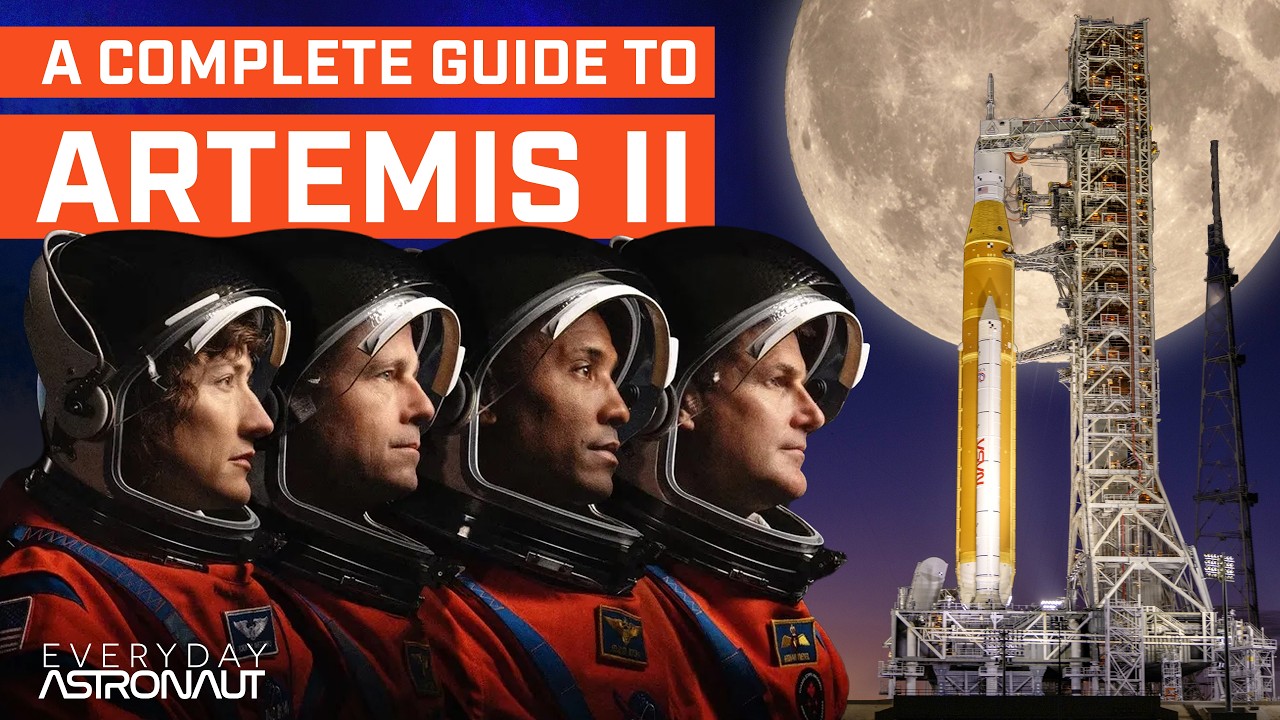
The YouTube channel Everyday Astronaut has a good video comparing the Artemis II to the Saturn V rocket. If the video does not start at the right point the OP’s question starts getting answered at 2:45 in the video linked below:
There’s no wind noise, obviously. Ventilator motor noise would be the big one I imagine
Nope.
Certainly the Apollo craft were noisy. Constant background noise of forced air movement and pumps running liquid cooling loops.
Unlikely things have changed much. Electronics are more efficient, so some cooling loads may be smaller. There is a lot happening aboard once you need to keep the fleshy cargo alive. And that hasn’t changed.
I don’t know about Orion specifically, but the ISS is a constant cacophony of whirring and rattling, due to all the life support and climate control systems always operating. I’m sure that any spacecraft carrying humans is much the same.
I’m reminded of a line from Mass Effect, the 2007 space opera PC RPG. Your character is the captain of a new state-of-the-art starship, and one of your crewmembers is a Quarian, a member of a race of refugees who have lived for the last 300 years in space in a rag-tag migratory fleet of centuries-old freighters and used alien ships acquired second-hand, ever since the sapient AIs they created kicked them off their homeworld. She finds it unsettling how quiet your ship is, because in the fleet, quiet means something has stopped working and you need to get it fixed quick if you want to live. She winds up insisting on spending most of her time in the engine room because it’s the only part of the ship with the kind of sounds that make her feel at home.
I have to imagine that if you’re a NASA astronaut and you wake up and notice it’s quiet, it would be pretty worrying.
But, as I recall…

“2001: A Space Odyssey” did this really well. When the viewpoint was from the person there were all sorts of noises. Breathing, noises from the computer or whatever. Then the viewpoint shifted to outside the space ship/suit and…silence. Masterfully done to great effect.
Here’s another somewhat related question. The entire surface of the moon pockmarked with craters formed by asteroids and other debris flying around in space. Seemingly, the earth hasn’t been on recipient of this matter. Only thing I can think of is our atmosphere which, upon entry, causes this stuff to burn up.
For recent encounters, the atmosphere filters out everything small. For older impacts the Earth wipes the slate clean over time. Everything from erosion to tectonic processes with volcanic action in between. One can compare the Wolfe Creek crater to the Shoemaker crater here in Oz. Wolfe Creek is about 300,000 years old, and looks like a proper impact crater. Shoemaker is maybe 1500 millions years old, about the same size, and only detectable by remote sensing imaging and confirmation by geological sampling looking for impact created rock. On the moon, both would still quite clearly be impact craters. The older having acquired a patina from more impacts.
You need a really big impact for anything to remain visible on the Earth over geological time periods. We can assume that the Moon and Earth see about the same actual impacts. The Moon has resurfaced some areas - the marias are basically big volcanic flows. That the near facing side of the moon has been so resurfaced, but the far facing side has not, is an interesting puzzle. Likely speaking to a catastrophic event in the past. At the other end of the scale the ever present bombardment with tiny particles slowly turns over the lunar regolith. So much so that the Apollo footprints will eventually disappear. But not for 10’s of millions of years.
The rate of bombardment has reduced enormously. Mostly because most of what was going to hit us has already done so. The moon acts as something of a historical record.
You also need the impact to occur in terrain that doesn’t get a lot of erosion. The Chicxulub crater is a really big impact and is 66M years old, yet it’s only detectable by the same means as the much older Shoemaker crater you mentioned. It’s in a high erosion area; if it had been in a desert, perhaps something may have been visible to more casual inspection.