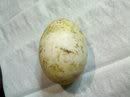
Look, the reason egg layers are kept in cages is to keep the eggs clean.
This is a random egg out of a nest box. Notice chicken crap is on the egg making it really necessary to wash the damned things. If I kept my critters in cages, I wouldn’t have to spend as much time washing my eggs, if I wanted to sell eggs. Scrubbing eggs disrupts a natural waxy deposit that coats the shells and keep air out, so scrubbed eggs oxidize faster. Chickens crap everywhere - nest boxes, out in the woods, in the water trough the geese like to swim in [from when we kept sheep] Hell, I picked one up to show someone and it crapped on me.
When you use a chicken tractor, it has a nest box, a perch [chooks who are not broody tend to like to perch, when they are broody they like to make chicken piles of 3 or 4 hens to a nest box. ] and is designed to not need bedding other than a washable pad in the nest box. You move them around so the chooks can scratch the ground over for bugs and green bits. The shit gets left behind to weather in as natural fertilizer. The floors of the movable chook houses tend to be mesh because the chooks are not restricted to them so it doesn’t harm their feet.
If you want to raise chooks by the thousands instead of hundreds, you have to change styles of raising, to battery raising, where you have them restrained to large warehouses that are floored in cement with floor drains. You put a batch of chicks into the battery, feed and water them for a time period of 8-12 weeks then bulldoze out the bedding and wash down the floors, sanitize the floors and air the buildings out [and occasionally run UV lighting fixtures for a week or so to kill off microbial life] then start all over again.
Egg batteries are different - the chooks are raised in a normal battery for 6 months [the baby chooks are debeaked so pecking is not a problem] then popped into battery cages that the floors are tilted so the egg is laid then rolls out and is collected. The poor chooks can barely move, and are fed a totally artificial diet that has antibiotics, calcium and a yellowing feed [marigold petals are common addition, to make the yolks a vibrant yellow] After about 2 years the chooks are sold off to the meat market and butchered and sold as stewing hens, or to the pet food industry.
My chooks get unmedicated feed, all the bugs and scratch they can chase down and eat, and lay eggs in a nest box. Since my egglayers are pets, they live out their little chickeny lives happily. I think my oldest hen is 5 years old.
That’s kind of like asking how much a pet dog is going to bark. Depends on the age, health, and breed of the bird and what you’re feeding it. I’ve seen estimates ranging from 150 for ornamental or meat breeds to almost 300 for laying breeds or hybrids. Most sources consider half a dozen dual-purpose or laying hens to be adequate to keep a family of four in eggs most of the year. Our 9-weekers are a laying hybrid, so I expect we’ll have plenty of eggs to share once they get going.
Do you keep any roosters, jlzania? I’m sure you end up with some, because sexing chicks still isn’t 100% accurate, but I’m curious what you do with them.
[/QUOTE]
When you’re only keeping the birds for the first 6 weeks of their life (they don’t hit puberty until about 6 months old), it doesn’t matter whether you have boys or girls. Sexing is only done for the chicks that are being raised to produce eggs.
aruvqan: I’m hoping my post just inspired you to describe battery cages, not that you think I specifically need some schooling on how battery cages work and their various pros and cons
Hm, my eggs (from my free-range backyard flock) are always much cleaner than that, I almost never have to wash them; occasionally there is a bit of down stuck to one, but very rarely any poop. Mine come out of the chickens looking just like supermarket eggs from the outside. Inside is a different story, the yolks are much more orange and taste much better.
If you only have a few chickens in a backyard, it’s less likely the eggs will get dirty. It’s very difficult, if not impossible, to scale that up. I take that back. It’s impossible to scale that up without getting lots more people and areas involved with chicken keeping. I mean, how many suburban homes would need to keep 5-6 hens in order to make enough eggs to meet the demands of Manhattan?
This is off topic, so if you’d rather smack me with a shovel than answer it I’ll understand. I have been told that the US Humane Society is a radical group that wants to outlaw any and all types of farming. There is so much information/disinformation on the web I can’t find any reliable answer. So is the HSUS a radical anti-farm organization as some claim, or are they the victims of a smear campaign as they claim?
Huh. Funny that this thread should get bumped right when I was going to seek it out & post a question myself (totally unrelated to today’s other question, though).
jlzania, would you mind telling us why you distrust Whole Foods? I’ve been hearing a lot of distrust from weird circles, but no reasons why.
Entertaining thread, glad it got bumped so I could brag that I have had the honor of a tour of jlz’s chicken farm. I’ll let her know y’all wanna chat (and that Code_Grey thankfully appears to be off doing some research.)
Oh, and next time I visit jlz I’m planning to have her chickens try on some shoes. But shhhh, don’t tell her.
Thanks for alerting me to the resurrection of the thread, Noodles. ( Love that user name)
If I recall correctly, part of your stay involved rounding up chickens in the rain.
One of my main beefs with Whole Foods is that it claims to really support local farmers and organic farming practices. It doesn’t.
I know of at least two farmers in Texas that seriously invested in equipment and animals/chickens because Whole Foods promised to start selling their pork and eggs.
It didn’t and the farmers were left holding the bag with no immediate market for their products. That’s tough.
Earlier this year, Whole Foods ( along with Organic Valley and Stonyfield Farm) reached an agreement with Monsanto regarding Monsanto’s gentically modified seeds.
Admittedly Whole Foods was the first grocery store to agree to pay more per pound for tomato grown in Immokalee Flordia because of the intense pressure applied by the Coalition of Immokalee Workers. However, the only reason that Whole Foods capitulated was because the Coalition of Immokalee Workers threatened massive protests at the Austin flagship store and they knew it would be very bad for business to have farm workers and students holding up signs in the parking lot.
The more expensive tomatoes are sold in two of the Whole Foods stores-one in Austin and one in Tampa. http://www.tampabay.com/blogs/venturebiz/content/backed-whole-foods-florida-tomato-pickers-gain-penny-fight
And then there’s John Mackey famous quote “The union is like having herpes.” And his diatribe against single payer health care.
I wouldn’t have a bitch if Whole Foods was honest in its advertising but I think it indulges in massive greenwashing.
That’s one of my biggest problems right now.
I really want to get my hands on a specific strain of Cornish X’s because they preform well but it’s nigh near impossible to do.
I am trying out a small hatchery in Waco right now.
Sorry-I know nothing about this.
West Nile is spread by mosquitoes.
Avian viruses are not a problem because we aren’t located near any major confinement houses and we’re very strict about biosecurity measures.
If you come to my farm from another chicken farm, you wouldn’t be allowed in my fields. Period. Also, the CDC believes avain flu may be spread by migrating water fowl, especially ducks.
We don’t have any ponds on our property for that reason.
Thanks, jlzania. I knew about the GM alfalfa (and what they, Organic Valley & Stonyfield Farm have to say about it), about the tomatoes, but little else about them.
I had to bump this thread because there was an article in a Finnish newspaper today about the first organic broiler farmers in Finland (sorry, article is in Finnish). They apparently got the idea from reading a US farm industry magazine. I think this is completely awesome and will definitely seek out the meat when it becomes available in stores.
Sorry if this has alreay been asked and answered, bu thave you ever thought of selling such frozen chicken parts as hearts for animal food? Many people who love animals have pets that they don’t want to feed tortured chickens to.
And the thread rises from the dead.
That’s great! I suspect that the growing season in Finland may be rather short so you might want to invest in a freezer when the chicken becomes available.
I do offer hearts and feet and backbones for pet food.
I sell them cheaply and have several dog clients.
If you go to my webpage, you can see three of them-Otis, Beanie and the dog whose name I can never remember.
Yes, on a client by client basis, right? But you still cart loads and loads of them to the dump. What if you found an organic pet food manufacturer who could take all of your supply from you?
I ask because there was a time, when i was still idealistic, that I searched the market for organic pet food for my cats. I found very little iavailable, and what I found was very expensive and didn’t even contain organic animal protein. Just organic plant matter (grain etc) and I didn’t care about that. I just wanted my pets not to be fed with tortured chicken meat.
So my guess is that an manufacturer of pet food containing chicken friendly poultry would have a market, he would need suppliers like you, and you would have a steady big client for your mostly unused chicken parts. It would be a win-win, no?

 and infuriating :mad: