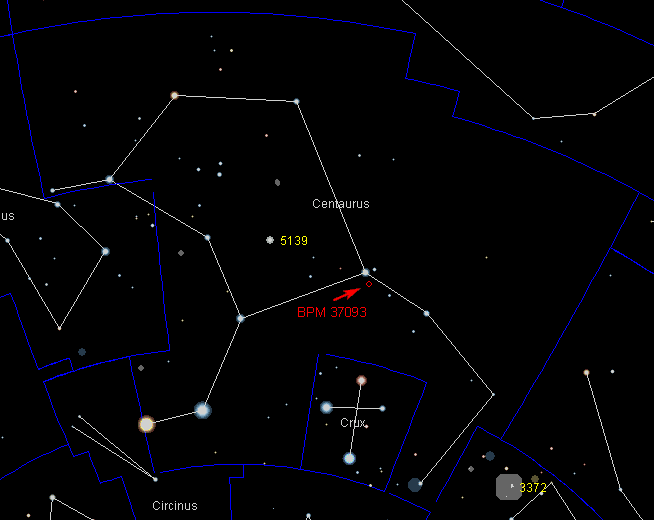
I am trying to find a chart that shows the location of BPM 37093 (the star with a “giant diamond” at its core) in the constellation Centaurus. I know it isn’t visible in the sky, but I would like to make a chart of the constellation that shows the star in roughly the correct place. After much searching for such a chart I have had no luck. Has anyone seen such a thing?
I found a site that says it is:
Is there any way I can figure out where it is from this info?
Have you tried the freeware planetarium software Celestia? I don’t have a copy installed at the moment, so I can’t verify that it’s in there, but it might be worth a check.
Go to this site, and enter “BPM 37093”; that’ll give you the coordinates (which you can then use with some other plotting software/site), and much other info.
Or I suppose I could just copy the coordinates here:
RA 12 38 49.93
Dec -49 48 01.2
But it’s a useful resource to know for this kind of thing.
Thank you. But I must admit, I am somewhat mathematically challenged. I understand the concepts of right ascension and declination, but I am not sure exactly how I would use that to place them on a chart in relation to other stars. Do you know of a site that could help with that?
I know a bit about astronomy, but I am a car-free city girl so having a telescope is not real practical. I read articles and look at pictures. I have never had the need to plot astronomical co-ordinates before like this.
And Tyrrell McAllister, that program didn’t seem to have this particular bit of info, but it is very cool! Thanks!
I have found some charts of Centaurus that have the grid for RA and declination on them. Since this is only going to be used for an illustration, I am thinking I can fudge it close enough using this.
The declination seems fairly straightforward. If I divide the space between -45 degrees and -50 degrees into five equal parts, I can find -49 degrees. Sound right? I am not sure what the “48 01.2” part means but it seems to be more accuracy than I need for my purposes.
I am not sure how to divide the right ascension to find 12 38 49.93. As I understand it, RA is not decimal, but measured in minutes/seconds. Roughly where between 12h and 13h would this fall? Does the 38 mean 38 minutes, and if so does that mean it would be just very slightly past halfway between 12h and 13h? I assume the full space is 60 minutes and 30 minutes would mark the halfway point.
Like I said, my math skills are pretty weak so it is possible I am not getting this at all right. I appreciate any light anyone can shed on it. I really am trying. And thanks for the link to that site, GABoy that info is very helpful.
I tried plugging the co-ordinates into Home Planet and for some reason, it put me into the wrong constellation. Sculptor, I think.
Yep. RA is hours/minutes/seconds, declination is degrees/minutes/seconds. So one can convert as you suggest, and get RA = 12.65 hours, dec = 49.80 degrees (roughly). The distinction between hours and degrees doesn’t matter for your purposes, i.e., just interpolating on a chart.
And as for Home Planet (which is actually a pretty nifty little freeware program) I think the reason it threw me into the wrong constellation was that it didn’t like the way I had the co-ordinates formatted. With my new understanding of what all those numbers actually meant, I was able to get the “telescope” to point at the right part of the sky. Unfortunately though, it didn’t actually mark the point it was aimed at, so the other program worked better here.
So welcome, GABoy and thanks for your help! I see you used your first posts to answer my question. I hope you decide to stick around!