The crew has recently broken the distance record set by Apollo 13.
They challenged “this generation and the next” to make sure the record be not long standing.
Brian
The crew has recently broken the distance record set by Apollo 13.
They challenged “this generation and the next” to make sure the record be not long standing.
Brian
I’m not crying you’re crying.
Commander Reid Wiseman submitted names for two unamed lunar craters. One of which he requested be named Carroll after his wife who died unexpectedly recently, while his young children listened in the viewing gallery above mission control. All the astronauts crying. Such a human moment. 
Because electronics don’t create the sheer physical muscle needed to actually get tonnage to the Moon. In that sense, the biggest improvement better electronics has to offer is faster and better CAD/CAM, including 3-D printing fabrication of components like rocket engines.
Lots of chatter about getting the camera against the windows. Did they not know about window hoods?
Correction: Jeremy Hansen
From what I understood from some of the chatter, they’re using them – at least on some windows.
I went downstairs for a few minutes a little while ago, and when I came back, the size of the moon relative to the bit of spacecraft visible in the left of the image from the camera on the solar wing was noticeably bigger in just that short time. Very cool!
Everything is going great, except the freaking toilet is bust again!  Very appropriately described as “toilet is a no go”.
The crew is relegated to portable containment devices.
Meanwhile the NASA commentator is desperately working to justify the manned mission, saying the observations being provided by the astronauts cannot be matched by any camera images from robotic missions. This is a little like coverage of a space mission being interleaved with an infomercial.
Ah, that is the reason they are taking selfies all the time?
That, and that they have nothing better to do all day.
The value of a test flight of course simply demonstrating the functionality of a crewed vehicle. It isn’t like the photos are the purpose of Artemis.
I should have taken some screenshots of the earlier images from the solar wing camera for comparison as the way the size of the moon is rapidly growing is pretty remarkable.
Also “stochastics” …
FWIW, the 1969 flight might have had a 50% chance of fulfilling its objective (and come home healthy), the 2026/27 flight might have a 95+% chance of doing so - so it is a much more mature endeavor *) …
*) both numbers pulled out of the last few inches of my GI-tract.
IOW: while the outcome might be the same, the chances to do so might be vastly different - which is a very relevant aspecto of any complex end to end process.
As I understand it, the only thing they have to do is survive. Good luck!
The pictures are a private hobby, there are no observations they can make, no instruments to use. This is not a scientific mission. And the toilet problems should have been solved long ago (see post #713).
They are doing science via observation for many hours!
Meanwhile, NASA has just released some images, downloaded from earlier today.
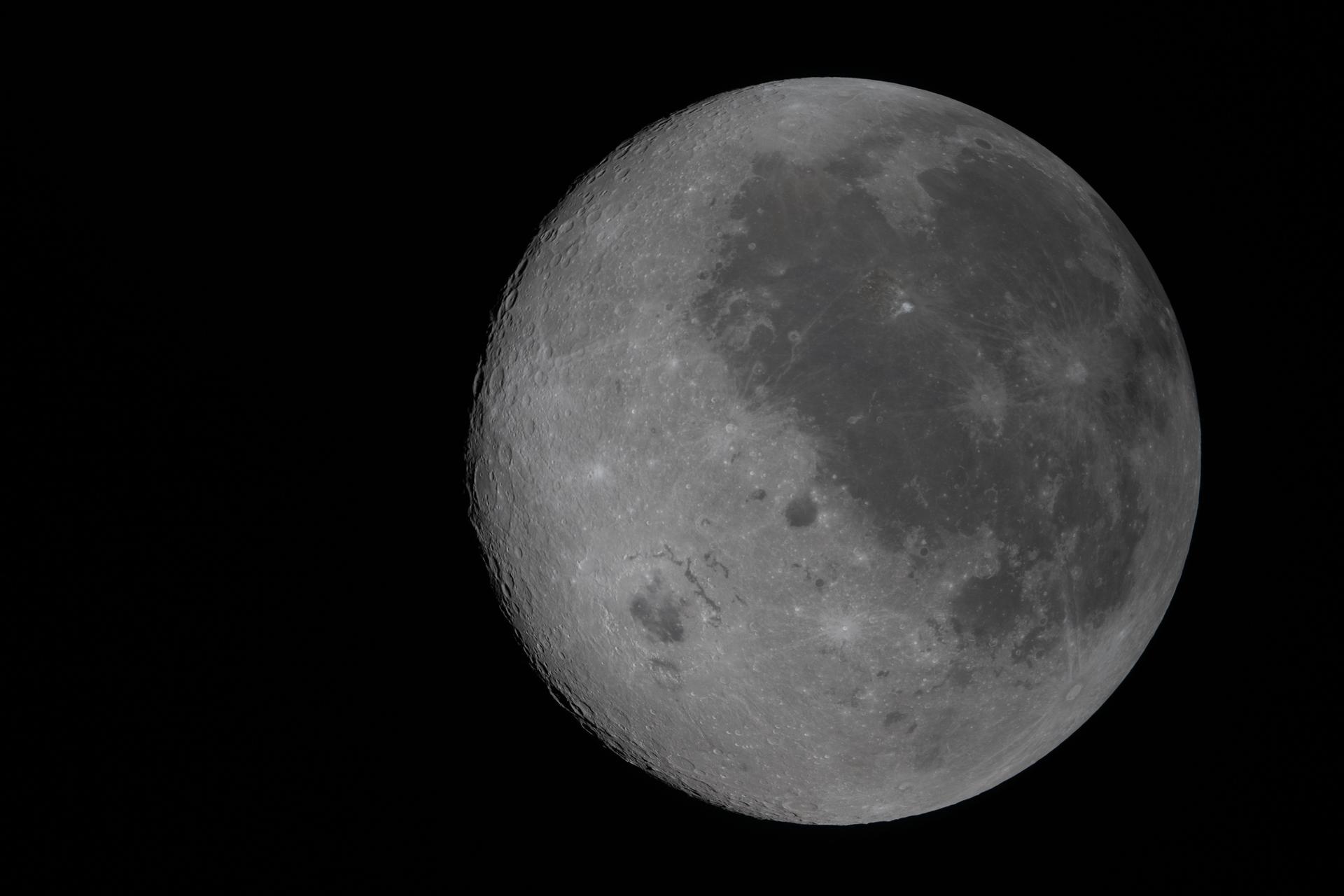
I have a certain amount of skepticism, too, but this is so far off on the extreme of hyperbole that it’s probably fair to describe it as “bullshit”. There is an entire science team that is actively recording their observations, asking questions, and guiding the photography. Just now, for instance, I heard a request for them to carefully photograph a particular area of the moon in such a way that all the photos could be combined into a continuous mosaic, which would represent the highest quality imaging of that area ever obtained.
Whether the scientific knowledge gleaned from this particular mission is worth the cost is a different question, and the answer is clearly “no”. But it’s also laying the groundwork for a great many future missions, and where that will lead and what discoveries and benefits it may bring is not something anyone can reliably predict.
That may well be the case, but you’re all so enthusiastic that a bit of pushback can’t do any harm.
Considering the difference in distance from the Moon, I’d be surprised if the Lunar Reconnaissance Orbiter has not taken pictures of the entire Moon in higher quality than Artemis II could ever take. The LRO orbits between 20 and 165 km above the surface of the Moon; much much closer than the Orion capsule will get. At best, the astronauts may get pictures at a different sun angle than LRO. That could be useful.
Why are mission control and the astronauts using miles in their communication? I thought NASA used the metric system?
Something that is seen for the first time complete by the naked human eye, probably. The whole moon has had the heck mapped out of it by orbiters for decades.
I suspect that you mean this.
NINJA’d
maybe the BS is not too far off:
there is NASAs Luna Reconnaissance Orbiter - well - orbiting the moon for 17 years … day-after-day and night-after-night.
here a snippet:
LRO has been studying the Moon from up close since 2009, making it the longest-lived lunar orbiting mission ever. The orbiter has mapped the Moon’s surface and measured its temperature, composition, and radiation environment in unprecedented detail. Data from LRO enables NASA, and our international and commercial partners, to select locations on the lunar surface where spacecraft and astronauts can safely land. The orbiter is also helping NASA identify areas near the Moon’s South Pole with crucial resources like water and extended sunlight, which provides power for equipment and supports exploration activities.
.
Will random photos taken out of windows at 4-5.000miles distance really reveal something new?
I am inclined to call BS or at least there is a lot of stuff being “hyped up” out of proportion… (just heard “humanity, mysteries, teachings of Jesus” in the stream w/ 6 min before blackout
just picked up this tidbit from the live-stream: Astronauts use 400mm zoom lenses …
… from 5,000miles (8,000km) away …
so yeah … thats basically as “scientific” as a big-game safari in Kalahari Natl Park.