Now, I’m starting to regret not paying more attention in Physics class in high school.
As long as they are on course, I’m going to trust that things are going to happen as they should.
Now, I’m starting to regret not paying more attention in Physics class in high school.
As long as they are on course, I’m going to trust that things are going to happen as they should.
I would imagine that technically one could do a translunar injection burn that was calibrated to be just weak enough that, at a certain equilibrium point, you would be exactly frozen in space, unmoving, in that point where you’re perfectly trapped between Earth’s gravity and Moon gravity and can go neither forwards nor backwards.
No, that’s a different issue. I already acknowledged my blunder in implicitly assuming that Orion had the same orbital period as the moon and would be passing through the L1 Lagrange point, but in fact that’s irrelevant and you’re quite correct that Orion is heading toward a point in space where the moon will be when it arrives, not where the moon is now.
What I was referring to was the timeline posted by @Fiendish_Astronaut, presumably from NASA, which says that at 12:41 AM EDT Orion will enter the “lunar sphere of influence at 41,072 miles from the Moon”. I’m just pointing out that whoever provided this data appeared to be wrong, as Orion was already closer to the moon than that, and at 12:41 was at a distance of 39,937 miles, unless the different measurements had different terms of reference.
The other thing that’s perplexing to me – though I may yet again be missing some other subtlety – is that “lunar sphere of influence” would mean that lunar gravity finally overpowers that of the earth, as it draws the capsule into a lower-altitude swing-around. Yet the capsule continues to slow.
Here are its speeds from the time of supposed entry to the lunar sphere of influence, for the next 50 minutes in 10-minute intervals, times in EDT, AM, April 6:
1,360   12:41 (39,937 mi from moon)
1,356   12:51
1,352   01:01 (39,243 mi)
1,348   01:11 (38,861 mi)
1,346   01:21 (38,582 mi)
1,342   01:31 (38,240 mi)
It just keeps slowing down. It’s currently (02:04) at 1,331 mph and still slowing.
The L1 Lagrange point in the earth-moon system, directly between the earth and moon, is unstable, so the slightest perturbation would send the spacecraft flying off in some arbitrary direction. There are, however, two Lagrange points ahead and behind the moon’s orbital path that are stable and where this would be true.
My point was that the place where the Moon’s gravity becomes dominant is further from the Earth than the Moon is. At leat that’s my understanding of Orion’s orbit. I’ll welcome corrections.
Maybe I’m missing some subtlety in what you’re trying to say, but on the face of it that’s clearly not true. For instance in this illustration of earth-moon Lagrange points, clearly anything closer to the moon than L1 will be dominated by lunar gravity. More trivially, if lunar gravity wasn’t dominant at all such points close to the moon, the Apollo capsules would not have been able to achieve stable orbits.
OK, I guess I misinterpreted a diagram (which I can’t find now) of Orion’s orbit. But I will note that Orion is not moving directly towards the Moon, but probably more sideways than towards it. That may be the reason for discrepancies in its velocity.
Another thing that also occurs to me is that there’s a subtle but very significant distinction between the concept of speed relative to earth and speed relative to the moon. The NASA stats are actually about velocity, not speed, which is another important distinction. Speed is a scalar quantity, while velocity is a vector, which in this case probably means the velocity of Orion relative to earth, which would have little bearing on how fast it’s moving relative to the moon. CNN just pulls these stats from NASA without either defining or explaining them, and I may have been looking at this all wrong!
But after Orion swings around the moon and starts heading back home, the velocity numbers will become a lot more meaningful and start going up quite rapidly.
Escaping the hands of Newton only to fall into the hands of Lagrange? Bad deal, if you ask me.
The cold dead hands of N and L, BTW.
I will say that while the velocity number continues to decline, the distance to the Moon is falling much more rapidly that it was when I was headed to bed last night.
If you swing around the Moon and come straight back, that does not change your speed relative to the Earth that much.
It will keep slowing down until around 19:27 EDT, then speed back up as it falls down to Earth.
There are apparently four satellites in stable positions at one of the Earth-Moon Lagrange points:
Though I should say, if you drop an object down to the Moon from far away, it will speed up relative to the Moon until it passes periapsis and comes back around, which is indeed what we see: the spacecraft is currently speeding up, and wil continue to do so until it reaches its closest point of approach to the Moon, which will be at 19:01 EDT.
Also, as has been pointed out, the Moon is not sitting there, so you need to aim for where the Moon is going to be at the desired encounter time.
Apologies for the multi-part comment.
Finally, we do not want to impact the Moon, however! So we need to pass either in front of or behind it. We should note that flying the spacecraft so that it passes in front of the Moon, rather than behind it in its orbit, helps slow it down: Could we use gravity assist to slow down spacecraft?
not speed it up
how did they shoot the pic from the far side of the moon that is circulating on mainstream media if they are still between earth and moon?
I am struggling to reconcile this … lateral angles?
Correct. Again, they are aiming for where the moon will be, later today. So, they’ve had a bit of a side-view of the moon, for the last day or so.
So the Chinese thought of putting a relay satellite on a stable Lagrange orbit behind the Moon but the USA thought it better to send the humans first and the relay satellite for communication later?
Know what? I think they could communicate with them if they wanted to. They only had to ask the Chinese politely and pay a small fee. Knowing the Chinese, they would do it for free just to boast that the USA needed them. The radio silence is theater.
I had someone ask me the other day “we landed on the Moon over 50 years ago, back when our technology was much more primitive. Now we have cellphones with more power than computers that used to take up whole rooms. Why are we just doing a fly-by this time? Why can’t we just go ahead and easily land on the Moon again?”
Maybe the question was covered in this thread, but it’s a big thread. I’ve seen some posters bring up the question “why are we going back to the Moon at all?” but not this specific question.
My reply was more or less “it’s not all about advanced electronics and computing power. Going to the Moon and back is an enormous engineering challenge. We have to redevelop the infrastructure and kind of ‘relearn’ how to go to the Moon again. Also, back then we were in a Cold War space race-- getting an American on the Moon before the Soviets was a top priority. Now we’re taking our time more and trying to doing it ‘right’ not ‘fast’. We’re developing new techniques for how to go to the Moon and back-- for example taking longer to get there and back because we’re using much less fuel and taking more advantage of orbital physics”.
Was my reply accurate? Was it adequate, or are there other factors I can mention if the subject comes up again?
Essentially, yes.
Until we actually do it, everything is a prediction, an educated guess. Yes we did it 50+ years ago, but it’s been so long since then. And this Orion system is drastically different and new compared to back then.
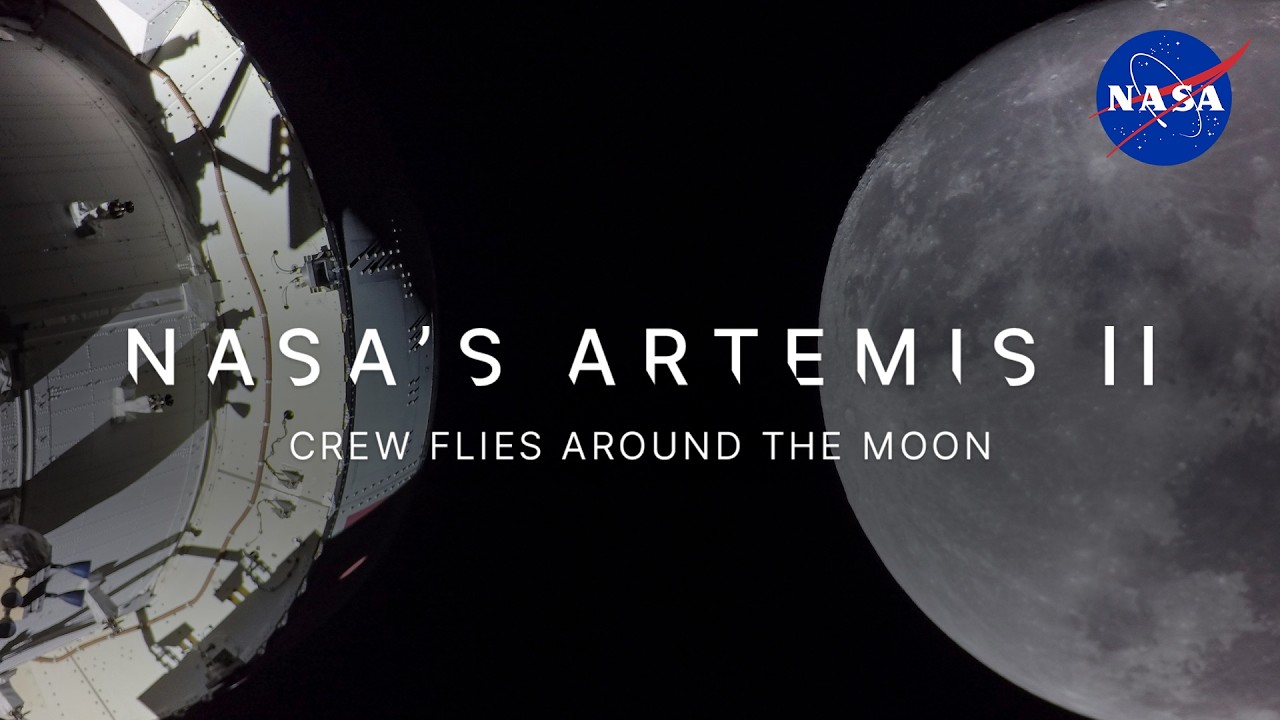
As I type this Netflix is showing the NASA feed, same as YouTube
Brian
Thanks for the video. I’m watching it in enlarged “cinema mode” on YouTube.
I have to say that as fascinating as this whole mission is, this “beat Apollo record for the farthest humans from the earth” is stupid. It deserves no more than an incidental passing comment, not touted as some major milestone.