Contemporary magazines have shown plunging necklines on dresses, blouses, and such for several decades. I have wondered whether this was just the whim of a (most likely male) fashion dictator; or whether, as I supposed when seeing some sports outfits, the design made for freer movement of a woman’s arms in various activities. I suppose there’s some give-and-take: It stands to reason that an athletic woman needs support, but she would also want to move her arms as freely as possible.
Men don’t dominate women’s fashions. There are men who do design women’s fashions, but there are plenty of women who do also, and it is women who buy the stuff in the end. Some people think these fashions are desired because they appeal to men, but there’s plenty of consideration that women like these styles to compete with other women.
As far as freedom to move their arms, it doesn’t make sense to me, but I’m not a woman. I see women in sports tightly wrap their assets to keep them from moving and I don’t see how plunging necklines would be an advantage for anything but appearance.
If anything, a plunging neckline makes you less likely to move your arms around too much to keep anything from popping out on you 
For arm movement, exercise wear that’s sleeveless or has something like a raglan sleeve (shoulder seam slopes towards the neckline instead of a seam going around the shoulder/underarm, which can cut in and irritate you) are easiest to move your arms around in.
Ventilation. Some women wrap 'em tight, while others don’t want overly-sweaty cleavage. Cite: a Runner’s World article on choosing sports bras. Don’t have my magazines at work, and not going to google for it at work. 
Many a good thing has been killed by over-analysis. Close this thread and never speak of it.
Several decades? Try several centuries.
Here’s a portrait of Nell Gwyn more than 300 years old.

A self-portrait of Artemsia Gentileschi that’s even older.

And a whole passel of 17th Century decolletage.
Whatever the reason for cleavage, I don’t think all the blame can be laid on male fashion dictators.
Stop it right now! You’re teasing us with your wicked innuendo.
What’s with the nip slip (or is it a birthmark)?
Speaking of plunging necklines, I give you Emily Ratajkowski in a neckline that plunged so low it exposed her bellybutton.
As the article notes, a fashion designer described this as appalling and repugnant. Which to mean demonstrates a serious misunderstanding of what those words mean.
Eh, no -cite, cite, cite. Nell Gwynn was not a modest lass ;).

_Gwyn_by_Gerard_Valck,_after_Sir_Peter_Lely.jpg)
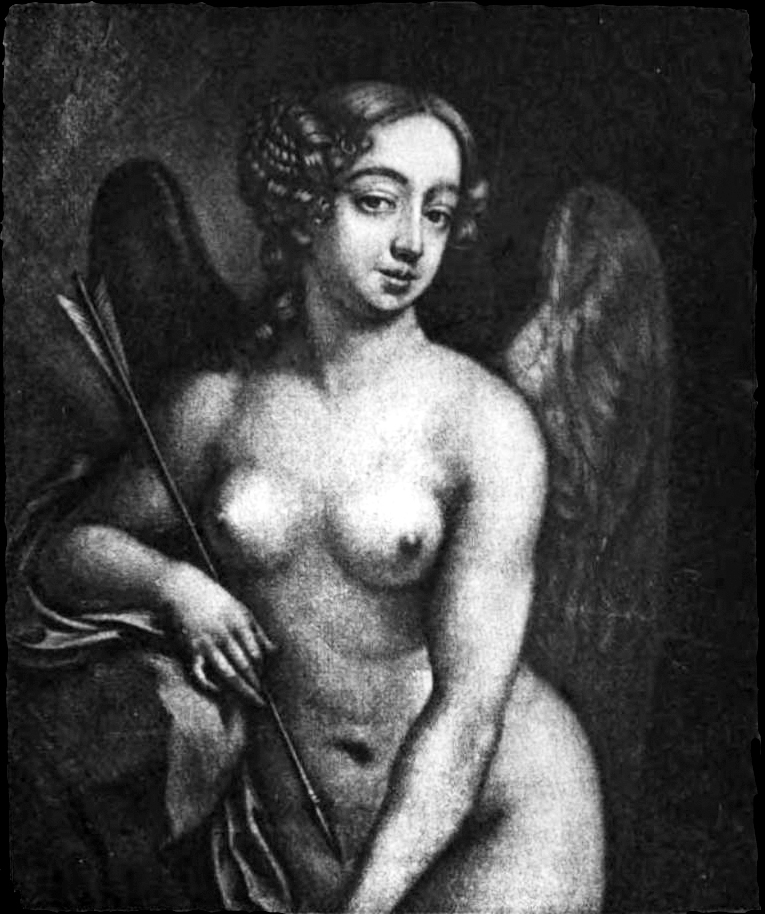
She actually was quite a hoot:
Nell Gwynn was one day passing through the streets of Oxford, in her coach, when the mob mistaking her for her rival, the Duchess of Portsmouth, commenced hooting and loading her with every opprobrious epithet. Putting her head out of the coach window, “Good people”, she said, smiling, “you are mistaken; I am the Protestant whore.”
and
She is noted for another remark made to her coachman, who was fighting with another man who had called her a whore. She broke up the fight, saying, “I am a whore. Find something else to fight about.”
From her wiki, of course.
One of the other links shows a similar one. It was a fashion choice at various times for society ladies in France, England, and elsewhere, to juuust barely expose nipples. More occasionally there were fads for baring whole breasts.

I’d like to call for a cite for the comment that men don’t dominate women’s fashion. In high-fashion (which is ultimately where overarching design silhouettes, “in” colors, and basic clothing forms for the next year all come from), yes, they absolutely do. Most of the houses are named for men, most of them are still run almost entirely by men, and the most women you’ll see is in the cutting room and on the catwalk.
It’s all about the boobs.
And, as has been commented on already, it doesn’t have anything to do with freedom of movement for the arms or torso. If you want freedom of movement, look at gymnastics costumes: tight, flexible, and high-necked so that nothing slips out or even moves around much. Fabric-covered arms aren’t exactly necessary, but can be useful if a person has a VERY pronounced chest, as it means there isn’t a hole at the armpit for things to slide towards or be compressed out of (which isn’t comfortable, even if you’re leaving out the question of whether it’s attractive).
The more cleavage that is exposed, the more delicately and moderately a person has to move (and/or the more double-sided tape must be used), especially if the person isn’t a model, and therefore they actually HAVE cleavage, instead of artfully-applied contouring makeup.
If you think it’s about freedom of movement, then why doesn’t MEN’s fashion have those same plunging necklines? :dubious:
Let’s make that straight men.
In any case, the dresses in question are worn on the runway and by actresses and other such at awards ceremonies, and not in real life. I suspect they are done to say “look at me” and to get clothes from the designer into the magazines and newspapers.
I think you’ll find the vast majority of purchasers of women’s clothes are women. I will admit that you may be correct about the word ‘dominate’ depending on how you define it. Most designers still are men I believe, but it’s not like they can prevent women from designing clothes, or force them to buy what they don’t want.
Obligatory Cubist cartoon link: http://imgc-cn.artprintimages.com/images/P-473-488-90/68/6820/1PFY100Z/posters/paul-noth-uh-hello-my-eyes-are-over-here-new-yorker-cartoon.jpg

Equally obligatory Hark! A Vagrant cartoon on the subject of the superheroes Cloak and Dagger, specifically Dagger: Hark, a vagrant: 398
It can be all about the boobs without necessarily being all about the men or about the men dominating fashion.
Quick, ask my wife what she thinks about a runway model. “She’s really pretty, but she has small breasts.” In fact, ask her about any woman with less than a C cup, and she’ll be sure to let you know that the woman’s breasts could be bigger. My wife pays more attention to breasts than I do!
I think that pretty much every body knows if it is a fashion statement or not.