Yugoslavia orginally, as far as I know. Not sure which country inherited the brand after the split.
ETA : origin in Soviet Russia. From Wikipedia,
Yugoslavia orginally, as far as I know. Not sure which country inherited the brand after the split.
ETA : origin in Soviet Russia. From Wikipedia,
Interesting.
Lada became the brand for export markets. Due to the scarcity of auto-repair shops in the Soviet Union, Ladas were designed to be easily maintained by their owners.
It’s a design philosophy I wish we had more of here.
They are resuming marketing in Mexico:
While a brand new Lada, bought in Mexico, should meet or beat the OP price requirement, it is probably expensive or impractical to register it in the U.S. Plus, unless you live close to the border, it would be impractical to obtain warranty service.
P.S. My link is actually to a dealer in Lebanon. I see articles saying that Lada is about to start selling in Mexico but it could be vaporware.
I have to partly take back my last post. This is a Google translation from Spanish:
Lada Cars in Mexico: The Dangerous Mirage of a Cheap Car That Doesn’t Exist
I used Kelley Blue Book’s Car Finder to try to find (what they call) a new sub-compact hybrid SUV, and they gave me two choices: Toyota Cross, which I had already been looking at, and Lexus UX, which I had no idea about. The Lexus is only about an inch longer and wider than the Toyota, but it is over 4 inches less tall, and it doesn’t seem to offer much except possibly some luxury finish touches for the several thousand additional dollars. I’m surprised they didn’t mention the Kia Niro or the Crosstrek.
Their car finder is a bit unclear, with several overlapping and ambiguous categories. But I see a bunch of options here: https://www.kbb.com/car-finder/?categories=suv&size=subcompact&fueltypes=hybrid
Thanks, I also now realize I had specified 40+ mpg, which rules out the Crosstrek, and I had specified New, which ruled out all those used models. I still don’t understand why the Niro is not represented.
That’s what I mean by their search being kinda crap. There’s no clear differentiation between “Small”, “Subcompact”, and “Compact”, or between SUV, hatchback, wagon, and crossover.
In their system the Niro is considered a compact wagon. How that’s different from a subcompact SUV, I have no idea…
If you do this, you should see more options:
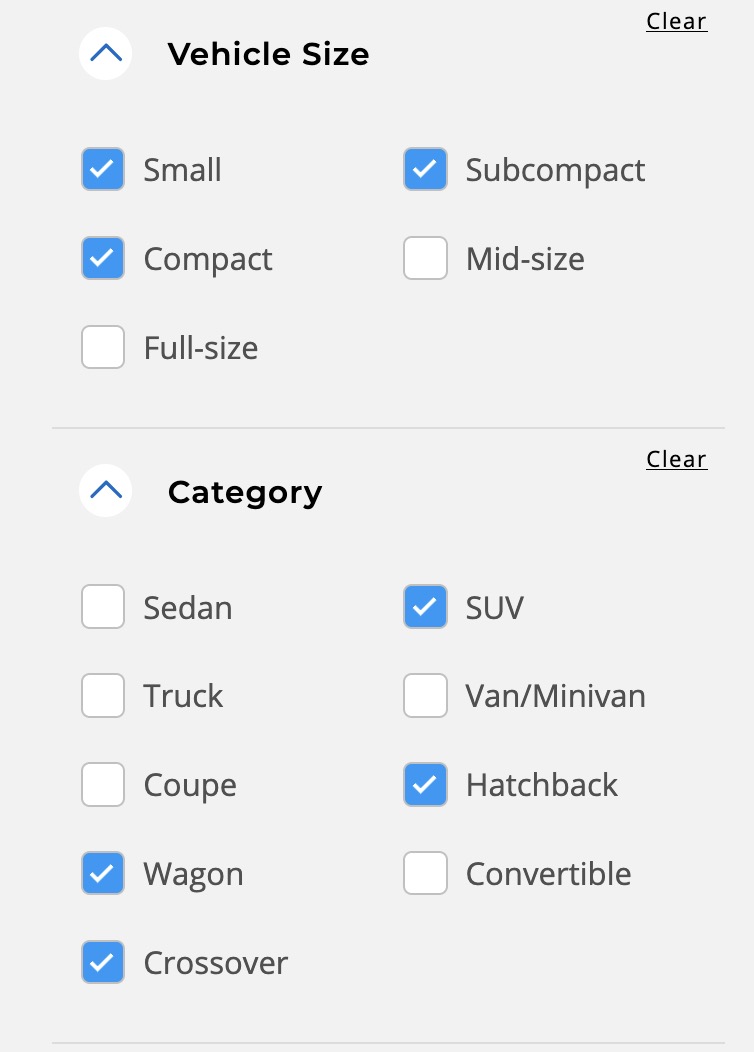
Googling, I find sites like this one that compare subcompact to compact to midsize cars. My understanding is that these categories are defined consistently.
Maybe there are definitions out there somewhere, but in my experience, it’s not consistent at all in the real world… e.g. looking at the Kia Niro:
KBB calls it a compact wagon.
Car and Driver calls it a subcompact SUV.
The EPA and EnergyStar call it a small SUV (a sub-category of truck).
Edmunds calls it both “small” and “compact”.
The IIHS calls it a small wagon.
Kia themselves call it a “crossover”.
With my Crosstrek, it’s been registered in four different states (CA, WA, OR, IL), and I think each one classified it something different in the paperwork.
Also, even if there were strict categories by interior volume, how that volume is distributed is very important and not something you can easily tell from one number, e.g. how much head room or leg room there is, or how big the rear row middle seat bump is, etc. Those size categories are just general guidelines IMO (useful for telling apart a large SUV from a subcompact, for example), but if you’re wondering whether something is a subcompact or a compact, you probably have to go test drive it in person to really get a feel for it.
Carsized.com is helpful too:
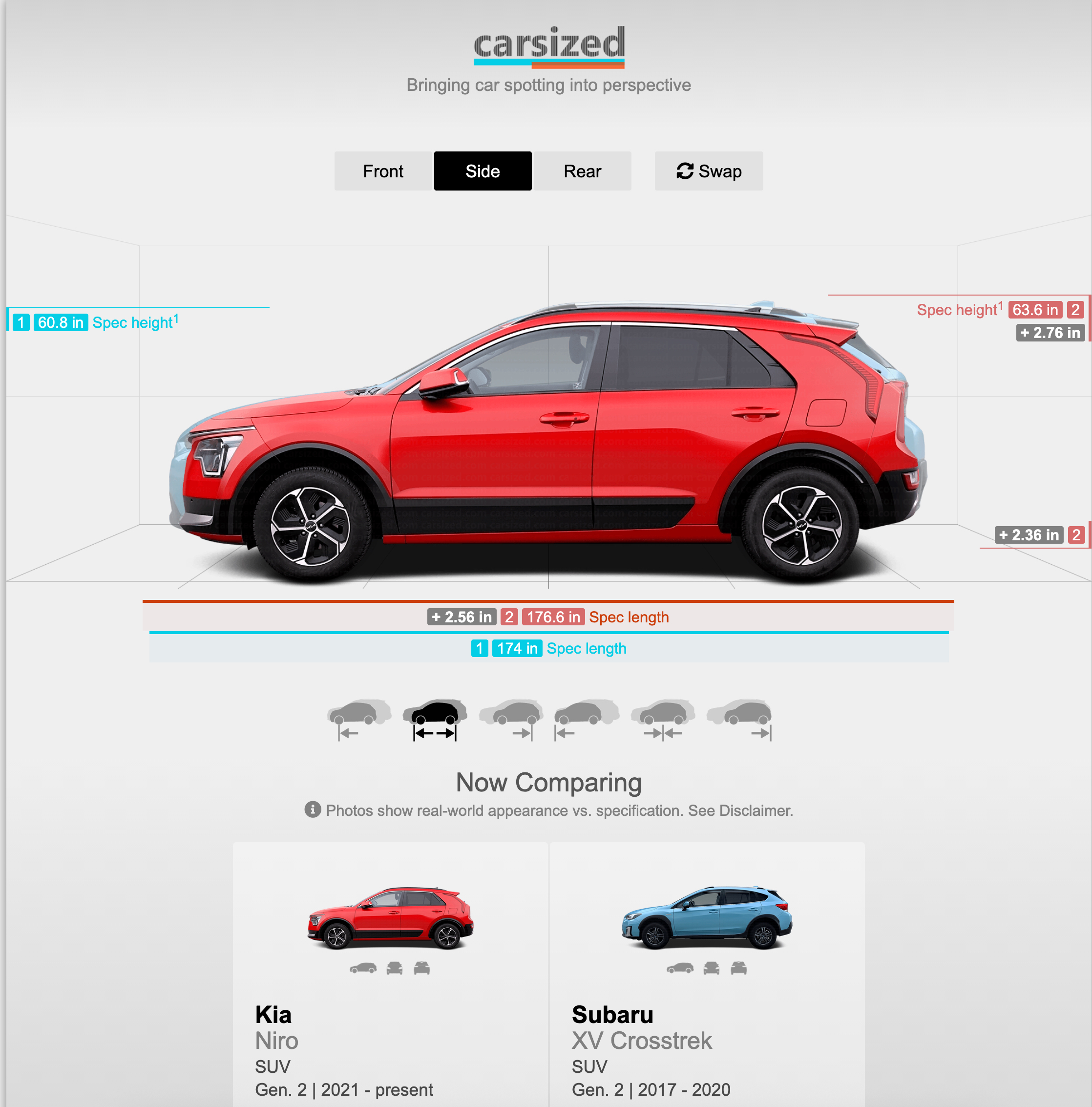
The red Niro is technically in a bigger size category on paper, but in reality it’s a little shorter (both length and height wise) than the Crosstrek.
I don’t think there is a clear distinction between station wagon and SUV. Some SUVs look like slightly tall station wagons.
Probably in the same category as the Crosstrek (typically classified as a crossover) is the Corolla Cross, which also has a hybrid.
The CC has better mileage and probably a better infotainment system, but it is E-AWD (the rear wheels are driven 100% by an electric motor, and only sometimes). The Crosstrek has a mechanical AWD (all the time). Both are rated for 1500 lbs towing (important for me because I’m looking to tow a SMALL teardrop trailer)
I’m leaning towards the Corolla because I drive on the road a lot more often than where 4WD is needed (even my FWD Prius does OK in snow)
The newer Prius models are a lot sportier than my 2016, but they sacrifice cargo space. I can jam quite a bit in mine, esp. when alone in the car.
Brian
That I’d say just reflects how nowadays most of those descriptors are really self-applied by the brands with little standardization of parameters.
Well, depending on how you define it, I would say the Hyundai Santa Fe is a good smallish SUV for the money.
We have a 2017 Santa Fe Sport that we’re very happy with and the daughter has a newer (2018?) Santa Fe that’s quite nice.
Mrs. H and I bought a used Kia Soul about a year ago, and we’re thrilled with it (knock on wood).
Good choice.
Yesbut- Only Honda, Toyota and Subaru have top rated reliability, Chevy and Volvo are pretty low. Especially Volvo, which has really declined in reliability since they were bought by China.
All Subaru are all-wheel drive, which generally give lower MPG. But yeah, the newer Subaru hybrid have better MPG.
Note, altho Toyotas are great cars, Toyota dealers are the worst.
Preach. I had a Yaris that had two problems. One was a driver’s side window that wouldn’t open all the way, and the other was so picayunely trivial that I don’t even remember what it was. Regardless, the feds decided it warranted a recall, and Toyota USA bugged me for months to get it fixed. I kept refusing until I got a downright hostile call from an agent who told me, in no uncertain terms, that I could go to Dealer A so many miles east, or Dealer B so many miles to my west, but “neither” was not an option. I caved and took it to Dealer B, and asked him to throw me a bone while I was in his shop and fix my window gratis. He refused.
Fuck Toyota USA. They are fantastic cars but as a corporation…
Yep. Back when Consumer Reports used to also rate “the deal” Toyota was always the worst. Their service dept is also really bad, worse than almost every other.
Of course now buyers can get a Toyota from other sources. just stay away from the dealer (or any dealer that uses a “four way” to price out the deal)
(Minor nitpick)
Most Subarus in the US are AWD. But there are a few that are not (necessarily), like the BRZ (RWD) and the Uncharted (FWD by default, AWD optional). Those also happen to be the models they co-branded/co-developed with Toyota, which is probably why a non-AWD variant exists at all.
In Japan, some other Subarus (like their small kei cars/trucks) are not AWD either.
This is why the Subaru EVs are interesting. They’re actually Toyota cars with mostly Toyota parts, but co-developed with Subaru. But when you buy them as a Subaru, you typically get better value (more features for any given trim/price level) and you deal with a Subaru dealership instead of a Toyota one. They all have AWD available (if not required), and sometimes, higher ground clearance too, along with minor tweaks here and there. But they’re otherwise Toyota cars, just relabeled and resold.
My understanding is that Toyota helped Subaru with their hybrid drivetrains too, but they did not altogether co-develop those cars the way they did with the BEVs. (Toyota partially owns Subaru.)
Thank you for the clarification.