Oh God. There have been repeated attempts by misguided Wikipedia editors to rewrite the article about Gadsby as a lipogram, but sanity has prevailed there. I’m disappointed to see that the lunatics have won in the A Void article.
Much of the book is unusual in content rather than form, but the frame story for Barth’s Lost in the Funhouse is supposed to be folded and pasted into a Möbius strip.
After Marvel Comic writer Mark Gruenwald died—he was cremated and his ashes were mixed with the ink used to print the first printing of the trade paperback compilation of the Squadron Supreme 12 part comic book series he wrote in 1985.
There is that novel where every copy is different. Subcutanean did this via print-on-demand; I wonder how many copies he sold, though? I suspect there was some procedural generation involved, meaning you can easily knock out as many variations as you need.
Do pop-up books qualify? There are many modern ones on all kinds of subjects, but I remember two that my father had: One was a steam engine, showing intricate details, and the other a motorcar. I was only allowed to look at them under supervision, and I have no idea what happened to them. I imagine that they would have been quite expensive back in the 1940s.
Oh man, I have two I want to post but I’ll respect the OP, and stick with “Les dîners de Gala” a cookbook by Gala and Salvador Dali. With her stunning dinner party menus and his illustrations, it’s a rich steaming feast for the senses. One of my all time favorite finds.
*ETA: The one in the video is not mine. A signed one would bowl me over!
The Amazon reviews are hilarious.
If we’re gonna submit unusual cookbooks, then I nominate one that’s in my collection - A Treasury of Great Recipes by Vincent Price. Yes, the Vincent Price. It’s not a cookbook in the traditional sense so much as it’s a travelogue of the haute cuisine restaurants he and his wife visited across America and Europe during the peak of his film career and the recipes they cajoled out of the management of those establishments, accompanied by gorgeous color photos and menus. The recipes are organized by the restaurant they originated from instead of by what kind of food they are. They’re hopelessly indulgent recipes from the era where heavy sauces were the norm, mushrooms were a condiment, and “finely chop four truffles” was a reasonable thing to ask of the reader.
https://www.allrecipes.com/vintage-cookbook-treasury-of-great-recipes-8728213
These two books belong together on a shelf.
Jennifer Egan’s A Visit from the Goon Squad has an entire chapter written in the form of PowerPoint slides and printed in landscape orientation, which requires the reader to rotate either the book or their head 90 degrees (and thus look like a weirdo if they’re reading it in public).
It’s not the only book printed in “landscape”. I have an edition of Jules Verne’s Dr. Ox’ Experiment that’s entire printed “Sideways”
I also have a copy of George Bernard Shaw’s play Androcles and the Lion published in his self-iinvented “Shavian Alphabet”. To my knowledge, it’s the only book that was ever printed in that script:
Sadly, it doesn’t have Shaw’s surprisingly long foreword (all of Shaw’s forewords are long, unless the Afterword is) on Christianity.
William Faulkner originally intended for The Sound and the Fury to be printed in various colored type to differentiate the multiple timelines. Almost a century later, the Folio Society published a limited edition to Faulkner’s specifications, using 14 different colors of ink. (It can be yours for a mere $950!)
Queen Mary had a doll house where everything was extremely detailed in miniature, including working plumbing, and a wine cellar with tiny bottles containing actual wine.
The house has a library with actual tiny books, with text written on tiny pages, containing original, if short, stories written by famous authors. It includes a Sherlock Holmes tale.
Frank Gellett Burgess, famous for writing the poem “The Purple Cow” (“I never saw a purple cow, I never hope to see one…”) and for writing the children’s book The Goops, which was in print forever (after their initial run, Dover republished them in paperback), and who coined the term “blurb” and other contributions to the English language, published a magazine entitled Le Petit Journal des Refusees, which consisted of pieces that had been rejected at least three times by other magazines, printed on oddly-cut pieces of wallpaper.
Princeton University has three copies.
I love that there’s an edition of Christopher Moore’s, “Lamb: The Gospel According to Biff, Christ’s Childhood Pal,” printed in the same manner as a lot of bibles - soft imitation leather cover, onion-skin paper, gilt edges.
Speaking of books printed in the appropriate style, I’d recommend The Jefferson Bible.
Properly it’s entitled The Life and Morals of Jesus of Nazareth by Jefferson, who constructed his edition by cutting out passages from the four new Testament gospels in four languages (Greek, Latin, French, and English) and pasting them in a blank volume side-by-side in the manner of a Biblical Concordance. Jefferson assembled these in chronological order, eliminating any supernatural or miraculous events, so as to portray the philosophy of Jesus. In order to fit things in, in at least one case he had to paste part of one sentence in at the edge and fold it over.
It was never intended to be a published book, or for wide circulation, but it has been republished several times. The most recent edition, published and sold by the Smithsonian Institution (which owns the original) is a photoreproduction of every single page, reproduced in its original size and bound i the same binding Jefferson used for his edition. It even includes that pasted-in-and-folded-down sentence. There’s a transparent plastic slipcover that tells you what it is, but you can remove this and it looks just like Jefferson’s edition. I got mine few years ago in Washington D.C., and I love it. I’ve read it twice.
Another book that isn’t as weird as many already listed, but which took me by surprise, is Christopher Logue’s 1962 translation of Book 16 of Homer’s Iliad, which he named the Patrocleia, since it concerns the actions and fate of Patroclus, Achilles’ closest friend.
Logue apparently didn’t know ancient Greek, but his translation is truly amazing. It’s unlike any other translation, with Achilles’ prayer to Zeus obviously modeled on The Lord’s Prayer from the New Testament. And he uses wild and sudden changes in typeface and type size to affect the mood, with single word taking up an entire page sometimes. Definitely worth a look
You can see a few pages reproduced here:
https://www.tandfonline.com/doi/pdf/10.1080/02666286.2022.2028524
Logue wanted to translate the whole Iliad in this fashion, but he didn’t do so before his death. He did, however, translate much of it in individual pieces, which I’ve read. Nothing else seems to follow in the graphical fireworks footsteps of his Patrocleia.
Dennis Wheatley and J. G. Links put out a series of “crime dossiers” in the 1930s. They purported to be actual files from a police case, not just transcripts of interviews but some actual physical objects collected at the scene, like hairs and matches. (The hairs were individually stuffed in by a squad of women, very bored women.) By looking carefully at the evidence the reader was supposed to act as a detective and solve the case.
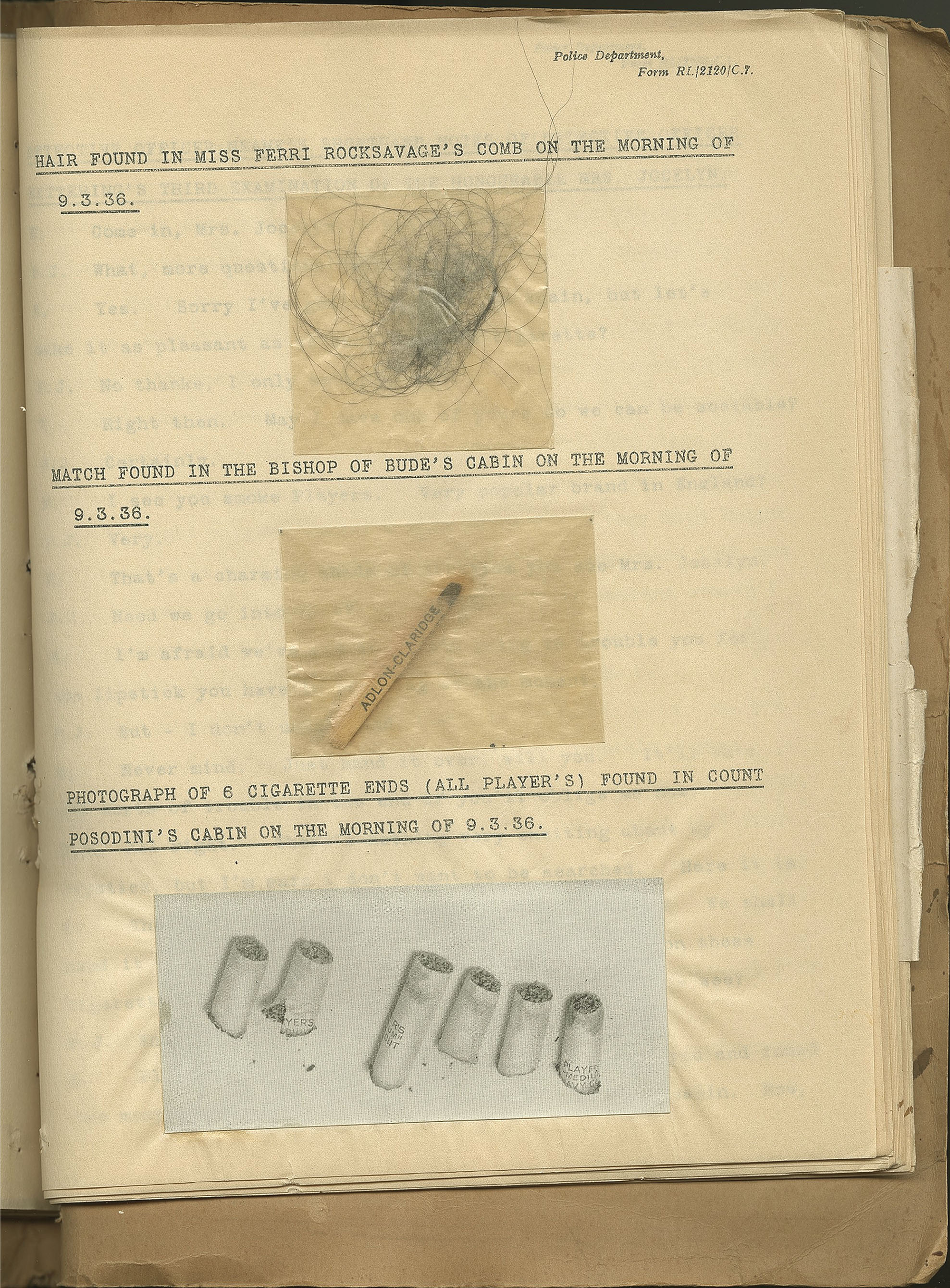
Wheatley and Links were British and the dossiers sold so massively that they got redone - reprinted isn’t quite the right word - in America several times along with later imitations.
Did you mean “Menelaiad”, a story in the collection Lost in the Funhouse? “Menelaiad” has a frame story that goes seven levels of quotes deep.
" ’ " ’ “Seasick,” she admitted. “Throwing up.” To my just query, why she repaid in so close-kneed coin my failure to butcher her in Troy, she answered-’
" ’ " ‘Let me guess’, requested Proteus."
" ’ “What I said in Troy.” said offshore Helen. “What I say to you now.”’
When Marvel used the band KISS in a comic, they (carefully) cut themselves and mixed the resulting blood in with the ink used to print it.
During WWII, the military worked with publishers to create the Armed Forces Editions, free books that would be distributed in the millions to the troops. Over 1300 were created in less than four years. All were printed sideways. Two books were printed on a page simultaneously, and then the pages were cut in half to make a 4" x 6" paperback, with the binding on the short side. Finding two books with nearly the exact same page length, so that the minimum amount of paper was wasted on blank pages, was always a problem, though.
When I went to the Kansas City Worldcon (MidAmericon II) they had a large display of Armed Forces Edition science fiction books. Wow!