Couldn’t they just make multiple copies of the same book?
Landscape-oriented books are also common for children’s picture books.
Couldn’t they just make multiple copies of the same book?
Landscape-oriented books are also common for children’s picture books.
Are there any books out there where the even number pages were one story, and the odd number pages were another story?
They only did eight sf titles, and that’s if you includes the novel The Adventures of Superman.* Maybe they were part of a bigger collection?
You’d think. I’ve always wondered that myself. The only thought I have is that it was better to have one long press run of two titles than two separate shorter runs of individual titles. Less set up time. But that implies that the cutting in half time was minimal.
* That page calls it “the novel on which the comic-book figure was based,” which is total nonsense. It did include a few details that later became canon, though.
There are quite a lot of ‘facing page translations’ and apparently even some cryptic menus in Word, etc. to assist in creating such documents… Nicholas Jenkins: "facing pages"
Most reform and conservative Jewish prayer books have pages like that. Often, most of the pages are like that. That’s not unusual.
Vast, vast numbers of ancient literary works have “original text edition with facing-page translation” versions that are like that.
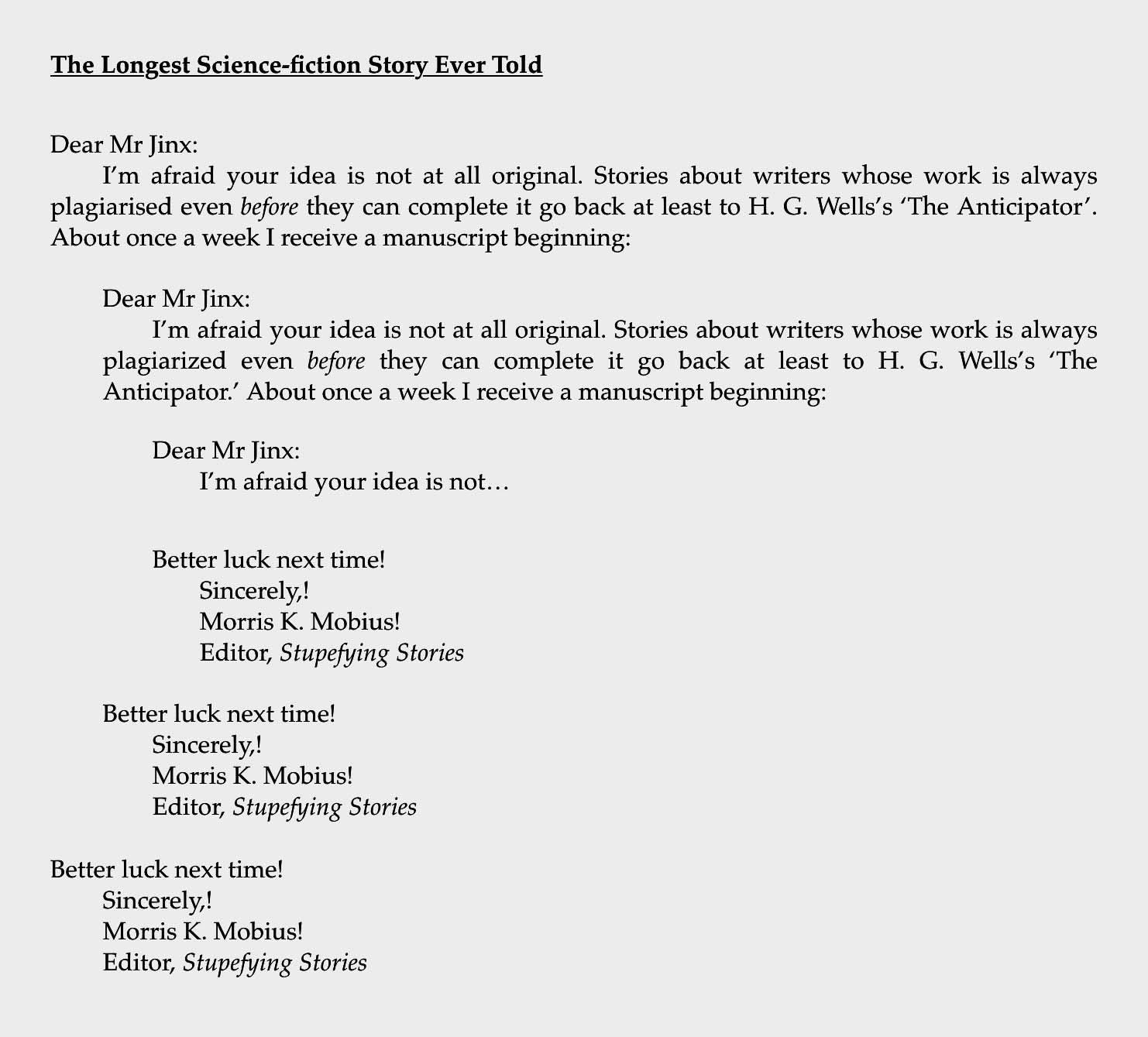
My original reference was to “Frame-Tale,” but “Menelaiad” captures the flavor of the thing very well. Somewhere (is it in “Menelaiad?”) there’s a line, as I remember it, “”“”“Help”" I cried" I cried" I cried.". (Apologies if I misbalanced the quotation marks.)
Stories-within-stories-within-stories-etc. have a long history. Recently David Mitchell’s Cloud Atlas has six nested stories (which they wisely didn’t try to follow in the movie adaptation, choosing to intertwine them). There are examples in Douglas Hofstadter’s Godel, Escher, Bach, which is appropriate, since the whole book is about self-referential systems and Strange Loops (and their role in Godel’s Theorem). I don’t recall how many levels his book descends, but he remarks upon how it’s unsatisfying if you don’t go “all the way down” or “all the way up” to return to your starting level.
There are multiple levels of storytelling i n the 1001 Nights, which go to at least four levels, but I haven’t read the whole thing yet, and I’m not sure what the maximum is.
There are quite a few such “nested stories” referred to in this Wikipedia article:
And of course, he doesn’t: The outermost story cuts off into the next one on a cliffhanger, and then the whole assemblage ends at the level below that.
Including a moment in one of the dialogues where a character in one level somehow hears his counterpart speaking in another level.
Not what I am looking for, which is one story on the odd pages and a totally different story (not an explanation or translation of that first story, etc.) on the even pages.
In my middle school library there was a book narrated in the first person about a country family that takes a day trip to the city. It was illustrated thoughout with black and white pictures in a minimalist, geometric graphic style. The gimmick of the book, as I recall, was that after reading about the journey there, you had to flip the book upside down to read about the journey back, or at any rate about the later part of the day. Viewed upside down, the image changed to reflect the places described in the text on the other side.
Another book we had was Black and White: Four Connected Stories, One Amazing Book by David Macaulay. It actually told four whimsical stories simultaneously on each page, and it quickly becomes clear that the rather different stories told from various perspectives are all the result of interconnected events, in a similar way to the 2006 movie Babel.
Another book that springs to mind is one I saw featured on the Internet about four years back, but unfortunately I can’t remember the title. It is a thick coffee table-type book with weird, colorful illustrations that are not given any text for context. I think the artist is Italian and that he was inspired by the mysterious, indecipherable Voynich Manuscript. In a similar fashion, the book purports to be some kind of science encyclopedia or similar desciptive volume, but with all kinds of crazy anatomical cutaways of fantasy vehicles and machines and strange creatures. The two most specific details that have stuck in my mind are: 1) a recurring presence of rainbow / spectral motifs and 2) an image of skeletons putting people on a machine that removes their flesh, causing the skeleton inside to leave alive and in one piece.
I found the book referred to at the end of the previous post. It’s called Codex Seraphinianus and was written by Luigi Seraphini. Here’s an article. Prepare to be weirded out.
Graeme Base’s The Eleventh Hour also has the pages containing the mystery’s solution sealed off, albeit with regular paper printed to look like a wax seal.
I was about to mention Codex Seraphinianus. I first read about the book in one of Douglas Hofstadter’s Metamagical Themas columns in Scientific American. One of my most prized possessions is a copy of the book that I got as a gift about 20 years ago. It’s a gloriously wonderful book.
Without the capitals I didn’t realize that was a specific story. I didn’t remember it until I looked it up. “Menelaiad” is the story that always stuck with me.
If any part of my memory is accurate, that’s exactly what Barth was parodying, and he went down seven levels so that he could have the record.
I have a friend who wrote and recently re-published a book in a very unconventional format, such that each book has to be assembled by hand. It chronicles the controversy about and the process of removing a statue of William McKinley from a small Northern California town to another town in the midwest, which happened a few years prior. Besides photos and text, there are pages that reproduce various kinds of communications relating to the statue and its removal, including letters, post-it notes, newspaper articles, and various other kinds of media. It is available for sale, $50 for the standard version and $250 for the deluxe version. The title is “Expositions are the Timekeepers of Progress.”
I think Arthur C. Clarke holds the record with infinity levels deep.
I’ll just drop a nostalgic shout out to the “H” volume of the World Book Encyclopedia.
Hello, Goodbye, Hello chronicles 101 meetings of famous people. Helen Keller met Martha Graham, Martha Graham met Madonna, Madonna met… The encounter between Harpo Marx and Sergei Rachmaninoff is a particular favorite. The book comes full circle, ending with the same person it started with (I think it’s Hitler), so you could start anywhere and just keep reading until you get back to where you started.
But there’s more. The forward explains that each entry in the book is exactly 1,000 words long, and the forward is 101 words, for a total word count of 101,101.
The Upside-Down World of Gustave Verbeek is a collection of Sunday comics from 1903 to 1905. Verbeek comics were six panels, which could be read and then turned over, telling a twelve-panel story. A character held in the beak of a giant bird in one panel becomes a different character in a canoe when turned over.