[QUOTE=jimmmy]
The Soviets thought the Shuttle could eaily be modified to carry weapons and in fact acted on that belief.
Soviet Premier Leonid Brezhnev “bankrupted his country’s space program” is sometimes said, spent way more than was logical I would say, by launching what was the largest and the most expensive project in the history of the Soviet space exploration to build the Buran - a copy of NASA’s space shuttle - because some subset of his advisers persuaded him that the United States wanted to use the SHuttle for bombing from Space.
[/QUOTE]
Maybe, wrong, and wrong. The Russian space shuttle program, commonly referred to as Buran (Russian: “snowstorm”), though that is only the name of what was the least shutttle in the class (the official Soviet designation was merely “1.01”), cost between 16 and 20 billion USD; if not the most costly program undertaken by the Soviet Union, it’s certainly the most expensive for which extensive records exist (although I would guess that their SSBN or solid booster ICBM programs cost most, based on a comparison with US expenses on similar programs), and was done during a period when the Soviets had little hard cash to waste.
Buran was externally similar to the US Space Transportation System (albeit slightly larger), but those visual similarities appear to be a combination of functional design and the Soviets using cues from publically available models as a source of inspiration. There are dramatic differences in actual functionality; in particular, Buran had no internal main engines aside from orbital maneuvering and reaction control thrusters. Buran rode piggyback on an Energya rocket combined with a variable number of Zenit kerosene liquid boosters, and had a reported maximum payload mass of 125-175 tonnes to Low Earth Orbit; this is 150%-250% more than the U.S. Space Shuttle. The Zenit is still used today in Boeing’s SeaLaunch commercial space launch appendage. Other differences include the thermal protection system (all but a few of the tiles are the same shape, as opposed to the uniquely shaped tiles of the STS, and Buran used more thermal blankets than the American Shuttle originally did), automated control to orbit, internal configuration of the flight/habitation decks, et cetera.
The Soviets were never worried about the U.S. Space Shuttle being used as an antipodal bomber? Why would they? By the time you launch the STS with a few orbital bombs in place, you could have easily launched wings of ICBMs and SCBMs flying low over the horizon. Nor would it be germane for the Air Force (the presumed client in bombing operations) to do so; it would be a clear violation of the Outer Space Treaty, and would result in a dramatic uproar if it were attempted. It’s not as if you can launch the STS without the support of thousands of engineers, technicians, and logistical support, and keeping such an act under wraps would be impossible. The Shuttle is designed to carry payloads for a quick polar orbit launch and return out of Space Launch Complex 6 (“Slick Six)” at Vandenberg AFB, but these are surveillance satellite payloads, as are (I’m morally certain) the classified launches on NASA-managed shuttle launches from KSC.
The Soviets were concerned about the antipodal bombing capability of the unfortunately named and stillborn X-20 DynaSoar shuttle (also to have been launched out of SLC-6 on top of a Titan II or Titan III booster), and that was indeed once of the mission profiles for the DynaMOWS variant, but it (and later the Air Force Manned Orbiting Laboratory, which was also to be supported from SLC-6) was cancelled by Secretary of Defense Robert McNamara, who saw no strategic value in it given the capabilities of Minuteman II and Polaris. The Soviet Mig-105 “Spiral 50/50” spaceplane/booster program was the Soviet response to this, but if never got off the ground (so to speak). There are rumors, which gained apparent substantiation via the fears of the Pentagon and artist conceptual drawings of a derivative of Spiral called Uragan, Brugan, and a few other names, but there’s no evidence that this ever existed. Like the vaunted missile gap, it’s likely an exaggeration fed by fears.
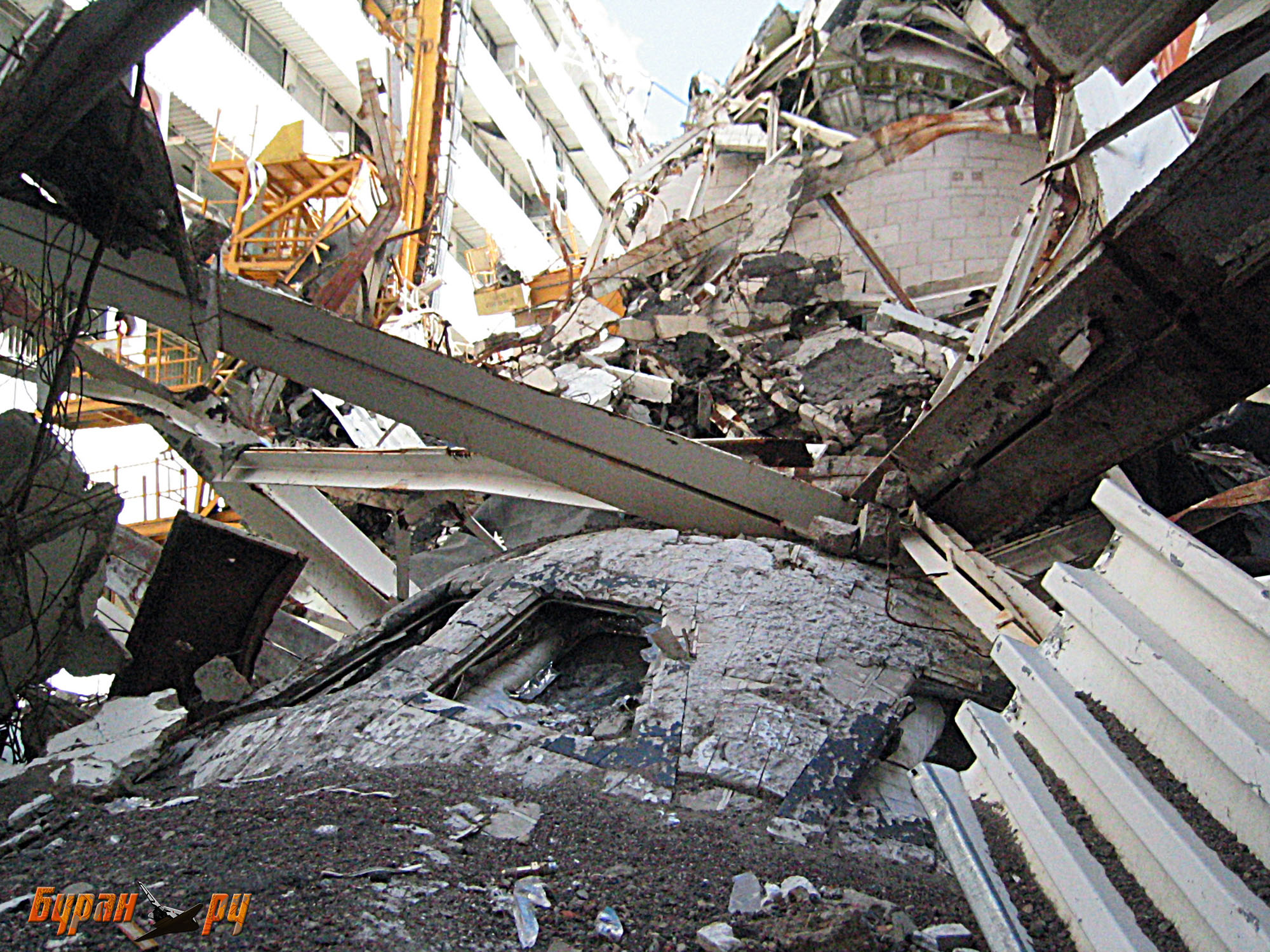
You’ll note that I’ve consistently (I think) referred to Buran in past tense. After a single orbital launch (in, appropriately enough, a snowstorm) in November 1988 to little fanfair. The Soviets apparently found that their shuttle system, like the STS, cost much more to operate than anticipated, and previously scheduled followup flights never occured, most likely due to the soon-thereafter collapse of the Soviet Union. In 1993, the program was officially cancelled, and the Buran spaceframes (five of them in various states of incompleteness and configuration) were mothballed and latter scattered or salvaged (2.03, the last and least complete, was completely dismantled). Buran-1.01 suffered destruction due to the collapse of a hanger in 2002, which also killed eight people. Here is a picture of the collapsed hangar. The Energya heavy booster program is also dead (except for Zenit). It’s a pity, because cost aside, Buran might have provided a viable alternative to the STS, and with substantially more payload capacity to boot.
The Shuttle has no weapon or defensive protection systems onboard, and no conceivable use for them. If you wanted to damage the Shuttle, all you’d need to do is launch an intercepting booster with a fragmentation warhead in a vector retrograde to the Shuttle. The size of the shrapnel cloud and orbital velocity would do all the damage that need be done to disable the Shuttle. Such systems exist in U.S. and (former) Soviet inventories in the guise of ASAT weapons, but their primary purpose is to bring down surveillance satellites, not Space Shuttles.
So, more than you probably wanted to know about the STS, Buran, and other options.
Stranger