Admittedly, I am not in the U.S.A., but surely that cannot really be true. I’m damn poor and read a lot, and no, not the Bible, (although, I might now that you’ve mentioned it - all that sex and violence and stuff). Seriously, I have trouble believing that all poor people don’t read, whether for instruction or recreation or both. There must be quite a few people on this board that are poor but read a hell of a lot. Surely?
Newspapers? OK, you win. I no longer buy newspapers, and yes, that is to do with saving money, but I am able to read more of them on the web than I could ever afford to buy. And I get to avoid the enormous pile of paper waiting to be recycled problem
Attitudes to money? Well, one tries, but it is pretty hard to save when there is only ever enough, or not quite enough.
Hmm, when I give it more thought, books are expensive, and public libraries closing to reduce municipal costs, so it might be difficult to get hold of books. However, with charity shops and exchanging with friends, there can still be some.
[QUOTE=Celyn]
Admittedly, I am not in the U.S.A., but surely that cannot really be true. I’m damn poor and read a lot, and no, not the Bible, (although, I might now that you’ve mentioned it - all that sex and violence and stuff). Seriously, I have trouble believing that all poor people don’t read, whether for instruction or recreation or both. There must be quite a few people on this board that are poor but read a hell of a lot. Surely?
[/QUOTE]
Surely there are but this board is an exception in this case, as in many things.
Reading is usually considered a major indicator of class in countries, simply because countries with a low literacy rate tend to be poorer. In the country I live in, it is considered one of the most important indicators of class standing in society. Here “street smarts” are held in much higher regard to “book smarts”, to such a degree that the population reads an average of 3 books per year and one third of the population has never finished a book. Needless to say, it’s a Third World country.
This is the same case in the US (though certainly not to such a degree), where “street smarts” and “country know-how” are seen as features of the working class and are better perceived socially than scientific and technical education.
This island sounds as though it belongs in a scary story involving a Big Nasty Plague that arrives on the island and then all the outsiders get to survive.
It might be different in the States, but I understand from a friend who delivers food that the poorer people (around here, anyway) are generally more generous in terms of tipping the delivery driver than the well off.
Your good points mean that I might have to backtrack a bit here. :smack: I used to teach Adult Literacy/Adult Basic Skills (although only in a voluntary way - so have no special qualifications therein), and, because it was a while ago, I am perhaps forgetting things that I ought to know. What I mean is, that the statistics for people who only read about three books per year are pretty horrifying here in Britain too. But I have to remember that reading, per se, is not all that wonderful, compared to knowing how to repair plumbing or sort out a dead car engine, or to cook great food.
I see your point, but now I give it more thought, I suppose the same thing is common in our so-called “developed” countries.
And we do , of course, have the stereotype of the absent-minded professor, or the “intellectual” type whose head is too far in the clouds and is regarded with the same sort of benevolent bemusement as is accorded to the village idiot.
I now realise my posts scarcely fit the topic, so how about brash jewellery? You know enormous earrings, gold (looking) neck chains? Those would seem to be a sort of social class thing, perhaps.
Poor people don’t have much on their walls. There may have one wall where they have all family photos hanging, but most of their living room walls will be bare. (The exception are grandmas. They will have every picture of every baby ever born in the universe hanging up on their walls, along with at least one picture of Jesus, JFK, and/or MLK.)
People from higher classes can afford artwork to put on their walls. None of their walls will be “blank”. And you won’t see a ton of family pictures. Everyone in the family gets only one or two pictures.
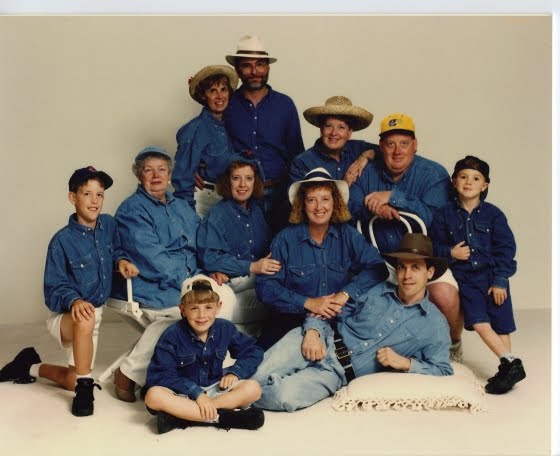
I’m sure family portraits themselves are indicators of class, but I can’t articulate how. K-Mart studio portraits seem lower class to me. School pictures with the laser-beam backgrounds make me think “low class”. The same with Glamor Shots. Why, I don’t know. And I also don’t know why when I see something like this, I assume the family is just “middle class” rather than rich.
Aha! I suddenly wonder whether the grandparent people feel obliged to have a picture of every single child and grandchild on their walls, just so that no-one will be offended.
I’m inclined to think that at least one wall being ‘blank’ is quite good. So now I know where I belong on the scale, but that’s all right.
However, forgetting about ‘proper’ art for a moment, don’t lots of people have some really trashy pictures on the walls?
I think I’d have to assume that it was a deliberate joke. Perhaps a sort of sponsored Wear-Blue-Denim-To-Support-Local-Charity-Day?
That’s a common attitude among the working class / blue collar types in the USA as well. “Street smarts” is superior to “book smarts”. “Going with your gut” is superior to “reason and logic”. “Working with your hands” is superior to “working with your mind”.
It’s not surprising really. Blue collar working class types tend to have less disposable income and tend to work in fields where they “do” stuff. Often the stuff they do might be dangerous if not done properly and some of it is actually really complicated and requires real skill. So the mindset would be to stick with what has been proven to work, with what produces immediate results, with what’s practical. Particularly if you are dealing with some snooty, entitled college kid who doesn’t know nothin’ about nothin’ 'cept what he read in some fancy textbook.
It sort of relates to Maslow’s Hierarchy of Needs.. Who care’s about your ideas for “self actualization”? We have to get these girders welded before lunch or we don’t get paid!
Sure, there are poor folks who read voraciously - I happen to be one of them. But there’s a difference between someone such as myself, raised middle class and dropping into poverty through various misfortunes, and people such as some of my in-laws, who come from generations of poverty. I have in-laws who don’t read because they can not read, they are functionally, and in a few instances, fully illiterate. They’ve been caught in multiple generations of hard-scrabble living, often in jobs that required little or no ability to read. The parents didn’t need to read to survive (never mind that might have been bare survival and no more) and don’t see it as a necessary skill, so they don’t promote it in their children and certainly don’t read to their children. While there is some, slow change (the younger generation can at least spell their names and read headlines) most of them have no books in their homes whatsoever, not even a Bible despite being rabidly religious.
Needless to say, there are some cultural gulfs between us. (Also between my spouse and them - he was the first of the family to go to college and while he doesn’t read for enjoyment he is quite literate).
Interestingly, according to the Wiki for Gibson Island, MD, 21056 is on Forbes list of “Most Expensive Zip Codes” just behind my old zip code of 10003 - Manhattan’s East Village. I don’t know if it was money, but my neighborhood reeked of something.
All my money got me was a rented studio apartment with one exposed brick wall and the classic Manhattan apartment view of the next door neighbor’s building ten feet away.
But, in the US we confuse wealth and class a lot. They are actually separate. A college professor with a moderate income is in a different class than a guy with a high school education who owns a carwash who in fact makes more money. And they both know it.
Speech, dress, habits of thought, manners, where you and your friends take vacations, and many other things, indicate class, not wealth.
Bad teeth indicates poverty, not class, though at that level there may be no difference.
Identifying with a particular “class” is simply a way for people with more to feel entitled to having more and for people with less to feel morally or intellectually superior.
It’s like Old Money types who look down on nouveau riche. The idea that someone of “low birth” can rise up to their level of wealth through determination, hard work and entrepreneurship is a threat to their sense of innate superiority. So they adopt an attitude that the pursuit of wealth is “gauche” or “unseemly”. Except that sort of attitude is a luxury of people who already have wealth.
Or a person may identify with a certain class to explain why they deviate from the expectations attributed to their wealth. A rich person may cite his working-class roots as why you’ll find him fixing up his motorcycle on the weekends instead of off on the golf course. Or if you have an expansive vocabulary and a love for books, despite living in the projects, you might hold onto the knowledge that you were raised by middle-class professionals, with middle-class “values”. It’s not just rich people who make a big deal out of class.
My whole life I’ve worked with people from middle-class upbringings. It’s not hard to know how to distinguish someone whose lineage has been middle-class for multiple generations from someone like me, whose parents grew up poor and working-class.
Not that I particularly want to hate on the woman, but Chelsea Clinton seems like a very public manifestation of this.
She’s clearly a brilliant woman, and I’m sure she’s hard working, but her schooling and career trajectory strikes me as something that is only really attainable by the children of upper class people with plenty of money and connections. I mean, Sidwell Friends school, followed by Stanford, Oxford and Columbia? Then a high-paying job at McKinsey followed by being on several boards of directors of non-profits and other organizations, and a stint on NBC?
Let’s say that Clinton lost to Bush in 1992- would Chelsea Clinton, daughter of former Arkansas Governor Bill Clinton have had the same trajectory as Chelsea Clinton, daughter of former President Bill Clinton and Secretary of State Hillary Clinton? Probably not; she’d probably be something moderately important in Arkansas, or maybe work for a Dallas consulting firm or something like that.
Even Chelsea Clinton, daughter of two Ivy League educated attorneys would have had a better career path than Chelsea Clinton, daughter of guy who was in the middle of his law school class at the University of Arkansas. I think that the extent and distance you can get from family connections is a marker of class - in both the socio and economic senses of the world.
On the other hand, she probably doesn’t have an uncle who can get her a great deal on a tv that fell off a truck…