Could a World-Class Card Counter Win Big in a Single Evening at a Casino Before Being Thrown Out?

There are such things as auto-shufflers. They can be set to shuffle an entire 8-deck shoe every hand. That’s enough to make card counting absolutely impossible.

And players hate it, and most casinos don’t do it, because it destroys the illusion. If you know that it’s absolutely impossible to count, a lot fewer players will want to play blackjack. And there are probably a fair few players who, even though they’re not counting and don’t have any intention of counting, believe that the auto-shuffler ruins their odds (it doesn’t, but perceptions are everything).

Not sure I follow what you mean. Who is “them?”: the casino or the players?

Fundamentally, the nature of the rules of 21/blackjack are slightly favorable to the house with a 52-card deck about to be played from. If by chance the deck burns through high cards over low cards early that favors the player. If the opposite the dealer. The whole point of counting is to track whether the random flow of cards in this particular deck to this particular point in time is unusually favorable to player or dealer. If the former, bet big & (probably) win big. If the latter, bet small and (probably) lose small. That’s all “counting” is.

If they shuffled the deck after every hand there’d be no point to counting; each hand starts with 52 cards and the standard house advantage. If they use an 8-deck shoe with 8 decks intermingled, the count will move off dead center at 1/8the the speed of a single 52-card deck. if they shuffle the 8-deck shoe after roughly 52 cards have been played, then statistically speaking count will never get far enough off top dead center to permit profitable play.

If on top of that the rules prohibit high bets versus the table minimum, you can’t even financially maximize the incredibly rare occasions where the cards fall perfectly for the player. Imagine the cards fall such that you’ve got a near sure thing and would like to bet 20x your normal table minimum bet to capitalize on the opportunity. But the rules prohibit betting more than double the minimum bet. Even given the one-in-a million-chance for a big score, your max play is an extra $20. Whoop-de-doo!!1!. Don’t spend it all in one place.

There is no tech the player(s) can deploy against this. As @Sam_Stone says, team play with a mongo bankroll is the last permissible move. And even then, by limiting the high stakes bet to a low multiple of the low stakes bet the casino in effect prevents the highly unlikely player-favorable situation from ever happening. The player(s) are left grinding out an existence even if it is at $1K / hand.

The author, a British math Ph.D., goes through many forms of gambling and explains how mathematicians - not gamblers - devised almost all the strategies for beating different forms of gambling, at least temporarily until those running the games started used counter-strategies on them.

He includes everything from lotteries to horse racing, but for this thread’s purposes he provides a lengthy history of taking on casino games, especially blackjack and roulette. Teams do play an extremely large role in winning and so do computers. Gamblers invented Big Data before the outside world make it into a thing. The lengths they go to is astounding. One team figured out a way to do high speed photography of a roulette wheel to see exactly how the baffles deflect the ball, and learned that particular throws yielded better results. Also that unless a roulette wheel is balanced as well as a quantum interference experiment the difference from perfection is detectable and exploitable. That is driving high stakes “cheats” to non-western world casinos that don’t have the money and expertise to invest in this equipment. He reports on the afterlife of the guy who won his British suit because they never could figure out how he did it. They still can’t.

The short version is that unless you are presented with a brand new game, have lots of computer experience, and can bankroll a team of players, you are unlikely to have any more than short-term success. Few of those opportunities exist any more. The house will probably win.

Yup. They had them at Resorts World on some of the higher limit games. I didn’t go into the high limit pit, somot’s possible that they had something like a two-deck game with an auto shuffler. A two deck game auto shuffled is still close to beatable with playing strategy changes alone, and offers better odds for the player because removal effects during the hand can give the player strategic advantages. It would be hard to male real money on it, though.

No, it’s pure statistics. The removal effects of a card are much lower when it is one of 312 cards unseen than it is when it’s one of 50. So it’s generally near the end of a shoe where the big true counts are found and the player gets a real advantage.

The way that’s tracked in a real game is by keeping a ‘running count’, which is a number representing how many low cards vs high cards you’ve seen go by, and dividing it by the number of decks left in a shoe to get the ‘true count’ or preponderance of low cards per deck. So if a miracle happens and the first ten cards out of an 8 card shoe are between 2 and 6, you have a running count of +10, but the true count is only 1.2 or so, which is not a profitable situation.

If you are playing in a two deck shoe, you have the same running count, but the true count is now +5, which is highly profitable - primarily because it means more blackjacks, and dealers only get even oney for blackjacks.

Actually, in the two deck case it’s even better, because those 10 cards represent almost 10% of the shoe. So you are only dividing by 1.9, not 2. That kind of predision isn’t necessary at the table, but it illustrates how it works.

If the game is always shuffled at 4 decks of an 8 deck shoe, you have to play too many hands at a disadvantage before you get the rare high true count, and just as the number of decks left becomes reasonable they reshuffle on you, Nothing to be done about it but find a better game.

Other way around. The player is at an advantage when the deck is rich in high cards, primarily because more blackjacks occur and the player gets 3/2 (or better… grrr) and the dealer gets even money. In shoe blackjack, that is about 80% of your profit, so long as you put really big money out in those situations. You have to make up for all those hands spent in a losing shoe situation.
D’oh! Thanks for the directional correction. But the point remains that the advantage is small and incremental as the deck(s) play(s) out.

It think about it like this. As has been mentioned, the basic playing strategy is the same regardless of count and the money is made by betting more when the count is favorable.

A simplified way to explain basic playing strategy (whether to hit, stand or fold) is to assume that every unseen card has a value of 10 and play accordingly. The more positive the count, the more likely that assumption is to be correct.

I’m sorry, but this is misleading. You are describing a ‘never bust’ strategy, which is one of the most expensive ways to play blackjack.

The truth is, there is no shortcut to understanding basic strategy. You just have to memorize it. It was developed computationally, not by some first principles. Run a million hands, try hitting a 16 against a dealer’s 9 and see what happens. Now do it for standing. Note the difference. Repeat for every combination. Some correct plays can even be counterintuitive for most people, such as hitting a 16 against a dealer’s ten or splitting 8’s when the dealer has a nine or a ten in the hole.

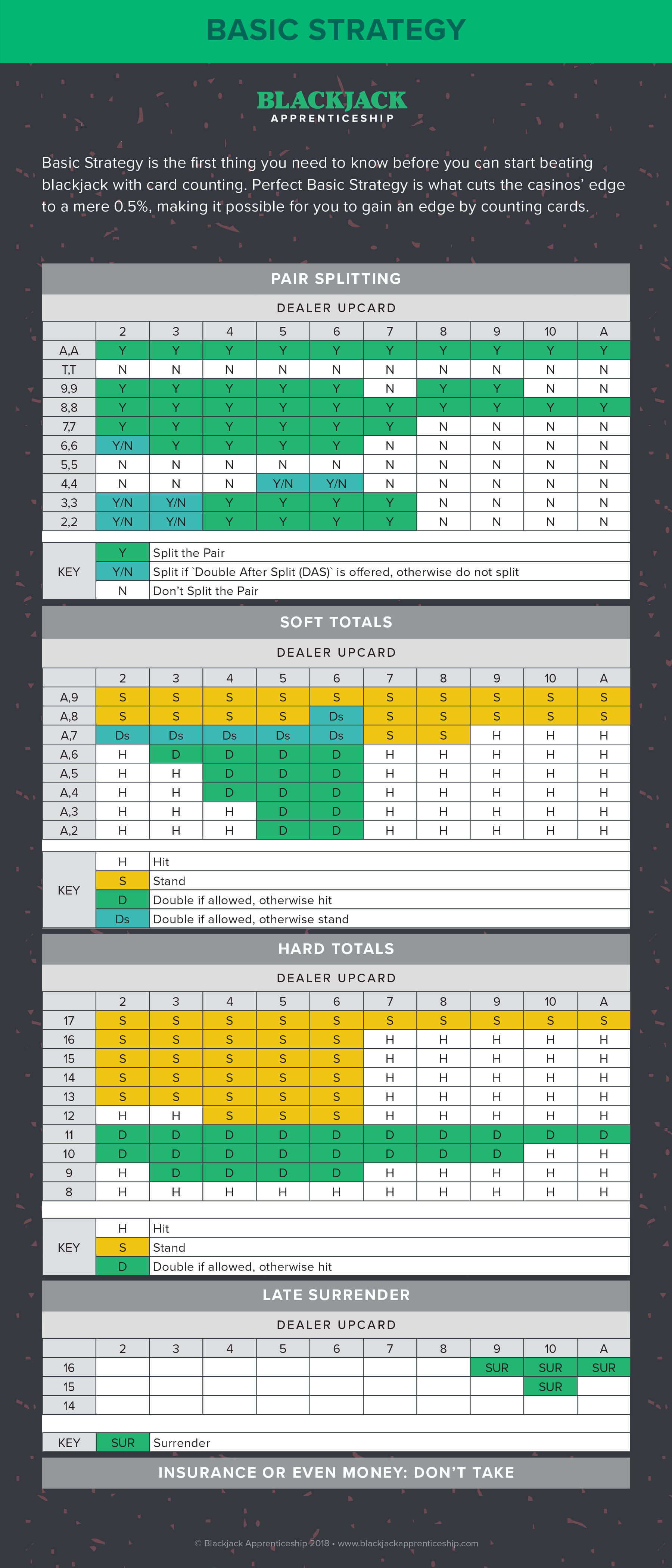
Here’s a basic strategy chart. Learn it, live it, love it.

It looks like there is a lot to memorize, but you only have to remember the edge cases.

Back when I was going to Vegas on a regular basis I had some variation on this card. I learned most of the basics from it, and managed to keep from losing too much. :slight_smile:

I don’t know whether this is still true, but I was told once that most casinos didn’t even mind if you kept a strategy card on the table to refer to while you were playing. The theory being that as long as it kept you playing, the house edge would still guarantee that the house would win.

That’s not what I meant but I described it poorly by grossly oversimplifying.

The key to understanding those two situations is to realize that holding a hard 16 just plain sucks. If you hit, you have a very high chance to bust, and if you stay, you have a very high chance that the dealer will beat you. For a (non-8s) 16 vs. a dealer’s 10, you’re screwed either way: The dealer will almost certainly win. It’s just slightly less likely that he’ll win if you hit than if you stay. For 88, you split, not because having split 8s is a really great situation: It’s only so-so. It’s just a heck of a lot better than the terrible situation of treating it as a 16.

But a casino is not exactly private property - it operates under a license from the state (or chief, or whatever). What do the licensing rules say about who can and cannot play? I assume that is why the NJ counter won his suit, that the license does not say you get to pick and choose who plays?

(OTOH, it serves nobody if the rules force casinos to go bankrupt.)

Excellent description of the situation. And also, when you hit and bust it feels like a worse move than if you stand but the dealer beats you. The immediate negative result of a hit and bust makes it seem like a bad decision.

There are other plays that are counterintuitive for the average player. For example, it’s MUCH worse to stand on a 16 against a dealer’s 7 than it is against a dealer’s ten. Standing on a 16 against a 10 is actually a very close play. So close in fact that if you get the 16 with low cards, say a 4, 6,6, then you should stand instead of hit because the extra low cards push the decision over to standing. For card counters, you stand on 16 vs 10 on any positive point, and hit it on any negative count. But standing on 16 vs a 7 is terrible.

Roulette, incredibly enough, is beatable or at least was before casinos improved their roulette wheels. Most of the cheaters used computers, but a few didn’t. Gifted article at Bloomberg: https://www.bloomberg.com/features/2023-how-to-beat-roulette-gambler-figures-it-out/?accessToken=eyJhbGciOiJIUzI1NiIsInR5cCI6IkpXVCJ9.eyJzb3VyY2UiOiJTdWJzY3JpYmVyR2lmdGVkQXJ0aWNsZSIsImlhdCI6MTY4NTMzMTk5NCwiZXhwIjoxNjg1OTM2Nzk0LCJhcnRpY2xlSWQiOiJSU09EVVBUMVVNMFcwMSIsImJjb25uZWN0SWQiOiI3RUU0QUE0NTMyMEM0Mjk0QTBDQTNBODJERUQyQ0YyOSJ9.JcGqMXl8b6iRalubCddhFzhJaYNstPcaJvPJNqDlAB0
“For decades, casinos scoffed as mathematicians and physicists devised elaborate systems to take down the house. Then an unassuming Croatian’s winning strategy forever changed the game.”

See also J. Doyne Farmer - Wikipedia , who developed a computer system for prediction in roulette. Mike Barnett: “To make money in roulette, all you need to do is rule out two numbers.”

This is critical. Most “Card counters” fail. As Sam points out, any deviation from perfection means you’ll lose anyway. The casinos WANT nitwits who think they can count cards to come try, just as they want guys who think they can beat sports betting to come try.

Continuous shufflers will eliminate card counting, and they speed up the game too.

That’s also simple enough to explain: There’s a good chance that the dealer’s hole card is a 10 (or an ace), and if it is, his 17 (or 18-- I think dealers stand on a soft 18) will beat your 16. And even if his hole card isn’t a 10 or ace, he might still beat 16, anyway. Your odds still aren’t great from hitting (you have approximately (for a many-deck game) an 8/13 chance of busting), but they’re almost nil from standing.

It is private property - but must follow the restrictions/regulations associated with the license. As a general rule , if the regulations are silent about something , that means the casino can do it, just like any other private business. If the law says I can’t refuse to serve someone based on race/gender/religion , that doesn’t mean I can’t refuse based on how they are dressed. The New Jersey court decision essentially held that the Casino Control Act gives the Casino Control Commission the exclusive right to set the rules for all games. So while the law and the regulations may be silent about card counting , the law is not silent on the question about whether casinos can add to the rules and prohibit card counting - they cannot. But that is due to how the NJ statute is written.

I suppose casinos are not as touchy about, say, good poker players? I assume because the casino is not part of the play, they just get a share of all wagers win or lose? (How does poker work in casinos?)

They don’t care who wins or who loses - the casino makes money through the rake, which can be a percentage of the pot , an hourly fee or for tournaments the entry fee might be $100 for the prize pool and $10 for the casino.

I did some work on the feasibility of humans clocking roulette wheels many years ago. I’m pretty sure I mentioned it here at the time. I did some experiments with methods to accurately judge velocity of the ball and wheel without a device, and it seemed accurate enough to actually beat a wheel if it was off enough from perfect. I never took it any further, though, as it was mainly academic interest and the next step would have required a ton of practice to prove out (and a roulette wheel).

It is not cheating. They throw you out for winning. You are not violating any rules; it is just that you cannot win and continue to play.

And to answer the OP, they will throw you out long before you have won millions or anything like it.

The one place where you can win is in poker. The house makes money because they take their profits out of the pots. If you can play enough better than the other players to come out ahead, more power to you; the house is not involved and doesn’t care.