I mean you have this perfectly symmetrical arrangement of fielders and did someone decide, “Hey let’s add one more.” “Where is he going to stand?” “Anywhere he wants to.”
Which brings up the next question - is there a defined area the shortstop can set up in? I don’t remember seeing one between 1st and 2nd base.
The shortstop position was added fairly early on in the development of baseball as a sport; Wikipedia indicates that it came into being around 1850, at a time when the number of players on the field, and their positions, was still very much in flux.
As far as where the shortstop can play, current MLB rules are that there must be two infielders on each side of second base, and that all four infielders must have both feet on the infield dirt at the time that the ball is pitched. So, by definition, the shortstop has to be (a) in the infield, and (b) to the left (third base side) of second base.
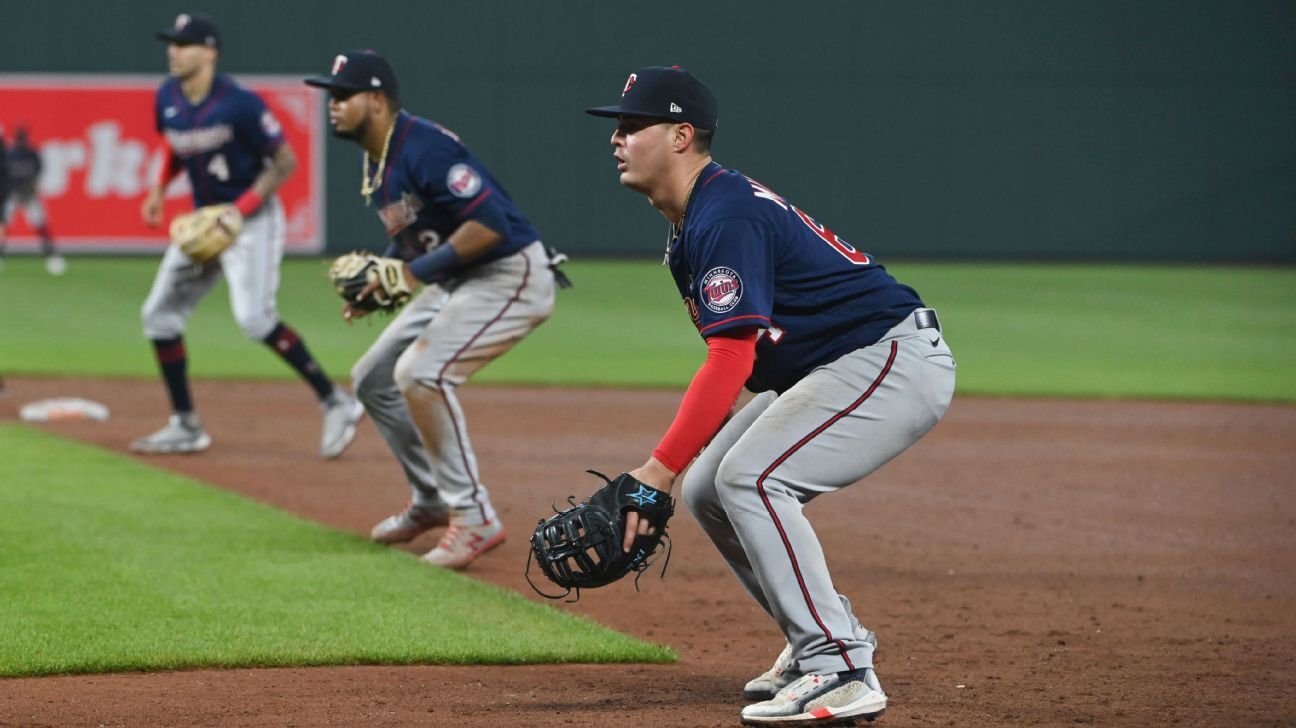
Note that that rule is pretty recent; it was instituted a few years ago to reduce the “infield shift,” in which teams would move an infielder to the other side of the infield (e.g., a shortstop moving over to the right side of second base), to counter hitters who predominantly hit to one side of the diamond. Prior to that rule, you could and would see three infielders on one side of the diamond, as shown in this picture:
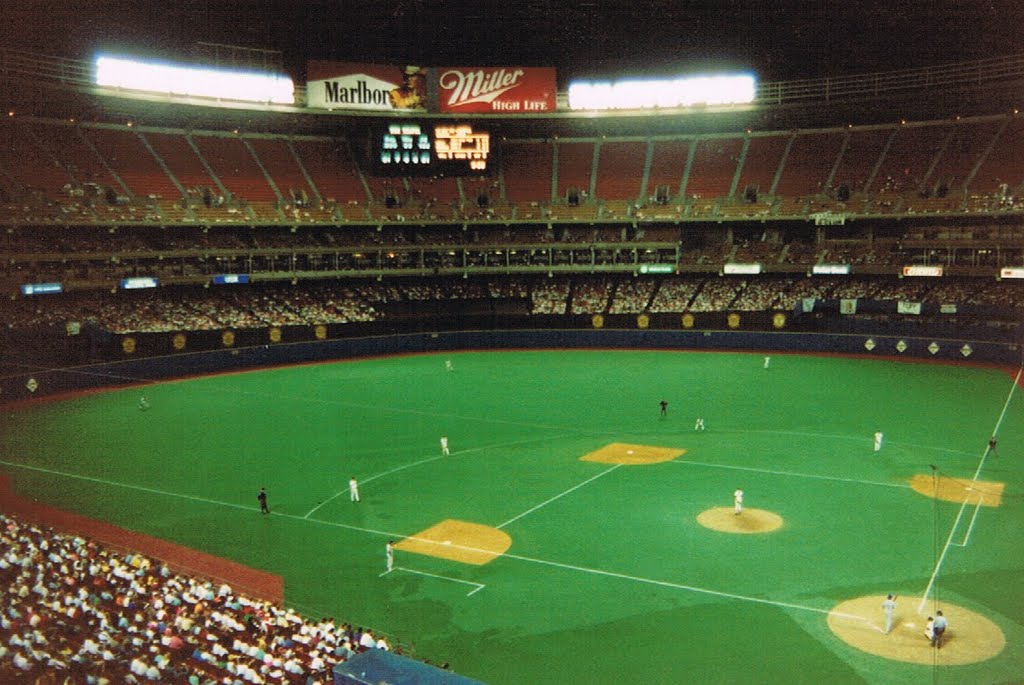
Baseball hasn’t had those sorts of fields for a while now, and that rule was only instituted three years ago, IIRC.
They were an artifact of multi-purpose stadiums, built in the 1960s and early 1970s, with first-generation low-pile Astroturf playing surfaces, where both baseball and football were played. Those stadiums had “patches” of turf which they would use to cover the infield dirt for football.
But, regardless, you can see, in the photo below of the infield at Three Rivers Stadium in Pittsburgh, that the fields had white stripes which showed the outline of where the traditional dirt infield would have been.
Also, just to add a bit on why the position is called “shortstop”:
At the time that it came into being (around 1850), teams typically only had three infielders, one covering each of the three bases. The “shortstop” was initially a sort of “short outfielder,” playing more shallow than the other outfielders, and it appears that he had the role of relaying throws in from the outfield to the infield, at a time when baseballs were more difficult to throw for distance.
When the size and weight of the balls changed, and the need for a relay thrower went away, shortstops moved into the infield, but the name stuck.
I had the impression (so take this with a grain of salt) that there were originally 8 position players, 3 infielders, 3 outfielders and 2 “short fielders” playing in between. Then at some point, they reduced the number of players and one of the short fielders moved. Notice that this explains why the numbering of the positions is out of order. 1st is position #3, then 2nd base is #4, 3rd base is #5 and shortstop is #6.
From what I’ve read, it was pretty squishy and variable in the early days.
This is very likely why shortstop is numbered “out of order,” (going around the infield) as that position was initially a shallow outfielder, rather than an infielder.
It took me awhile because I the version I always listen to used “I don’t give a darn.” (April 17, 1947 radio broadcast on a “Golden Age of Radio” cassette tape collection)
Actually, I think cricket is simpler than baseball. It just seems more complicated to Americans because we’re not used to it. But I think that baseball is probably the most complicated major sport in the world.
Since you brought up symmetry as an argument: In my view, the shortstop brings symmetry to the infield rather than ruining it. That’s because the basemen typically don’t stand right on the base they’re named for. The second baseman is about as far off second base, towards first, as the shortstop is towards third.